
Starting an AI automation business means picking one of three paths: build a service where AI enhances what humans already do, create software where AI is the product, or run an agency that implements AI for clients. The models differ in capital needs, talent requirements, and how revenue scales. This guide walks through how to evaluate fit, estimate costs, and identify the first critical hire for each approach, using fintech examples throughout.
Quick answer: Three models for AI automation businesses
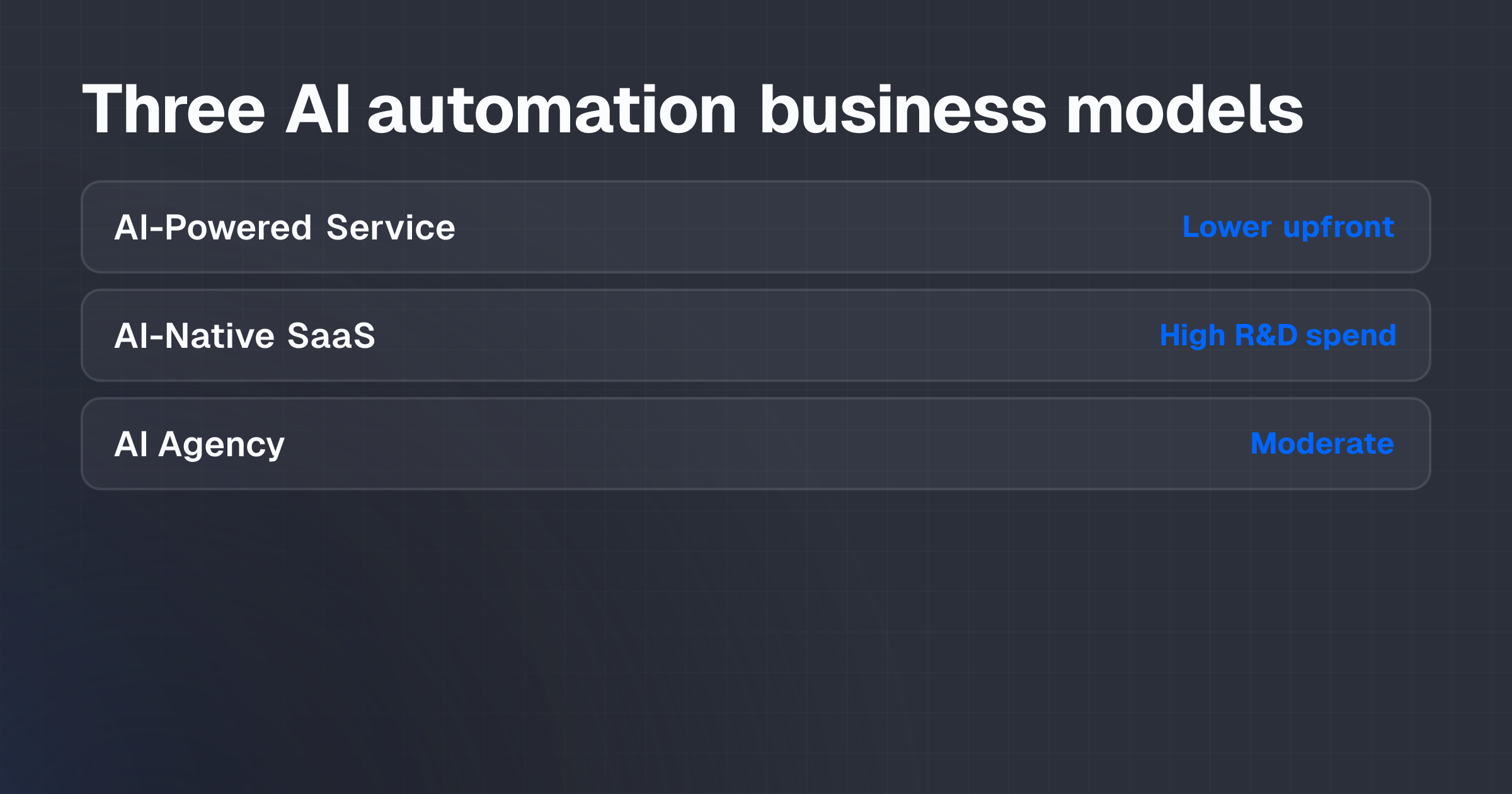
AI-Powered Service: AI amplifies an existing workflow. A fintech example: an investment advisory where AI scans market data and drafts portfolio suggestions, but human advisors keep client contact and final approval. Lower upfront cost than building software, but success depends on smooth integration that doesn't confuse clients or break compliance rules.
AI-Native SaaS: The product is AI. HybridTrader, an AI trading journal launched September 2026, sits here. It prices bad habits, scores trader psychology, pulls in six macro feeds, and syncs with brokers, AI runs the core functions. High R&D spend and scarce technical talent, but revenue can scale without hiring proportionally.
AI Agency: You sell expertise and custom builds to other companies. An agency that installs fraud detection systems for banks fits this profile. Moderate capital needs, strong delivery required, but no need to build a product that works for thousands of users on day one.
Your choice hinges on current capabilities, cash on hand, access to AI engineers, and target customers.
The workflow and operating decision
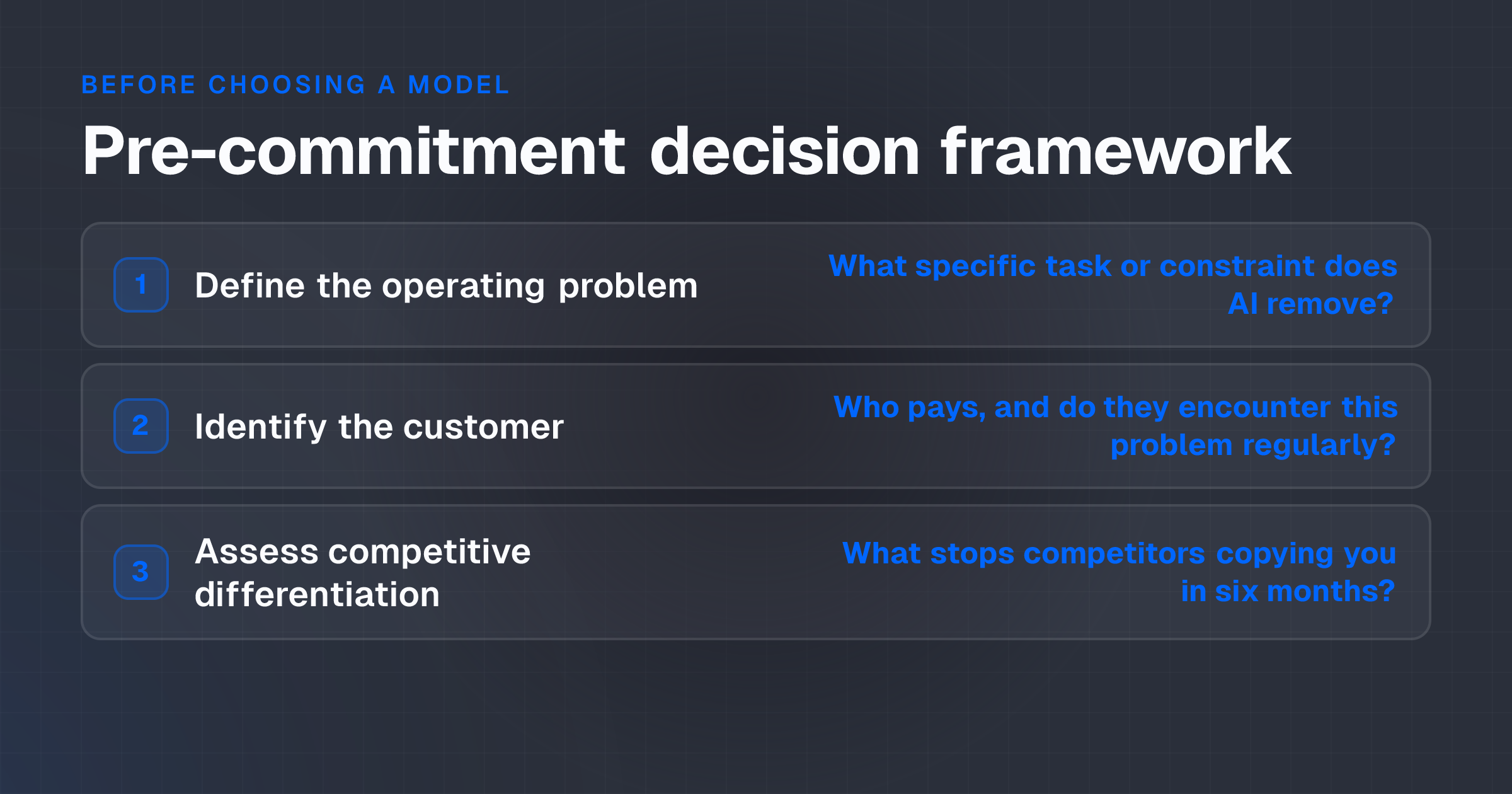
Before committing to a model, clarify three things: the specific task or pain point you're addressing, the customer willing to pay, and whether AI genuinely removes a constraint they care about.
Define the operating problem
A viable business starts with a concrete problem, not excitement about the technology.
AI-Powered Service: Does AI measurably improve speed, accuracy, or capacity in a workflow customers already pay for? Can you add it without replacing the human touch they value?
AI-Native SaaS: Does the AI solve something in a new way that existing tools can't match? Is the advantage defensible?
AI Agency: Do potential clients want AI but lack internal know-how? Is there a clear adoption barrier you can close?
Identify the customer and market demand
Each model attracts different buyers.
AI-powered services need customers already using a related service. Demand is real if they encounter the problem regularly and trust you enough to try an AI-augmented version.
AI-native SaaS requires a market large enough for standalone subscription software. Willingness to pay for the tool itself, not as a free extra, validates demand.
AI agencies require clients with transformation budgets and projects big enough to justify custom work. Demand shows up in direct conversations, not public signals.
Assess competitive differentiation
What stops competitors copying you?
For AI-powered services: Why can't competitors bolt on similar AI and match you in six months? Is your edge sustainable?
For AI-native SaaS: Do you control proprietary data, a unique model architecture, or network effects that create a moat? Or can well-funded rivals replicate your core within a year?
For AI agencies: What specialisation, vertical, geography, technical depth, keeps you distinct before you have case studies or scale?
Approaches and trade-offs
Each model carries distinct risks you need to weigh upfront.
AI-Powered Service: Integration risk and client acceptance
This model trades simplicity for adoption friction. The AI must slot into what customers already do. If they're unfamiliar with AI outputs, they may distrust recommendations or hesitate to adopt.
Compliance matters, especially in fintech. An investment advisory using AI must meet suitability rules and avoid algorithmic bias in client portfolios. That adds legal review and governance costs that early estimates often miss.
Humans stay central. AI typically handles analysis and draft recommendations; humans keep client relationships, handle exceptions, do complex customisation, and sign off decisions. Your team cost doesn't drop in proportion to AI adoption, you still need advisors for edge cases and to maintain trust.
AI-Native SaaS: Data, scalability, and technical complexity
Building SaaS means solving three hard problems: getting enough high-quality training data, building infrastructure that scales, and acquiring customers who see the product as essential.
Data is often the binding constraint. HybridTrader benefits from real-time broker and trade data that users supply. If your AI needs proprietary or hard-to-access data, development will take longer and cost more than you think.
Scalability has two dimensions. The AI model must handle rising user volume without degrading performance or exploding cost. The product stack, hosting, databases, APIs, must scale without rearchitecting.
Technical talent is expensive and scarce. A Lead AI Engineer or Machine Learning Scientist at senior-level pay is non-negotiable. If you can't attract that hire, the product won't reach viability.
AI Agency: Client dependency and margin pressure
The agency model trades product scalability for immediate revenue but introduces delivery and acquisition risk. Each project requires scoping, staffing, and execution, no software scales without more labour.
Client expectations often exceed feasibility. Non-technical stakeholders may imagine AI solving vague problems ("make fraud detection smarter"). Defining scope and managing expectations takes strong client-facing skills, not just technical depth. Failed projects destroy credibility and referral networks, so early client selection matters.
Regulatory and ethical risk in fintech is high. If an AI you implement produces biased or wrong outcomes, your agency may share liability. That demands clear accountability frameworks, audit trails, and contractual liability caps.
Common mistakes across all models
Starting from hype, not demand: Launching because AI is fashionable, without a clear problem or willingness to pay. Enthusiasm doesn't create customers.
Data quality and availability: Insufficient or poor training data cripples AI. Many projects fail not because the approach is wrong, but because data is incomplete, outdated, or unrepresentative.
Ethical and bias risk: Models reflect training data biases. In fintech, regulators increasingly scrutinise algorithmic decisions for fairness. This shapes model design from the start, not after launch.
Measuring ROI: For services and agencies, proving return on investment is harder than predicting it. Define success metrics, time saved, error reduction, revenue uplift, before launch.
Compliance and transparency: WhatProp, founded 2026 as a prop verification engine issuing independently verifiable certificates, reflects rising demand for auditable, transparent AI claims in fintech. Regulators expect explainability and audit trails. Budget compliance review as a core operating cost.
AI-Powered Service: Estimated cost structure
Technology costs:
- AI tool subscriptions or API usage (large language model APIs, predictive analytics): £500-£5,000/month depending on volume and sophistication.
- Integration development and customisation: £5,000-£50,000 one-time, varies by complexity.
Human costs:
- Senior specialist in the service domain with AI proficiency (e.g., Senior Financial Analyst): £60,000-£150,000 annually in established markets.
- Customer success or implementation support: £40,000-£80,000 annually, scales with customer count.
Operational overhead:
- Existing service infrastructure (office, tools, customer support): leveraged from current operations; assume no net increase if AI is an add-on.
- Marketing to promote the AI-enhanced service: £2,000-£10,000 initial launch.
Illustrative total first-year cost for a small team: £80,000-£200,000 (two senior people, tool subscriptions, integration, marketing, overhead), assuming you already run a service business and add AI incrementally.
Expected value:
- Capacity uplift: If AI cuts analysis time per client by 30%, a team handling 100 clients/year might serve 130 with the same headcount, yielding 30% margin uplift if pricing holds.
- Quality improvement: Better recommendations may reduce churn or lift referral rates, valued indirectly through lifetime customer value.
- Avoided hiring: If AI lets current staff serve more clients, you defer the next hire, freeing capital or slowing payroll growth. This is released capacity, distinct from cash savings.
AI-Native SaaS: Estimated cost structure
Product development:
- Lead AI Engineer or ML Scientist: £100,000-£200,000+ annually.
- Backend and frontend engineers (two to four): £70,000-£150,000 each annually.
- Custom AI model development, training, validation: £30,000-£100,000+ depending on complexity.
Infrastructure:
- Cloud hosting (compute, storage, API calls): £2,000-£20,000/month, scales with users and model inference.
- Database, security, monitoring: £1,000-£5,000/month.
Go-to-market and operations:
- Product marketing and customer acquisition: £10,000-£50,000 initial launch; ongoing spend varies by sales model.
- Customer support and documentation: £30,000-£80,000 annually for initial team.
- Legal, IP protection, regulatory compliance: £5,000-£20,000 one-time setup; ongoing varies by jurisdiction.
Illustrative total first-year cost for MVP launch: £200,000-£500,000+ (core team of four to six, infrastructure, tooling, launch marketing), excluding extended R&D or market validation before product launch.
Expected value:
- Recurring revenue: Subscription creates predictable, repeatable revenue if retention is sustainable.
- Gross margin: SaaS businesses typically target 70-80% gross margin (revenue minus infrastructure and support), compared to 50-60% for services.
- Unit economics: Each customer should generate lifetime value (LTV) exceeding three to five times cost to acquire (CAC) for sustainability.
AI Agency: Estimated cost structure
Talent:
- AI Consultant or Solutions Architect (client-facing, technical): £70,000-£150,000 annually.
- Project managers and delivery staff: scale per project; assume £50,000-£100,000 annually per full-time delivery person.
- Sales/business development: £50,000-£100,000 annually or commission-based (typically 10-20% of project fees).
Operations:
- Software licenses (development tools, cloud platforms): £1,000-£5,000/month.
- Office overhead and travel: £2,000-£5,000/month, varies by client geography and team size.
Marketing and client acquisition:
- Initial brand and thought leadership: £5,000-£20,000.
- Ongoing lead generation and sales: typically 10-20% of revenue reinvested.
Illustrative total first-year cost for initial team of two to three: £120,000-£250,000 (salaries, tools, overhead, initial marketing), assuming project revenue covers most delivery costs and margins run 40-50%.
Expected value:
- Project margins: Typical AI agency margins run 40-50% (project revenue minus delivery and allocated overhead), assuming 70%+ billable utilisation.
- Revenue per hire: Each delivery person typically generates £80,000-£150,000 annual project revenue, varies by project size, scope, pricing power.
- Scaling challenge: Unlike SaaS, agency revenue scales linearly with headcount. Profitability depends on utilisation and margin discipline; it doesn't improve with scale unless you build productised services or IP reducing delivery effort per project.
Cost comparison and decision criteria
| Model | First-Year Cost | Gross Margin | Scaling Dynamic | Key Breakeven Metric |
|---|---|---|---|---|
| AI-Powered Service | £80,000-£200,000 | 50-70% | Linear (headcount-driven) | Clients served per FTE; pricing power |
| AI-Native SaaS | £200,000-£500,000+ | 70-80% | Non-linear (software scales) | Monthly recurring revenue (MRR); LTV:CAC ratio |
| AI Agency | £120,000-£250,000 | 40-50% | Linear (headcount-driven) | Billable utilisation rate; project margins |
The service model needs lowest capital but scales linearly with headcount. SaaS needs highest upfront investment but offers better long-term margin if acquisition and retention work. The agency offers moderate capital needs and faster initial revenue but doesn't escape the labour-to-revenue constraint.
Controls and failure conditions
Each model needs specific controls to catch failure early.
AI-Powered Service: Critical monitoring
Model performance drift: Track AI recommendation accuracy and client outcomes over time. If accuracy drops below a threshold (e.g., 85% of human-validated recommendations correct), halt recommendations and revert to human-only until root cause is found.
Client adoption: Monitor percentage of clients accepting AI recommendations and proportion overridden by human advisors. If override rates exceed 40%, the AI may add friction rather than value, signalling product-market mismatch or poor calibration.
Regulatory and bias risk: Audit AI recommendations for demographic disparities. If recommendations show statistically significant differences in asset allocation or risk exposure by client demographic, escalate to compliance and legal.
Failure condition: If client churn accelerates after AI launch, or compliance flags bias or explainability issues, the model isn't viable and should be disabled, not iterated.
AI-Native SaaS: Critical monitoring
Data quality and model degradation: Monitor prediction accuracy, latency, error rates in production. Set alerts for degradation beyond threshold (e.g., API response exceeding 2 seconds, error rate above 1%, accuracy below 80%).
Infrastructure cost vs. revenue: Monitor cloud infrastructure as percentage of gross revenue. If it exceeds 20%, margins compress and unit economics degrade. Signals inefficient model architecture or pricing too low.
Customer retention and churn: Track monthly churn rate (percentage cancelling each month). If churn exceeds 5-10% monthly, customer value isn't sticky, indicating product-market mismatch.
Regulatory compliance drift: If users deploy the product in ways introducing regulatory risk (e.g., using AI recommendations for regulated investment advice without disclosure), monitor and enforce usage controls.
Failure condition: If customer acquisition cost (CAC) exceeds lifetime value (LTV), or churn prevents positive unit economics, the product isn't viable at current pricing or feature set and needs major repositioning or sunset.
AI Agency: Critical monitoring
Project delivery quality: Track on-time, on-budget completion. If more than 20% of projects exceed scope or budget, delivery processes are broken and client trust erodes.
Client satisfaction and references: Monitor satisfaction scores and willingness to refer. If Net Promoter Score falls below 30 or reference requests decline, reputation and repeat business suffer.
Billable utilisation rate: Track percentage of staff time billed to clients. Below 60%, overhead per project rises and margins compress. Above 90%, burnout risk increases and quality declines.
Project profitability: Track margin by project type and client. If certain types or clients consistently deliver margins below 30%, they're subsidised by others and should be repriced or declined.
Failure condition: If billable utilisation falls below 50% and can't improve through sales or pricing, the business can't cover overhead. If satisfaction declines or projects consistently miss milestones, reputation damage prevents scaling.
Pilot structure for each model
AI-Powered Service pilot:
- Duration: 6-12 weeks with 5-20 customers.
- Measurement: Track AI recommendation accuracy against human validation, client satisfaction, adoption rate (percentage of recommendations accepted and acted upon).
- Decision gate: If accuracy exceeds 80% and adoption exceeds 50%, proceed to full launch. If either falls short, isolate the failure (calibration, user education, or fit) and decide whether to iterate or abandon.
AI-Native SaaS pilot:
- Duration: 8-16 weeks with 20-100 beta users, pre-revenue or freemium.
- Measurement: Track daily/weekly active users, feature adoption, support ticket volume, qualitative feedback on core AI functionality.
- Decision gate: If retention after 4 weeks exceeds 40%, and users rate core AI as "essential" or "very useful," proceed to paid launch. Below 20% retention or low feature satisfaction means the product needs fundamental redesign or isn't viable.
AI Agency pilot:
- Duration: 3-6 months; complete 2-4 client projects.
- Measurement: Track project profitability (revenue vs. delivery cost), client satisfaction, time from pitch to contract.
- Decision gate: If projects deliver 40%+ margins and clients express willingness to refer or sign longer contracts, proceed to growth. Below 30% margins or hard-to-satisfy clients means reassess pricing, scope definition, or service offering.
Decision criteria summary
| Criterion | AI-Powered Service | AI-Native SaaS | AI Agency |
|---|---|---|---|
| Viability gate | 80%+ recommendation accuracy; 50%+ adoption | 40%+ 4-week retention; "essential" rating on core AI | 40%+ project margins; positive client feedback |
| First key hire | Senior specialist in domain + AI proficiency | Lead AI Engineer or ML Scientist | Solutions Architect with strong client-facing skills |
| Time to first customer | 4-8 weeks (adds to existing service) | 12-20 weeks (build MVP, infrastructure) | 2-4 weeks (pitch and close first project) |
| Scaling dependency | Client capacity and pricing | Customer acquisition and retention | Billable staff utilisation and project scope |
Conclusion and next step
Pick your model based on three constraints: existing market access, available capital, technical talent.
If you run an existing service with a clear customer base and a specific workflow pain point AI can solve, start with an AI-powered service. Lowest capital investment, leverages existing relationships and infrastructure. Validate with 5-20 customers over 8-12 weeks.
If you've identified a large, underserved market clearly benefiting from an AI-native product, and you can attract or afford a strong AI engineering hire, build AI-native SaaS. Expect 12-20 weeks development before beta, budget £200,000-£500,000+ first-year costs. Only pursue if unit economics (LTV:CAC) and retention data from early pilots support viability.
If you have deep technical expertise in a specific AI application and can win initial clients through your network or sales capability, launch an AI agency. Fastest path to revenue, lowest upfront capital, but requires strong project delivery and client management to avoid margin erosion.
Next step: define your target customer segment and the specific workflow or problem your AI addresses. Map the viability framework for your chosen model, problem identification, market demand, competitive differentiation, against your resources. If any gate fails (no clear demand, missing technical talent), reassess the model before investing capital.
Document this assessment and share it with one trusted advisor or potential customer. Their feedback validates your assumptions or exposes gaps you need to address before proceeding.