
Founders evaluating an AI automation business face three distinct operating models, each with different startup costs, team structures, and market risks. An AI-powered service leverages existing AI tools to enhance service delivery while retaining human expertise; an AI-native SaaS embeds AI as the core product; and an AI agency provides AI implementation consulting without owning the product itself. The path you choose depends on your team's technical depth, available capital, regulatory exposure, and appetite for building versus deploying. This guide provides a framework to evaluate idea viability, estimate startup costs, identify your first critical hire, and decide which model matches your constraints and strengths.
The useful question is not whether AI can automate a process, but whether the workflow can be measured, monitored and reviewed safely. Understanding the operating model you're building into, not just the technology, determines whether you can defend decisions, scale reliably, and retain customer confidence. Fintech examples appear throughout because the stakes are highest where regulatory compliance, error detection and client trust are non-negotiable.
Quick answer: Choosing your AI automation model
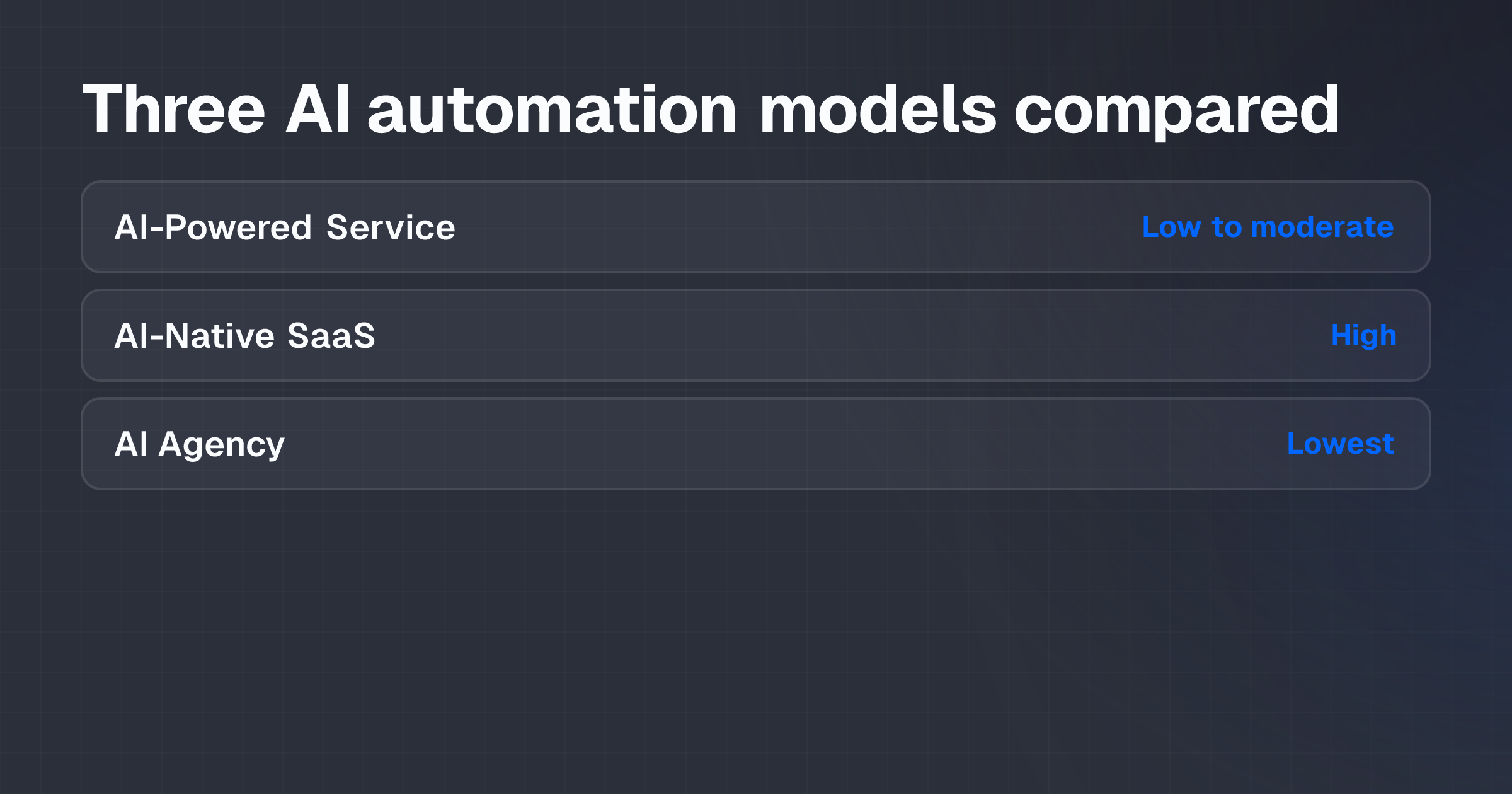
The three models differ sharply in capital requirement, technical risk and time to revenue.
AI-Powered Service: You integrate existing AI APIs or tools into a service business where humans remain the primary value driver. Startup costs focus on integration, data infrastructure and hiring service specialists. Time to revenue is shortest; regulatory risk is moderate because humans oversee decisions.
AI-Native SaaS: You build a software product where AI is fundamental to the core offering. Startup costs are highest, AI engineers, infrastructure, compliance tooling. Time to revenue is longer; regulatory risk is high because the system must operate reliably without constant human intervention.
AI Agency: You offer AI strategy, implementation and integration services to other businesses. Startup costs are lowest: you hire consultants and project managers, not engineers. Time to revenue is fast; regulatory risk is lower because your client owns the deployed system.
The right choice depends on your geography, risk exposure, team capacity and implementation constraints, not on which model is most trendy.
The workflow and operating decision: Defining your business model before the technology
Before evaluating technology, clarify what you're actually selling and who will operate it day-to-day.
AI-Powered Service: You own the service delivery and employ the people doing the work. You apply AI tools to increase their output, reduce errors, or improve personalization. In fintech, a wealth management firm might use AI to personalize investment recommendations or automate routine client communication while a human advisor retains decision authority. The service model remains human-led; AI is the lever that makes it faster or better. Your liability is to your client; you control the output.
AI-Native SaaS: You build software that delivers value autonomously through AI. Your customers use it as a tool; they don't hire your staff. In fintech, HybridTrader (launched September 2026) is an AI trading journal where AI scores psychology patterns, macro desk feeds, and broker sync, all embedded in the product itself. The software is the offering; your liability is that the system works correctly. You don't control every user interaction; the system must be reliable enough to operate without your constant supervision.
AI Agency: You advise other businesses on AI strategy, build custom integrations, or manage AI implementation projects. You don't own the deployed system; your client does. In fintech, a consultancy might help a financial institution implement AI for fraud detection or algorithmic trading strategy. You deliver expertise and a working solution; the client operates it. Your revenue is project fees or retainers; liability is shared with the client.
Each model has different handoffs, failure points and staff responsibilities. An AI-powered service requires service staff who can use AI tools but also handle exceptions. An AI-native SaaS requires AI engineers who can build a system reliable enough to run without constant human review. An AI agency requires consultants who can translate business problems into AI solutions and communicate risk clearly to clients.
Approaches and trade-offs: Evaluating each model's strengths and constraints
AI-Powered Service advantages and trade-offs
Advantages:
- Fastest path to revenue because you leverage existing AI APIs (large language models, image recognition, data processing tools) rather than building custom models.
- Easier regulatory compliance because humans remain in the decision loop; you can show how decisions are made and reviewed.
- Lower technical risk: if an AI API changes or performs poorly, you adjust the workflow rather than rebuilding your product.
- Easier to pivot. If the market signal weakens, you adjust your service offering without rewriting core technology.
Trade-offs:
- You're limited by the capabilities of existing tools. If no AI API solves your specific problem well, this model breaks.
- Unit economics depend on labor. If you need one specialist per client or a large team per deployment, you won't scale efficiently.
- Margins compress as you grow unless you can automate the delivery itself, moving toward SaaS.
- Over-automation without human oversight can lead to errors and reputational damage. The useful question is not whether AI can automate the task, but whether the workflow can be measured and reviewed safely.
AI-Native SaaS advantages and trade-offs
Advantages:
- Scales without proportional staff growth once the product is built. Each customer uses the same software; you don't add headcount per customer.
- Can capture significant margin because software isn't labor-bound.
- Network effects or data effects can emerge if the product improves as more data flows through it.
- Defensible competitive moat if you own proprietary data or a trained model that competitors can't easily replicate.
Trade-offs:
- Highest upfront capital requirement: AI engineers, data scientists, software developers, product managers and infrastructure costs accumulate before you see revenue.
- Longer time to revenue and higher technical risk. Poor model performance, inadequate data quality, or scaling issues can delay launch by months.
- Regulatory risk is acute in fintech. The system must operate reliably and you must be able to audit and explain its decisions. Data privacy, model bias, and error handling must be defensible.
- Ongoing cost of model maintenance, retraining and infrastructure. A lower transaction cost doesn't automatically mean a lower total operating cost.
AI Agency advantages and trade-offs
Advantages:
- Lowest startup capital: hire consultants and project managers; no need for expensive AI engineers early.
- Fast path to revenue. Sell your first project within weeks, not months.
- Manageable technical risk: you're implementing known AI techniques for a specific client problem, not building a new product category.
- Easier to validate demand. Each client engagement teaches you what problems are worth solving.
Trade-offs:
- Revenue scales with your time and headcount. Agency work is labor-bound; you can't achieve the margin or growth potential of SaaS or a scaled service business.
- Harder to build defensible IP. Each client engagement is custom work; limited reuse across clients.
- Staffing bottleneck: you need AI consultants or senior engineers, who are expensive and scarce. Finding and retaining them is a constant constraint.
- Client dependency: large clients can consume your capacity; losing a major contract hurts revenue directly.
Costs, capacity and expected value: Estimating startup investment and first-year burn
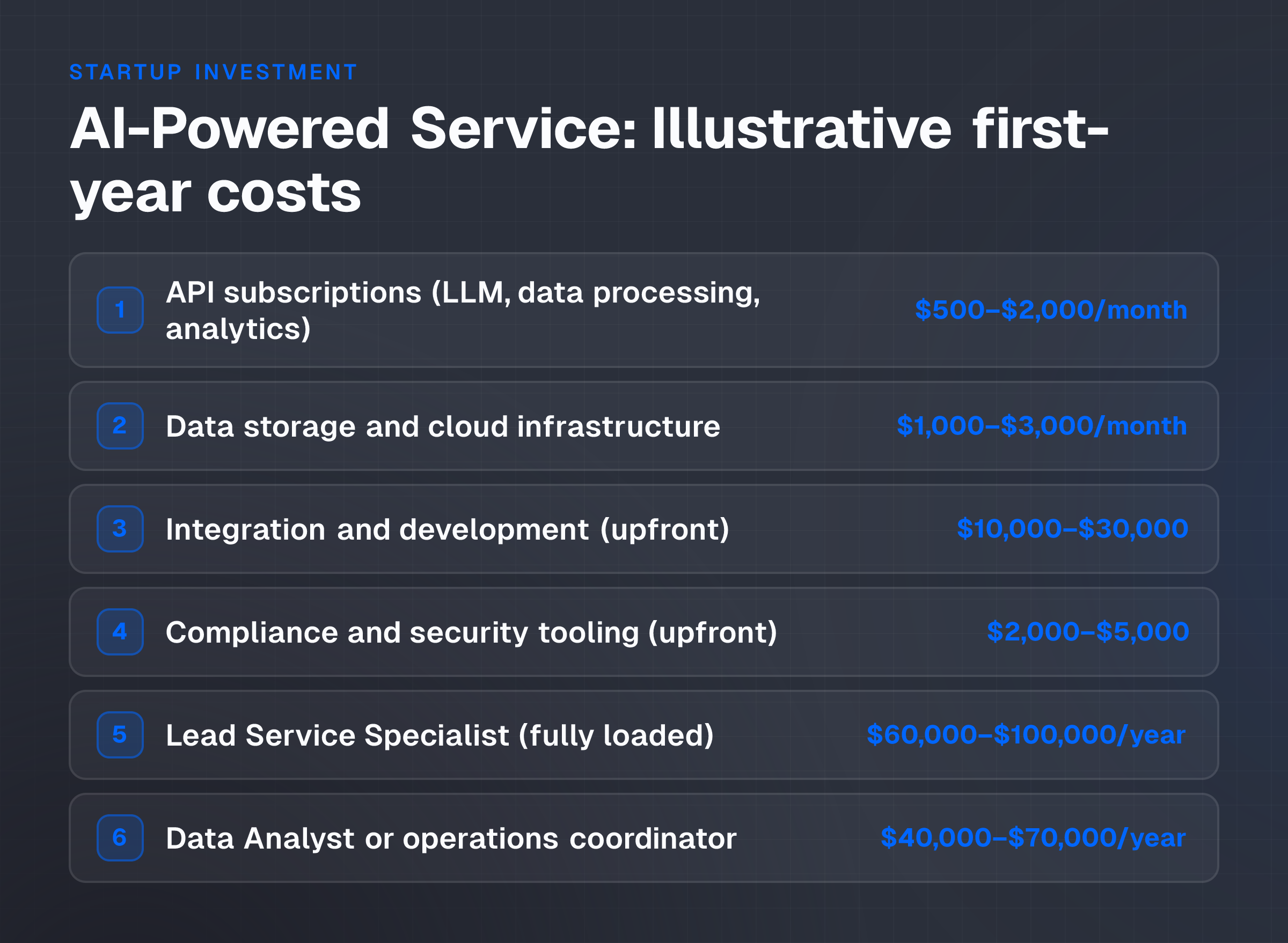
Startup costs vary sharply by model. All estimates below are illustrative; actual costs depend on geography, team location, infrastructure choices and regulatory requirements. Where terms vary by provider or jurisdiction, verify current pricing with your vendors.
AI-Powered Service: Illustrative startup costs
Technology and infrastructure:
- API subscriptions (LLM access, data processing, analytics): $500, $2,000/month depending on usage volume.
- Data storage and processing (cloud infrastructure, secure data pipelines): $1,000, $3,000/month.
- Integration and development (customizing APIs, building internal workflows): $10,000, $30,000 upfront.
- Compliance and data security tooling (audit logs, encryption, access controls, especially critical for fintech): $2,000, $5,000 upfront.
Personnel (first-year fully loaded costs, including salary, taxes, benefits):
- Lead Service Specialist with industry knowledge and AI proficiency: $60,000, $100,000/year. This person defines how AI is integrated into service delivery and trains subsequent hires.
- Data Analyst or operations coordinator to monitor AI outputs and collect feedback for refinement: $40,000, $70,000/year.
- Part-time AI specialist or consultant (0.25-0.5 FTE) to oversee integration and troubleshoot issues: $20,000, $40,000/year.
Legal and compliance:
- Business registration, contracts, IP documentation: $2,000, $5,000.
- Data privacy legal review (especially critical for fintech handling client data): $5,000, $15,000.
Marketing and sales:
- Website, initial content, case studies: $3,000, $10,000.
- Initial outreach and lead generation: $2,000, $5,000/month.
Illustrative first-year total: $75,000, $160,000 in fixed costs, plus $10,000, $15,000/month in operational burn.
For a fintech wealth management example: you integrate an LLM API for client communication and a data analytics tool for investment performance tracking. Your Lead Service Specialist is a financial advisor trained to use these tools. Your Data Analyst reviews AI recommendations for accuracy before they reach clients. Your part-time AI consultant handles API troubleshooting. Total year-one cost is roughly $120,000, $150,000 in staff, plus $60,000, $72,000 in infrastructure and tooling.
AI-Native SaaS: Illustrative startup costs
Technology and infrastructure:
- AI model development and training (data engineers, compute, GPU infrastructure): $30,000, $80,000 upfront, then $5,000, $15,000/month ongoing.
- Cloud infrastructure (scalable servers, databases, data pipelines): $5,000, $20,000/month depending on usage.
- Security, compliance and data governance tools: $5,000, $15,000 upfront, plus $2,000, $5,000/month.
- Product development and UI/UX design: $40,000, $100,000 upfront.
Personnel (first-year fully loaded):
- Founding AI Engineer or Lead Data Scientist: $120,000, $180,000/year. This person sets the technical direction and builds core AI capabilities.
- Software developers (1-2): $80,000, $150,000/year each.
- Product Manager: $80,000, $130,000/year.
- UI/UX designer: $60,000, $100,000/year.
Legal and compliance (particularly acute for fintech):
- Business structure, IP protection, regulatory compliance review: $10,000, $25,000.
- Data privacy and financial services regulatory review: $15,000, $50,000.
- Terms of service, data agreements, liability documentation: $5,000, $15,000.
Marketing and sales:
- Website, product demos, content: $5,000, $15,000.
- Initial user acquisition and feedback loops: $5,000, $20,000/month.
Illustrative first-year total: $300,000, $800,000 in fixed costs, plus $25,000, $50,000/month in operational burn. Likely no revenue in year one.
For a fintech SaaS example like HybridTrader's trading journal with AI psychology scoring and macro desk feeds: you invest in building the core AI models for behavioral analysis, secure integration with broker APIs, and a scalable platform. Your Founding AI Engineer builds the scoring engine. Your developers handle broker sync and platform reliability. Your Product Manager defines the feature roadmap. Total year-one cost is roughly $500,000, $700,000, with minimal revenue expected before month 9-12.
AI Agency: Illustrative startup costs
Technology and infrastructure:
- AI platform access and tools (project management, various AI APIs, prototyping platforms): $2,000, $5,000/month.
- Office, collaboration software, communications: $1,000, $3,000/month.
- No custom model development or significant infrastructure needed upfront.
Personnel (first-year fully loaded):
- Principal AI Consultant or Solutions Architect with strong fintech domain knowledge and client-facing skills: $100,000, $150,000/year. This person scopes projects, manages client relationships and delivers strategy.
- Junior AI Developer or Data Scientist: $60,000, $100,000/year.
- Operations and project manager: $40,000, $70,000/year.
Legal and compliance:
- Business registration, contracts, liability insurance: $3,000, $8,000.
- Data security and confidentiality agreements: $2,000, $5,000.
Marketing and sales:
- Website, case studies, thought leadership: $3,000, $8,000.
- Business development and networking: $2,000, $5,000/month.
Illustrative first-year total: $150,000, $280,000 in fixed costs, plus $5,000, $8,000/month in operational burn. Revenue often begins in month 1-3.
For a fintech consultancy example: your Principal Consultant helps financial institutions scope AI fraud detection or algorithmic trading strategy implementation. Your Junior Developer prototypes solutions. Your Project Manager coordinates delivery. You don't build custom models or infrastructure; you use existing AI platforms and integrate them for clients. Total year-one cost is roughly $200,000, $250,000, with project revenue often offsetting burn by month 4-6.
Controls and failure conditions: Where AI automation breaks and how to catch it
The question is not whether AI can automate a process, but whether the workflow can be measured, monitored and reviewed safely. This principle applies across all three models.
AI-Powered Service: Failure modes and controls
Failure modes:
- An AI tool produces plausible but incorrect outputs (false recommendations, misinterpreted data) that a rushed service specialist deploys without review.
- A client receives inconsistent treatment because the AI tool's performance varies with input quality or context.
- Regulatory or compliance risk emerges because decisions made with AI support can't be audited or explained to regulators.
Controls:
- Implement a human review gate before outputs reach clients. The service specialist retains decision authority and must be able to explain why they accepted or rejected an AI recommendation.
- Log all AI-assisted decisions, inputs, outputs, human judgment, for audit. In fintech, this is non-negotiable.
- Set performance baselines and monitor whether AI is actually improving outcomes. If it's not, stop using it. Don't automate for automation's sake.
- Define escalation paths: when should the AI tool be bypassed and the task handled entirely by a human?
- Train service staff on the AI tool's limitations. Knowing when the tool is likely to fail prevents costly mistakes.
AI-Native SaaS: Failure modes and controls
Failure modes:
- The trained model performs poorly on data it hasn't seen before (model drift), degrading customer outcomes.
- The system makes decisions that violate regulations or expose the company to liability.
- The product scales poorly; infrastructure costs or latency become untenable.
- Customers discover that the AI output is biased or systematically unfair, damaging trust.
Controls:
- Establish baselines for model performance (accuracy, precision, recall) before launch and monitor continuously. If performance drops, flag it immediately and investigate.
- Implement human-in-the-loop review for high-stakes decisions. If a trade or a fraud flag affects a customer's money, a human should confirm before execution.
- Build comprehensive logging and audit trails so that every decision the model made can be traced, explained and reviewed by regulators.
- Test for bias and fairness across different customer segments, geographies and market conditions.
- Plan for infrastructure scaling and understand cost implications before sign-up grows exponentially.
AI Agency: Failure modes and controls
Failure modes:
- A custom AI implementation works in testing but fails in the client's production environment because data quality or integration assumptions were wrong.
- The client doesn't adopt the AI system because it requires workflow changes they're not ready for, or they don't trust the outputs.
- A deployed AI system causes financial harm (a bad fraud detection flag, a poor algorithmic trade) and the client disputes liability.
Controls:
- Pilot in the client's environment with real data before full deployment. Don't assume testing results will hold.
- Define success criteria and acceptance thresholds upfront with the client. What does "working well" mean to them?
- Train the client's team thoroughly. They own the system after deployment; they must understand its limits and how to operate it safely.
- Document all assumptions, data quality issues and identified risks in a deployment handoff. Make clear what the client must monitor and maintain.
- Include a post-launch support period and monitor whether the system is actually delivering promised outcomes. If it's not, investigate and adjust.
Pilot and decision criteria: Testing before you commit
Before scaling any of these models, run a small pilot to test your core assumptions.
AI-Powered Service pilot
What to test:
- Can you actually source and retain service specialists with the right mix of industry knowledge and AI aptitude?
- Does the AI tool actually improve service quality or efficiency, or does it create more work for review and exception handling?
- Can you price the service profitably? Integrate the cost of the AI tools and the human review into your unit economics.
- Do clients accept an AI-assisted service, or do they distrust it?
Success criteria:
- You complete 5-10 service engagements using the AI tools and can document improved outcomes: faster turnaround, fewer errors, better client satisfaction.
- Your Lead Service Specialist confirms that the AI tool is genuinely useful and doesn't require so much review that it eliminates the time saving.
- You price a full engagement and can confirm that margin is positive after all costs.
AI-Native SaaS pilot
What to test:
- Can your AI model achieve target performance (accuracy, latency, reliability) on representative data?
- Do early users find the product valuable and easy to use, or do they abandon it?
- Can you operate the infrastructure reliably and at reasonable cost?
- Are there regulatory or compliance issues you haven't anticipated?
Success criteria:
- Your Founding AI Engineer confirms that the core model meets performance targets and can scale.
- You recruit 10-20 beta users, preferably in your target market. At least 60% continue using the product after the pilot period.
- You collect evidence that the product saves users time or money, or improves outcomes in a way they value.
- You've tested the system against regulatory requirements, in fintech, data privacy, model explainability, audit trails, and have a roadmap to compliance.
AI Agency pilot
What to test:
- Can you scope and deliver a custom AI implementation within your estimated timeline and budget?
- Does the client see measurable value from the deployed system?
- Can you document a reusable framework or process that you can apply to your next client engagement?
Success criteria:
- You complete one full engagement (scoping, development, deployment, 2-3 months of post-launch support) on budget and on time.
- The client confirms that the system delivers the promised outcomes and they'd hire you for follow-on work.
- You've documented the engagement well enough that your team can replicate the approach for a similar client.
Why Fintech Teams Reject AI Tools After Pilot Phase and Should You Automate It? A Fintech AI Risk Assessment explore common reasons pilots fail and how to design them to succeed.
Conclusion and next step: Choosing your model and executing the first hire
The three models aren't ranked by viability; the right choice depends on your geography, risk exposure, team capacity and implementation constraints.
Choose AI-Powered Service if you have domain expertise in a specific industry (wealth management, trading operations, customer support), can access the right AI tools for your workflow, and want to deploy revenue quickly. You'll need disciplined people who can use AI but retain judgment. Hire your Lead Service Specialist first; they'll define how AI integrates into your service.
Choose AI-Native SaaS if you've identified a genuine, repeatable problem that an AI product can solve better than existing options, you have access to capital ($300,000, $800,000+ for year one), and your team includes strong technical talent. Regulatory compliance in fintech is substantial; don't underestimate it. Hire your Founding AI Engineer first; they'll set the technical direction and determine whether the idea is buildable.
Choose AI Agency if you have deep expertise in AI implementation and strong relationships in a specific industry (fintech, payments, fraud detection), can close business quickly, and prefer consulting revenue over product scaling. You'll need a Principal Consultant with both technical credibility and client-facing skills. Hire that person first; they'll be your primary business generator.
Your next step: Identify which model aligns with your team's strengths, available capital and market timing. Run a small pilot to test your core assumptions before committing significant resources. Document your success criteria upfront so you can measure whether the pilot is working. AI Automation in Fintech: Costs, Exceptions and Human Review details how to set up measurement frameworks and How to Measure AI ROI in Fintech: A Practical P&L Framework shows how to build the financial case as you scale.