
Fintech operators face rising pressure to deploy AI automation for competitive advantage. But adoption without a risk-control framework creates compliance exposure and operational brittleness.
The useful question isn't whether AI can automate the task, but whether the workflow can be measured, reviewed, and governed safely. This playbook maps decision gates, governance checkpoints, and measurement thresholds to help operators automate responsibly, distinguishing where AI reduces human error and where it introduces new risks that require human oversight. The framework draws on guidance from financial regulators including the US Office of the Comptroller of the Currency and the Financial Stability Board, research into AI deployment risks in financial services, and the operating constraints of lean fintech teams. It's designed for founder-operators with live products and real compliance exposure who need to decide which workflows to automate and how to structure oversight without paralyzing deployment.
Quick answer: Can you automate this workflow safely?
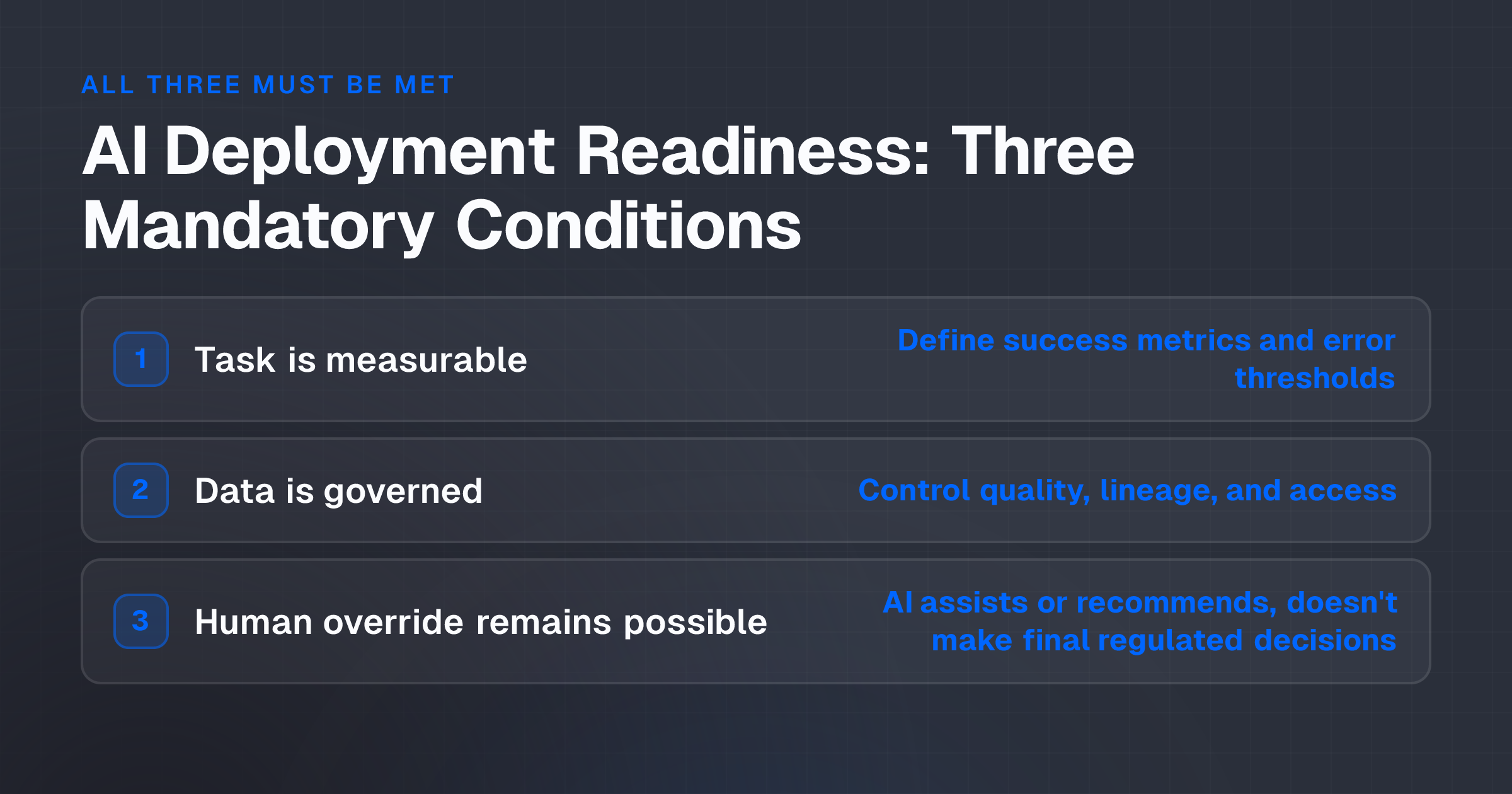
Deploy AI automation only to workflows that meet three conditions.
The task is measurable, you can define success metrics and error thresholds. The data is governed, you control quality, lineage, and access. Human override remains possible, AI assists, recommends, or flags, but it doesn't make final decisions on regulated outcomes.
If any condition can't be met, the workflow isn't ready. Delay deployment until data governance and measurement infrastructure are in place.
The business problem
Fintech operators automate workflows to reduce manual effort, eliminate human bias, and improve consistency. AI systems introduce new categories of risk that manual processes don't carry: algorithmic bias, data privacy breaches, model opacity (inability to explain why a decision was made), performance drift (accuracy degradation over time), and operational brittleness (failure under edge cases or changed conditions).
The pressure to deploy quickly conflicts with the need to govern safety. A lower error rate in a pilot doesn't guarantee safety in production. A high-accuracy model in a test dataset can fail catastrophically when exposed to real-world data it wasn't trained on. An AI system that works correctly 99% of the time can still cause compounding damage if deployed to high-volume or high-stakes processes without human checkpoints.
Compliance regulators now expect sound risk management for AI systems used in banking and trading. The Office of the Comptroller of the Currency has emphasized the need for robust validation and governance of AI and machine learning models. The European Union's proposed AI Act mandates risk management systems, data governance, and human oversight for high-risk AI applications in financial services. Failure to implement these controls exposes operators to regulatory fines, legal action, and reputational damage.
The core tension: speed of deployment versus depth of oversight. Operators who skip governance steps move faster but accumulate unmanaged risk. Those who over-govern move slowly and may lose competitive advantage. The decision framework resolves this by defining specific gates where formal review is required before proceeding, and allowing fast movement within approved bounds.
Where AI helps and where it does not
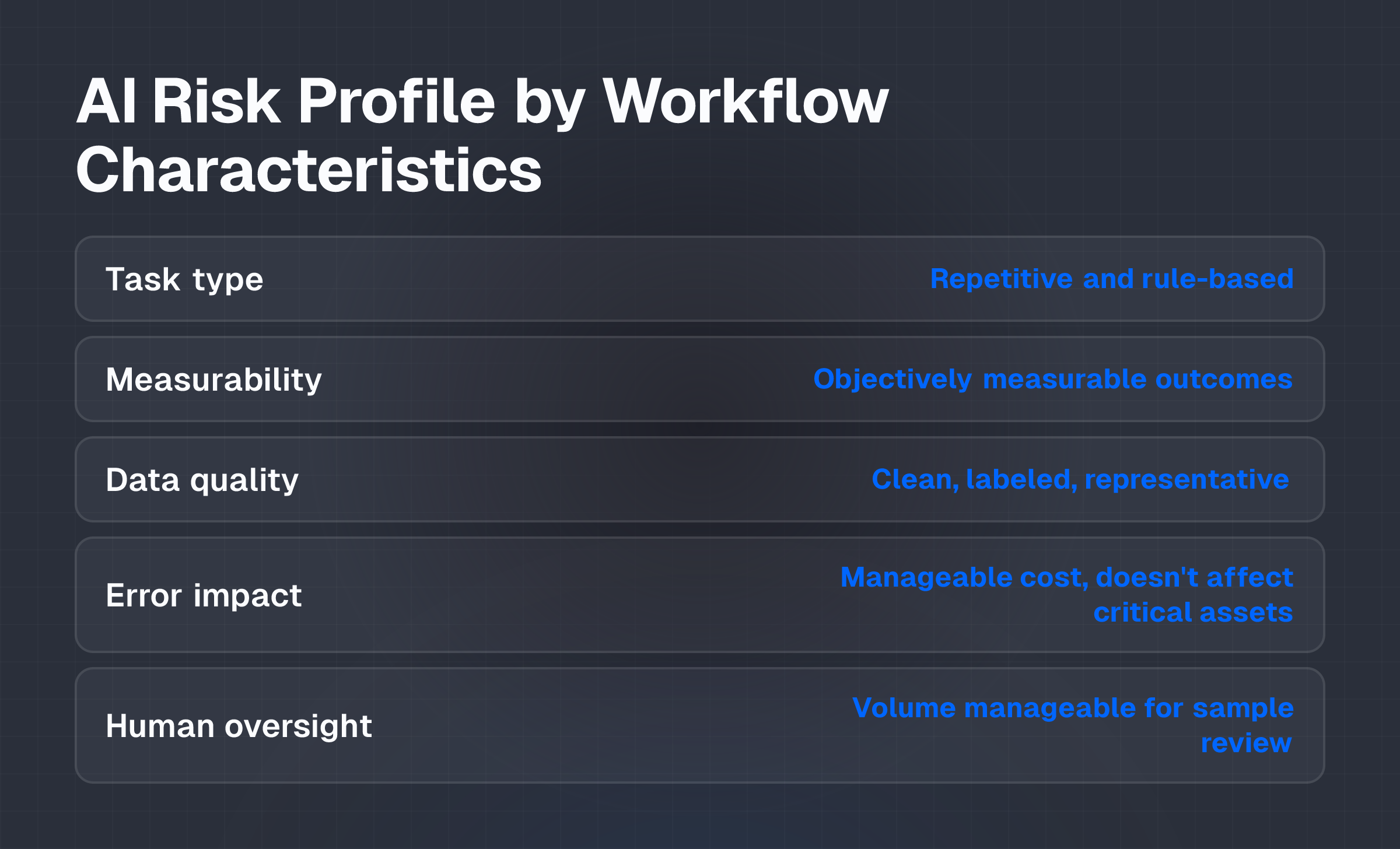
AI reduces risk and effort when:
The workflow is repetitive and rule-based (parsing customer KYC documents, flagging fraud patterns, routing support tickets). Success can be measured objectively, accuracy, false positive rate, processing time. Human oversight remains feasible: the volume of decisions is manageable for a small team to sample and review. The data is clean, labeled, and representative of real-world conditions. The cost of error is manageable and doesn't affect critical infrastructure or client assets directly.
AI introduces new risk when:
The task involves novel or ambiguous judgments (subjective credit decisions, novel market conditions). Outcomes can't be measured objectively or are hard to define in advance. The workflow processes sensitive personal data, PII, financial records, with high regulatory exposure. The data is biased, sparse, or unrepresentative of the population the AI will serve in production.
A single error or cascade of errors can propagate quickly. An AI system that flags false frauds could block legitimate traders; model drift in risk scoring could expose the firm to undetected losses. The decision is final and can't be overridden by a human. True autonomous decision-making should be rare in fintech.
Common misconception: AI can detect and eliminate bias.
While AI systems can flag outcomes that disproportionately affect certain demographics, they can also perpetuate and amplify biases inherent in training data. If historical lending data shows disproportionate rejection of applications from certain demographics, an AI model trained on that data will learn to replicate those patterns unless specific bias mitigation steps are taken during design and validation.
The distinction matters. AI can assist human decision-makers by flagging patterns and reducing manual work. AI can automate routine tasks with clear outcomes: categorization, routing, data extraction. But AI shouldn't autonomously decide regulated outcomes without human review, particularly when the decision affects client assets, regulatory standing, or individual rights.
Implementation model
A three-phase decision framework governs AI deployment in fintech: assessment, pilot, and governance.
Phase 1: Risk identification and assessment
Before building or acquiring an AI system, define the risks specific to your workflow.
Assessment checklist:
Impact on critical operations: Does the AI affect core financial processes, regulatory reporting, or client data?
Data sensitivity: Does the workflow process sensitive personal identifiable information (PII) or financial data?
Regulatory landscape: Which regulations apply? GDPR and CCPA for data privacy. MiFID II for trading decisions. Dodd-Frank for credit and market practices. Local financial authority guidelines vary by jurisdiction.
Bias potential: Could the data or algorithm introduce or amplify biases leading to unfair outcomes?
Measurability: Can you define success and failure thresholds before deployment?
A 2023 report by Deloitte identified algorithmic bias, data privacy, and model risk management as the top AI risks for financial services firms. The Financial Stability Board's 2023 report on "Artificial Intelligence and Machine Learning in Financial Services" highlighted risks related to data quality, model opacity, and concentration risk from reliance on a few AI providers.
If assessment reveals high regulatory exposure, sensitivity to bias, or ambiguous success metrics, move to Phase 2 with increased rigor. If the workflow is routine, low-stakes, and measurable, the pilot phase can be compressed.
Phase 2: Pilot and proof-of-concept
Test the AI in a controlled environment before production deployment.
Pilot success criteria:
Performance metrics: Does the AI meet predefined accuracy, speed, or efficiency targets?
Error rates: Are error rates below acceptable thresholds? False positive rate for fraud detection below X%, misclassification rate for credit scoring below Y%. Your thresholds depend on the use case and risk tolerance.
Resource consumption: Is compute and storage footprint manageable within your infrastructure budget?
Monitoring capability: Can the AI's performance be reliably monitored and audited in real time?
Human override: Can a human operator easily review, override, or suspend the AI's recommendations?
The UK Financial Conduct Authority's Regulatory Sandbox allows fintech firms to test innovative products and services, including AI applications, in a controlled live environment with regulatory oversight. This model, controlled deployment with defined exit criteria, is a practical reference for internal pilots.
Don't move to production until the pilot proves measurable improvement over the baseline (manual process or existing system) and demonstrates that error rates, bias, and monitoring can be kept within defined bounds. If the pilot shows high variance, unexplained errors, or edge cases that the AI can't handle, either fix the model and data before scaling or abandon the automation.
Phase 3: Governance and production deployment
Once the pilot succeeds, establish the governance framework that will oversee the AI system in production.
Governance structure:
Accountability: Assign clear responsibility for model performance, risk management, and compliance. Typically shared between product, risk, and compliance teams.
Model validation: Independent validation of the AI model before and after deployment, reviewing design, data sources, and decision-making logic.
Transparency and explainability: Document how the model works and why it made specific decisions, aligning with principles of explainable AI (XAI). This is essential for audit, dispute resolution, and regulatory review.
Change management: Define processes for updating, retraining, or decommissioning the model if performance degrades or the operating environment changes.
Continuous monitoring: Set up automated alerts if performance drifts below defined thresholds. Accuracy drops by Z%, false positive rate rises above Y%.
Controls, governance and human review
Fintech operators must implement three layers of control: real-time monitoring, human-in-the-loop triggers, and periodic governance review.
Real-time monitoring and drift detection
Deploy automated systems to detect when the AI's performance degrades in production.
A 2022 McKinsey survey found that only a minority of organizations have fully implemented mechanisms for continuously monitoring AI models for drift or bias in production environments.
Monitoring thresholds to establish:
Performance drift: Accuracy, precision, or recall falls below the pilot baseline by more than a defined margin, 5%, for instance.
Bias emergence: Real-world outcomes show disproportionate impact on specific demographics or customer segments.
Volume and latency: Processing speed increases unexpectedly or throughput drops, signaling infrastructure issues or data quality problems.
Data distribution shift: Input data characteristics change (customer profile, transaction size, market volatility), which can cause model performance to degrade.
If any threshold is breached, trigger an automated alert to the responsible team and implement a human review workflow.
Human-in-the-loop decision points
Define conditions under which human intervention is mandatory. Don't rely on the AI to make final decisions on high-stakes or regulated outcomes.
Common human-in-the-loop scenarios:
Fraud flagging: An AI system flags a transaction as suspicious. A human reviewer examines it before the transaction is blocked or delayed.
Credit and risk decisions: An AI scores loan risk or trading account risk. A human approves or overrides before the decision is communicated to the client.
Customer service: A chatbot or AI agent can't resolve a customer query with confidence. It escalates to a human agent.
High-value or novel transactions: Transactions above a threshold or transactions with uncommon characteristics are routed to human review before execution.
Set a clear escalation threshold and time limit for human review. If humans can't review all flagged cases within a reasonable time, the automation has scaled beyond your team's capacity. Either add resources or reduce the scale of automation.
Periodic governance review
Beyond real-time monitoring, conduct regular audits of the AI system's performance and compliance.
Governance review cadence:
Weekly or fortnightly: Review real-time monitoring alerts, identify patterns, and escalate issues to product and risk teams.
Monthly: Assess performance metrics against baseline, review a sample of human-overridden decisions to identify systematic patterns, check for new regulatory requirements.
Quarterly: Deep-dive review of model performance, data quality, bias metrics, and security posture. Determine whether model retraining or decommissioning is needed.
Document findings and maintain an audit trail. Regulators expect to see evidence of ongoing oversight and timely corrective action.
Measuring AI ROI in fintech
The useful metric isn't time saved but impact on key performance indicators tied to your business model: transaction cost, error rate, compliance exposure, or customer satisfaction.
A lower error rate doesn't automatically mean a lower total operating cost if the system requires expensive infrastructure or ongoing manual review.
Framework for measuring AI impact:
Baseline metric: Define the manual or existing-system baseline. Current fraud detection accuracy, manual processing time per transaction, current customer satisfaction score.
AI metric: Measure the same metric post-deployment.
Incremental value: Calculate the difference, isolating the AI's contribution from other operational changes.
Fully loaded cost: Include infrastructure, data, model maintenance, human review, and compliance overhead, not just the AI software license.
Payback period: Divide total cost by monthly incremental value. If payback exceeds your planning horizon, the automation may not be justified.
Cost categories to track:
Infrastructure: Compute, storage, and data pipeline costs.
Data governance: Cost of data cleaning, labeling, lineage tracking, and quality assurance.
Model development and validation: Cost of building, testing, and independent validation of the model.
Monitoring and maintenance: Cost of real-time performance monitoring, retraining, and drift remediation.
Compliance and audit: Cost of documentation, regulatory reporting, and external audit of the AI system.
Human oversight: Cost of human reviewers or operators who monitor alerts and override the AI.
For a lean team, human oversight cost often exceeds infrastructure cost. If your team must manually review 50% of AI decisions, the efficiency gain is halved, and the AI may not be justified unless it also reduces error rates significantly.
Common failure modes
Failure mode 1: Skipping data governance
Operators assume data quality and availability are sufficient without dedicated work. Training data is often biased, incomplete, or unrepresentative of real-world conditions. An AI model trained on historical data will inherit and amplify those biases.
Mitigation: Invest in data cleaning, labeling, and governance before building the model. Verify that training data is representative of the population the AI will serve in production.
Failure mode 2: Insufficient regulatory foresight
Deploying AI without understanding evolving regulations or anticipating future compliance requirements. Regulations for AI in fintech are changing rapidly: EU AI Act, OCC guidance.
Mitigation: Engage legal and compliance teams early in the project. Maintain flexibility to adjust the model or add oversight if new regulations emerge.
Failure mode 3: Lack of cross-functional collaboration
AI projects fail when product, risk, and compliance teams aren't integrated early. Product teams want to ship fast, risk teams want to minimize exposure, and compliance teams have regulatory constraints. Without alignment, the project stalls or launches without adequate controls.
Mitigation: Establish a cross-functional steering committee with clear decision authority. Define roles and decision gates upfront.
Failure mode 4: Black-box models without explainability
Deploying an AI system that can't explain why it made a decision makes auditing, dispute resolution, and regulatory review difficult. If a customer disputes a decision (a loan denial or account suspension), you may not be able to explain or justify it.
Mitigation: Prioritize model architectures and practices that support explainability (XAI). If black-box performance is necessary, invest in post-hoc explanation techniques and maintain detailed audit logs.
Failure mode 5: Assuming performance will be stable
Pilot performance doesn't guarantee production performance. Model drift, data drift, and changes in the operating environment (market volatility, regulatory changes, customer behavior shifts) can degrade performance over time.
Mitigation: Build automated drift detection into your monitoring framework. Set up regular retraining schedules. Define exit criteria for when to pause or decommission the model.
Failure mode 6: Vendor lock-in and concentration risk
Over-reliance on a single AI vendor can create operational dependencies. If that vendor changes pricing, discontinues the service, or is compromised, your entire automation is at risk.
Mitigation: Where possible, use modular architectures that allow you to swap vendors. Document model logic and data requirements so you can rebuild if needed. Diversify critical workflows across multiple providers where feasible.
Implementation checklist
Use this checklist to assess whether your workflow is ready for AI automation and to track implementation progress.
Pre-automation assessment:
- Workflow is repetitive, rule-based, or measurable (success and failure are objective).
- Data is available, clean, and representative of real-world conditions.
- Success metrics and error thresholds have been defined in writing.
- Regulatory requirements and compliance constraints have been mapped.
- A cross-functional team (product, risk, compliance) has reviewed the proposal.
- Potential bias sources have been identified and mitigation strategies drafted.
- Human override or escalation remains feasible (volume and time constraints are acceptable).
Pilot phase:
- Pilot environment is isolated from production and doesn't affect live clients or transactions.
- AI performance meets or exceeds baseline (manual process or existing system) by a material margin.
- Error rates, false positives, and edge cases have been measured and are within acceptable thresholds.
- Monitoring infrastructure is in place to track real-time performance.
- A sample of AI decisions has been reviewed by humans; no systematic errors or biases have been detected.
- Exit criteria have been defined (conditions under which pilot will be paused or abandoned).
Governance and production deployment:
- Accountability for model performance, risk, and compliance has been assigned to named individuals and teams.
- Independent validation of the model has been completed by a team separate from the development team.
- Model documentation includes design, data sources, decision logic, and known limitations.
- Explainability or interpretation methods have been implemented (humans can understand why decisions were made).
- Real-time monitoring for performance drift, bias, and anomalies has been activated.
- Human-in-the-loop triggers and escalation workflows are defined and tested.
- Compliance and audit logs are being maintained and are accessible for review.
- Change management process for model updates or retraining has been documented.
- Periodic governance review schedule has been established (weekly, monthly, quarterly).
- Costs (infrastructure, data, model maintenance, human oversight) are being tracked against projections.
Next step
The decision to automate isn't binary. It's a series of staged commitments with exit points.
Use the framework above to assess your highest-priority workflow: Is it measurable? Is the data governed? Can humans review and override?
If all three are yes, move to pilot with defined success criteria and monitoring. If any is no, delay automation and invest in the missing infrastructure, data governance, measurement tools, or team capacity. The cost of that investment is far lower than the cost of deploying an AI system that fails in production or creates compliance exposure.
The next step is typically to select one low-risk, high-volume workflow (document classification, alert routing, data extraction) and run a structured pilot using the framework in this article. Document what you learn, iterate on the governance model, and use that pilot as a template for scaling AI across your operation.