
AI governance in fintech operations is not optional, it is foundational to safe deployment. The question for founders and operators is not whether to govern AI, but how to build governance that prevents regulatory exposure and model failure without paralyzing product velocity. Effective AI governance establishes clear roles, risk assessment processes, technical controls, and continuous monitoring before deployment, aligning AI systems with business strategy and compliance obligations while maintaining human oversight on high-stakes decisions.
This playbook is designed for fintech founders and operators making deployment decisions before launch. It draws on published regulatory frameworks, governance research, and model risk management principles to establish a practical governance model that scales with operational complexity.
Quick answer: governance before deployment
Fintech firms should establish AI governance through a structured sequence: define strategy and principles, conduct risk assessment for each application, assign clear accountability, document policies covering the entire AI lifecycle, implement technical controls, set up continuous monitoring, and embed responsible AI into organizational culture.
The most common failure? Treating governance as a post-deployment check rather than a design constraint built into the workflow from the start.
Regulatory bodies including the Monetary Authority of Singapore and the European Commission have published frameworks that treat AI systems by risk tier. High-risk applications, credit decisions, fraud detection, automated trading recommendations, require stronger documentation, explainability, bias monitoring, and human review thresholds than lower-risk systems.
The business problem
Fintech operators deploy AI to reduce cost, accelerate decision-making, or improve consistency. Without governance, these gains create regulatory and operational risk: algorithmic bias can lead to unfair outcomes and enforcement action; model drift can degrade accuracy silently; unexplainable decisions invite regulatory scrutiny; and data quality issues can corrupt downstream models.
The underlying business problem is asymmetric.
The cost of governance, documentation, monitoring, human review processes, is visible and felt immediately. The cost of failure (regulatory penalties, reputational damage, customer harm, operational breakdown) is realized later and often publicly. Governance exists to make the invisible cost visible before deployment.
Deloitte's 2022 research on AI governance in financial services identified the principal risks as regulatory compliance breaches, ethical violations, operational failures, and reputational damage. The severity and likelihood of each vary based on the AI's function and criticality to the business. A credit scoring model carries higher regulatory risk than an internal email classification system; a fraud detection model carries higher operational risk because false negatives create direct financial loss.
The decision to deploy AI should hinge on whether the firm can measure, review, and audit the system's decisions. If the answer is no, the deployment should not proceed until it is.
Where AI helps and where it does not
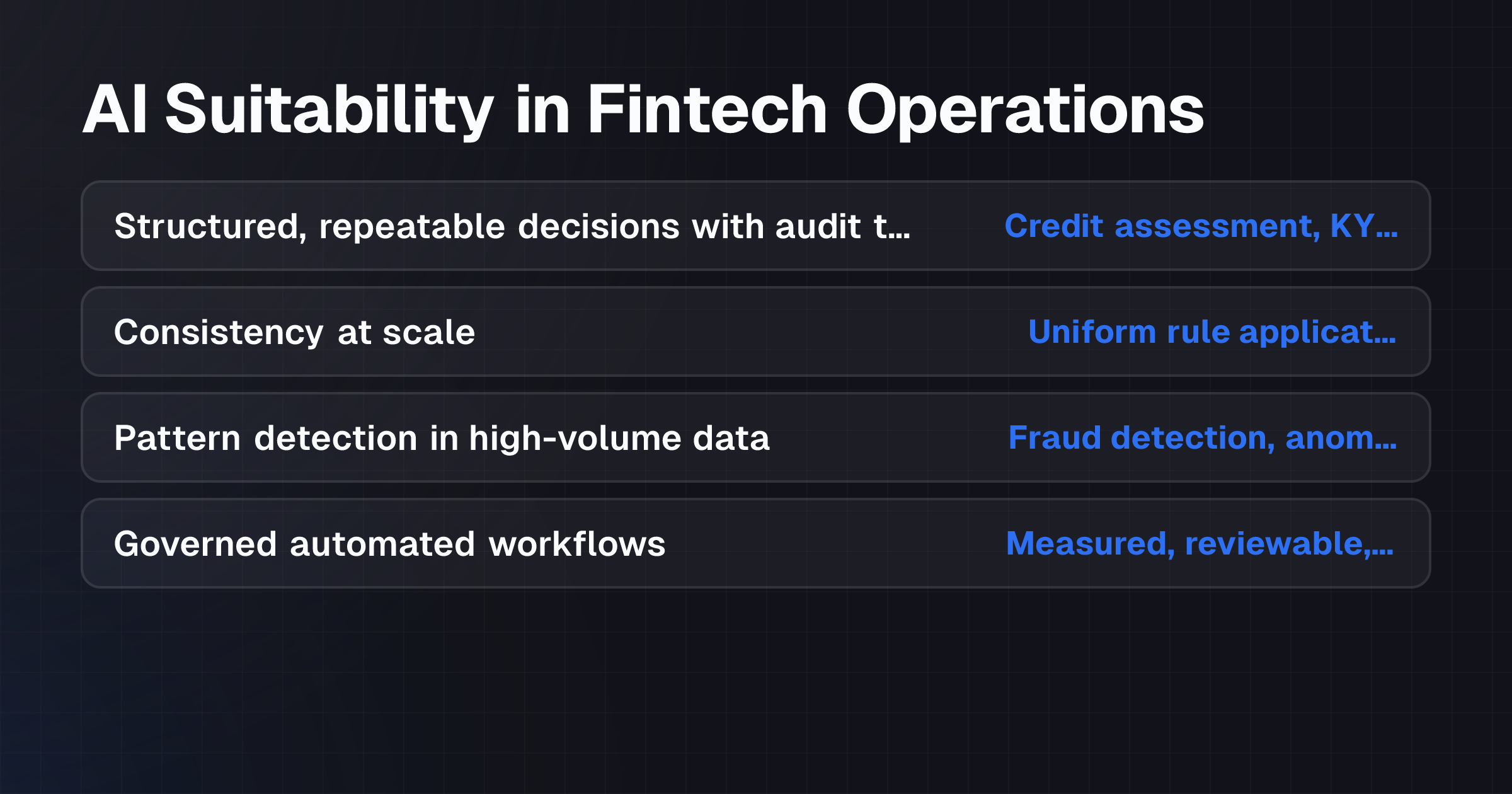
Where AI helps in fintech operations:
Structured, repeatable decisions with audit trails. AI excels where the decision process can be documented, the input data can be validated, and outputs can be monitored for drift or bias. Credit assessment, KYC screening, or transaction flagging are candidates.
Consistency at scale. Once trained, AI models apply rules uniformly across millions of cases without fatigue. This consistency is valuable for compliance; it's also a control point for governance.
Pattern detection in high-volume data. Fraud detection, anomaly flagging, or market microstructure analysis benefit from AI's ability to process and correlate signals humans can't handle manually.
Where AI does not help, or creates more risk:
Novel, low-volume, or contextual decisions. One-off underwriting decisions, crisis-mode customer escalations, or novel market conditions often require human judgment because the training data doesn't exist or doesn't apply.
Black-box systems deployed without explainability. If a regulator or customer asks why the AI denied a loan or flagged a transaction, the operator must be able to answer. If the answer is "the neural network decided," governance has failed.
Systems without continuous monitoring. AI models degrade silently as real-world data drifts from training data. A credit model trained on 2022 originations may not reflect 2025 borrower profiles. A fraud detector trained on historical patterns may miss emerging attack vectors. Without monitoring, decay goes undetected.
High-stakes decisions without human review. Regulatory frameworks and operational risk management dictate that consequential decisions, loan approvals, trading halts, customer account closures, retain human sign-off, even when AI recommends the action.
The useful question is not whether AI can automate the task, but whether the workflow can be measured and reviewed safely.
Implementation model
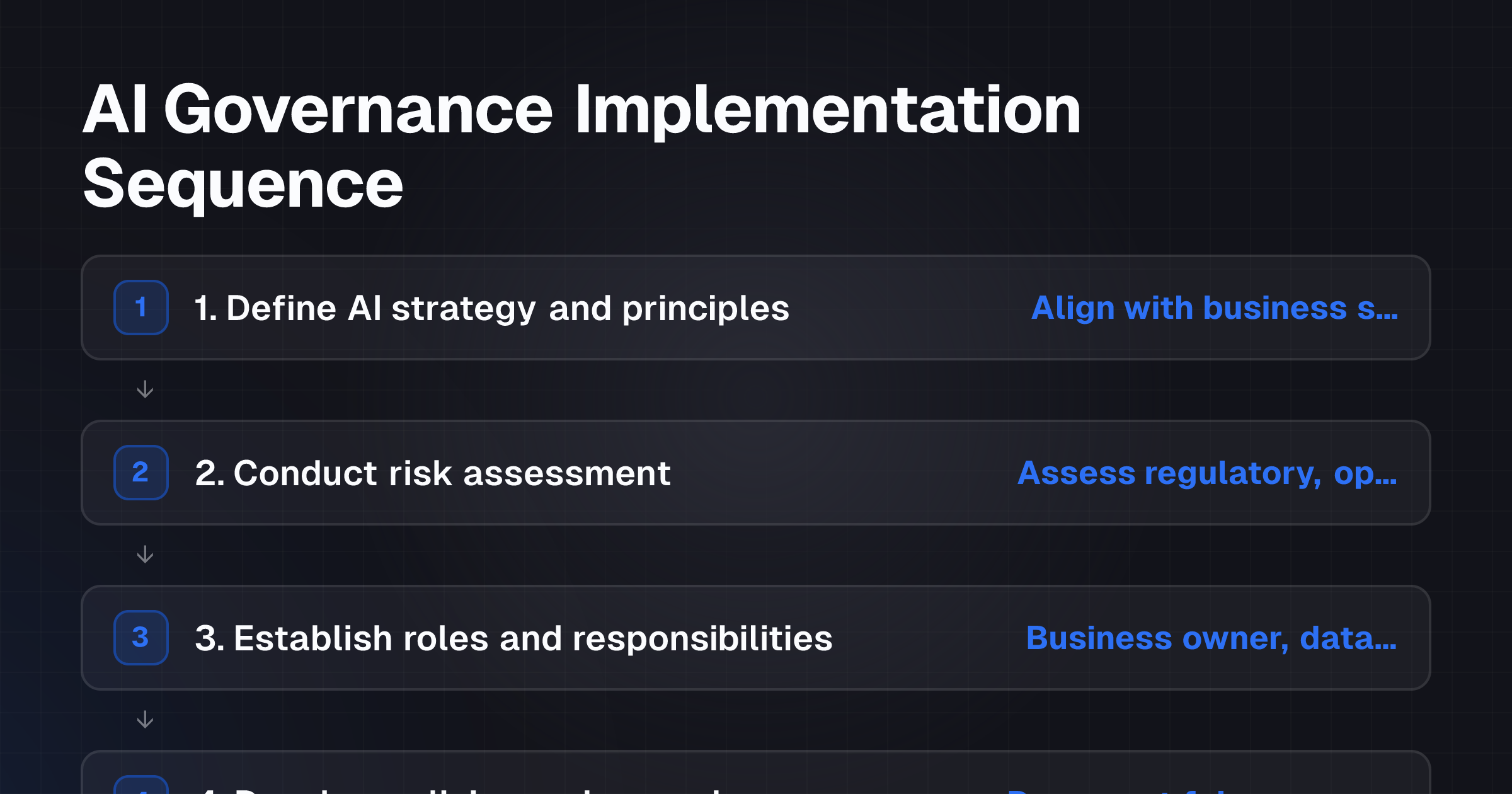
Effective AI governance follows a sequence of seven steps, each with defined decision criteria and accountability.
1. Define AI strategy and principles
Establish clear objectives for AI use within the firm. What problems will AI solve? What value will it create? What ethical boundaries apply?
Decision criteria:
- Does the AI initiative align with overall business strategy and risk appetite?
- Can success be measured in business outcomes (cost reduction, speed, accuracy, compliance)?
- Are the firm's ethical guidelines and compliance obligations compatible with the intended use?
Example: A fintech firm automating customer support might prioritize AI models that deliver consistent, accurate information and enhance customer satisfaction, rather than purely minimizing cost. This principle shapes model selection, training data, and success metrics.
2. Conduct risk assessment for each AI application
Identify and categorize potential risks before deployment. Don't wait for production failure to discover risk.
Decision criteria:
- Regulatory risk: Does the AI system make decisions subject to financial or consumer protection rules? (High risk.)
- Operational risk: What's the financial impact if the model fails or drifts? (High risk if loss of revenue, breached SLA, or system unavailability.)
- Ethical/reputational risk: Could biased or unexplainable decisions harm customers or damage trust? (High risk if publicly visible.)
- Data security risk: What's the sensitivity of the data the model ingests? (High risk if payment card data, personally identifiable information, or trading data.)
Assess severity (financial loss, regulatory penalty, customer harm) and likelihood (how probable is the failure mode?). Prioritize high-risk applications for more stringent governance controls.
3. Establish clear roles and responsibilities
Assign accountability for development, deployment, monitoring, and governance. Define handoffs and communication channels.
Typical roles in a fintech AI governance structure:
Business owner: Defines use case, success criteria, and acceptance of risk.
Data scientist / AI engineer: Owns model development, training data quality, and performance documentation.
Legal and compliance: Ensures alignment with regulations and consumer protection law.
Risk management: Owns monitoring, bias detection, and incident response.
Responsible AI officer or AI governance committee: Oversees policy implementation, reviews escalations, and approves deployment to production.
Establish a clear approval gate: no AI system moves to production without documented sign-off from business, legal, risk, and governance leads.
4. Develop AI policies and procedures
Create documented guidelines covering the entire AI lifecycle: data privacy, data security, model development standards, bias mitigation, explainability requirements, ongoing monitoring, and incident response.
The Monetary Authority of Singapore's Fairness, Ethics, Accountability and Transparency (FEAT) Principles provide a starting framework:
Fairness: Treat customers fairly. Don't discriminate based on protected characteristics. Monitor for disparate impact.
Explainability: Provide clear explanations of why the AI made a particular decision, especially for high-stakes outcomes (loan denial, account closure).
Accountability: Assign responsibility for model performance and outcomes. Don't hide behind "the algorithm decided."
Transparency: Document the data, logic, and assumptions behind the model. Make this documentation available to regulators and auditors on request.
Additional policy areas:
Data lineage, track the origin, transformations, and usage of data feeding into AI models.
Model validation, define performance standards before deployment. What accuracy, precision, recall, or fairness metrics must be met?
Bias testing, conduct pre-deployment testing for algorithmic bias. Check for disparate impact across demographic groups or customer segments.
Monitoring and drift detection, set thresholds for model performance degradation. Define escalation and remediation processes.
5. Implement technical controls and tools
Deploy technology to support governance objectives. Key capabilities:
Model validation and performance monitoring: Automated dashboards tracking accuracy, precision, recall, false positive/negative rates against baseline performance.
Drift detection: Flagging when real-world data distribution diverges from training data, signaling model decay.
Explainability and auditability: Tools that explain why a model made a specific decision and trace data lineage back to source.
Bias detection and monitoring: Automated checks for disparate impact across demographic or business segments.
Research from Gartner (2023) notes that AI governance tools are emerging to automate aspects of AI lifecycle management, including lineage tracking and compliance checks. These tools can reduce manual effort in monitoring, but tool selection should prioritize auditability and integration with existing risk and compliance systems.
6. Ensure continuous monitoring and auditing
Regularly assess AI model performance, fairness, and compliance. Don't assume a model trained and validated once will perform correctly forever.
Continuous monitoring includes:
Performance tracking: Daily or weekly updates on model accuracy and key performance indicators (KPIs) against baseline.
Bias and fairness monitoring: Regular checks for disparate impact. For a credit scoring model, track approval rates, default rates, and interest rates by demographic group and flag material divergence.
Data quality monitoring: Validate that input data continues to meet quality standards (no missing values, no unexpected distributions, no data poisoning).
Model drift detection: Alert when performance degrades or input data distribution shifts, signaling that retraining or investigation is needed.
Audit trails: Maintain logs of all model decisions, inputs, and outcomes to support audit and incident investigation.
Example: An AI-driven credit scoring system should continuously track whether approval rates, default rates, or loan performance vary materially across demographic groups. If disparities emerge, the model should be flagged for review, and the source, biased training data, model specification, or changed business process, should be investigated before the system continues unchanged.
7. Foster a culture of responsible AI
Integrate responsible AI principles into organizational practice. Provide training for all employees involved in AI. Encourage open discussion about ethical considerations and potential unintended consequences.
A culture of responsible AI doesn't mean slowing down or avoiding risk, it means acknowledging risks explicitly, making trade-offs transparent, and maintaining accountability for decisions.
Controls, governance and human review
Governance controls separate three types of AI workflows: automation, assistance, and autonomous decision-making.
Automation (low-risk, high-volume, rule-based)
AI fully replaces a human process with minimal or no human review. Example: Data entry, document classification, routine notification.
Control design:
- Establish performance thresholds before deployment (e.g., accuracy ≥ 95%).
- Monitor continuously for drift or error spikes.
- Build an exception queue: flag low-confidence cases for human review.
- Conduct periodic audits to verify the system remains within bounds.
Human review: Minimal, unless drift or error rates exceed thresholds.
Assistance (medium-risk, decision support)
AI recommends or surfaces information; a human makes the final decision. Example: Fraud flagging, customer segmentation, lead scoring.
Control design:
- Require the AI to provide reasoning and confidence scores with every recommendation.
- Log all recommendations and human decisions to detect systematic overrides or underrides (e.g., humans reject AI fraud flags 95% of the time, suggesting miscalibration).
- Set performance targets for both AI accuracy and human decision quality.
- Escalate recommendations to a senior reviewer if the AI is uncertain or if the human decision diverges from AI recommendation.
Human review: On all high-stakes recommendations; on a sample of routine recommendations; always when performance metrics signal misalignment between AI and human judgment.
Autonomous decision-making (high-risk, low-volume, consequential)
AI makes binding decisions without human review (or with review after decision is executed). Example: Automated trading execution, automated account closure, automated transaction denial.
These workflows should be rare in fintech because regulatory and operational risk is highest. Where they exist:
Control design:
- Require pre-approval of the model, logic, and decision criteria by legal, risk, and business leadership before any autonomous decision is executed.
- Implement hard stops: the system can't execute a decision if conditions fall outside predetermined bounds (e.g., trade size exceeds risk limit, account closure affects high-value customer).
- Maintain a full audit trail of every decision, including model state, input data, reasoning, and outcome.
- Conduct post-decision review: a human inspects a sample of autonomous decisions to verify the system acted as intended.
- Build a kill switch: the system must be pausable or reversible if harm occurs.
Human review: Pre-deployment sign-off by governance committee. Post-deployment sampling. Immediate review if error rate or customer complaints spike.
The core principle: where the decision affects customer outcomes, regulatory compliance, or financial risk, human judgment should remain in the loop unless the firm has explicitly accepted the risk of autonomous operation and embedded controls are proven.
Cost and measurement framework
AI governance creates direct and indirect costs. Both must be measured and compared against the value AI creates.
Direct costs of governance
Policy development and documentation: 40-80 hours to establish baseline policies (data governance, model development standards, monitoring protocols). Ongoing updates: 10-20 hours annually per policy.
Pre-deployment assessment and testing: 20-60 hours per model (depends on complexity). Includes risk assessment, bias testing, explainability evaluation.
Technical infrastructure: Monitoring and auditability tools, data lineage systems, performance dashboards. Tool costs range widely; basic open-source solutions are available; enterprise platforms cost $10k-$50k+ annually.
Ongoing monitoring and audit: 20-40 hours monthly per model for continuous monitoring, drift detection, performance review. Periodic audits (quarterly or annually): 40-80 hours per audit.
Incident investigation and remediation: Variable, depending on frequency and severity. Budget 20-100 hours per incident.
For a fintech with 5-10 models in production, annual governance cost (policy, monitoring, audit) is likely in the range of $100k-$300k depending on team size, tool investment, and complexity. This is the cost of safety and compliance.
Measurement framework
Compare governance cost against the value AI creates and the cost of failure.
Value created by AI:
Labor hours saved (annual cost reduction from automation). Decision speed improvement (faster approval, faster fraud detection, faster escalation). Accuracy improvement (fewer errors, fewer defaults, fewer false positives). Compliance improvement (fewer regulatory findings, fewer customer complaints).
Measure these against baseline performance before AI deployment.
Cost of failure (loss prevention):
Regulatory penalties avoided (costs of compliance gaps, enforcement action). Customer harm avoided (fraud losses, incorrect denials, unfair treatment). Reputational cost avoided (customer trust, media scrutiny). Operational resilience (system availability, data quality).
Not all costs are easily quantified, but regulators increasingly expect firms to document the risk-benefit trade-off.
Metrics to track:
Governance cost per model: Total annual governance spend ÷ number of models in production.
Value per model: Annual cost savings + annual accuracy gains (in $ terms) + compliance benefits.
Cost/benefit ratio: (Governance cost + model infrastructure cost) ÷ (Value created + loss prevention value). A ratio below 1.0 suggests AI creates more value than governance costs.
Incident rate: Number of AI-related incidents or breaches per year. Trend downward.
Audit findings: Number of governance gaps discovered in internal or external audit. Trend downward.
Model performance drift: Percentage of models exceeding performance thresholds during monitoring period. Target: 0% or near 0%.
A lower transaction cost doesn't automatically mean a lower total operating cost. A model that's cheap to run but requires 40 hours of human review per month may cost more in total than a more expensive model that runs autonomously within tight governance bounds.
1. Over-regulation vs. agility
The trap: Imposing governance so strict that model development slows to a crawl or the cost of compliance exceeds the value of AI.
The correction: Calibrate governance to risk. A low-risk, non-regulated internal process (e.g., email classification) requires minimal governance. A high-risk, regulated decision (e.g., credit approval) requires rigorous governance. Balance the two with a clear, tiered approval process.
2. Poor data quality and inherited bias
The trap: Assuming data is neutral. Training data often reflects historical decisions and systemic inequities. A credit model trained on past lending decisions will encode whatever biases existed in historical underwriting.
The correction: Before training, audit training data for bias and completeness. Document known biases. Test models for disparate impact across demographic groups before deployment. Continue monitoring post-deployment.
3. Lack of explainability
The trap: Deploying black-box models (complex neural networks, ensemble methods) without the ability to explain decisions. This violates regulatory expectations (especially in lending, where Equal Credit Opportunity Act requires explanation of denial) and makes debugging impossible when things go wrong.
The correction: Prioritize explainability as a design constraint, not an afterthought. Use simpler, more interpretable model architectures where possible. If black-box models are necessary, invest in explainability tools that can surface the key factors driving each decision.
4. Model drift without detection
The trap: Models degrade silently as real-world data drifts from training data. A credit model trained on 2022 borrowers may not apply in 2025. A fraud detector trained on historical attack patterns may miss new threat vectors.
The correction: Set up automated drift detection. Monitor key input distributions and model performance metrics continuously. Define thresholds for escalation (e.g., if accuracy drops below 88%, flag the model for retraining review).
5. Over-reliance on AI without human review
The trap: Treating AI as infallible and removing human judgment from the loop. This leads to systemic errors, especially in novel or edge-case scenarios.
The correction: Maintain human review for high-stakes decisions. Use AI to assist, not replace, judgment. Log all cases where human decision diverges from AI recommendation to detect systematic misalignment.
6. Ignoring ethical considerations
The trap: Optimizing for accuracy or cost reduction while ignoring fairness, privacy, or customer impact. A perfectly accurate model that discriminates is a regulatory and reputational liability.
The correction: Define ethics principles upfront. Test models for bias and fairness before deployment. Involve legal, compliance, and ethics stakeholders in deployment decisions.
7. Fragmented governance
The trap: Different teams (data science, engineering, legal, risk, product) operate in silos. One team trains and deploys a model without risk sign-off. Another monitors it without notifying operations. Governance gaps emerge.
The correction: Establish a single governance framework with clear roles and sign-off gates. Create an AI governance committee that meets regularly to review models in development and in production. Use a centralized model registry that tracks all models, their risk tier, approval status, and monitoring state.
Implementation checklist
Use this checklist before deploying any AI system to production.
- Define strategy and principles. Documented objectives for AI use. Board or leadership approval.
- Conduct risk assessment. Completed risk assessment for the model. Risk tier assigned (low, medium, high).
- Assign roles and accountability. Named owner for each role (business, data science, legal, risk, governance). Escalation path defined.
- Document policies. Data governance policy. Model development standards. Monitoring and drift detection procedures. Incident response process.
- Pre-deployment testing completed.
- Model performance validated against stated targets (accuracy, precision, recall).
- Bias and fairness testing completed. No material disparate impact detected.
- Explainability testing completed. Operator can explain why model recommends a specific decision.
- Data quality audit completed. Training data documented; known biases flagged.
- Technical controls in place.
- Performance monitoring dashboard built and tested.
- Drift detection alerts configured.
- Audit trail logging enabled.
- Exception queue or escalation process designed.
- Governance approval. Model reviewed and approved by legal, compliance, and risk stakeholders. Signed-off by governance committee.
- Deployment plan documented. Rollout strategy (pilot, phased, full). Rollback procedure. On-call escalation contacts.
- Monitoring baseline established. Pre-deployment performance metrics recorded. Baseline against which drift will be measured.
- Post-deployment review schedule set. Weekly performance review for first month. Monthly thereafter. Quarterly audit scheduled.
- Culture and training. All operators trained on model logic, governance expectations, and escalation procedures.
Next step
Start with the highest-risk models already in production or planned for near-term deployment. If no formal AI governance exists, begin with a single high-risk model: conduct a gap analysis, apply the seven-step implementation model above, and document lessons learned. Governance scales from there.
The goal is not perfection. The goal is to know what risk the firm is accepting, to measure it, and to maintain the ability to fix or pause the system if it fails. A firm that does this is in a position to defend its AI deployment to regulators, customers, and itself.