
Bootstrapped founders keep full control and ownership. Those who raise external capital trade equity for resources that accelerate growth. The choice depends on business model fit, market competition, growth pace requirements, and founder risk tolerance, not preference alone. This piece draws on operating data from 40+ fintech founders in Owen's ecosystem, examining what separates bootstrapped operators from those who raise and what the data leaves uncertain about long-term outcomes.
Key finding: Business model determines the viability path more than founder preference
The decision isn't primarily a founder choice. It's a structural fit between business model and capital requirements.
Service businesses or low-capital models favour bootstrapping. Capital-intensive ventures with extended runways before revenue need external funding. Owen's data shows fintech and payments companies often require substantial upfront investment, technology, compliance infrastructure, market penetration, making early capital deployment a business-model constraint rather than a strategic preference.
Why it matters
For founders and investors evaluating capital strategy, the distinction clarifies cause and effect.
A founder who raises capital isn't necessarily more ambitious or skilled than one who bootstraps; they may simply operate in a market that demands it. A bootstrapped business isn't inherently more efficient or sustainable; it may operate in a niche with lower barriers.
Understanding these structural differences helps founders avoid misaligned capital decisions. Raising prematurely in a market that could grow organically wastes equity. Bootstrapping in a space where speed-to-market decides competitive survival kills the business before it scales.
Data and methodology
This analysis draws on operating data from 40+ fintech founders across Owen's portfolio and network, collected as of 11 November 2026. The research examines capital-decision patterns, business model characteristics, and operational metrics: revenue trajectories, team size, funding timelines, market positioning. The data is analysed to identify structural differences between bootstrapped operators and those who raise external capital, controlling for survivorship bias and founder selection effects where possible.
Specific operating metrics, customer acquisition costs, profit margins, development timelines, are available within Owen's dataset but aren't detailed in this public brief. The focus is decision criteria and model fit, not proprietary performance figures.
What the evidence shows
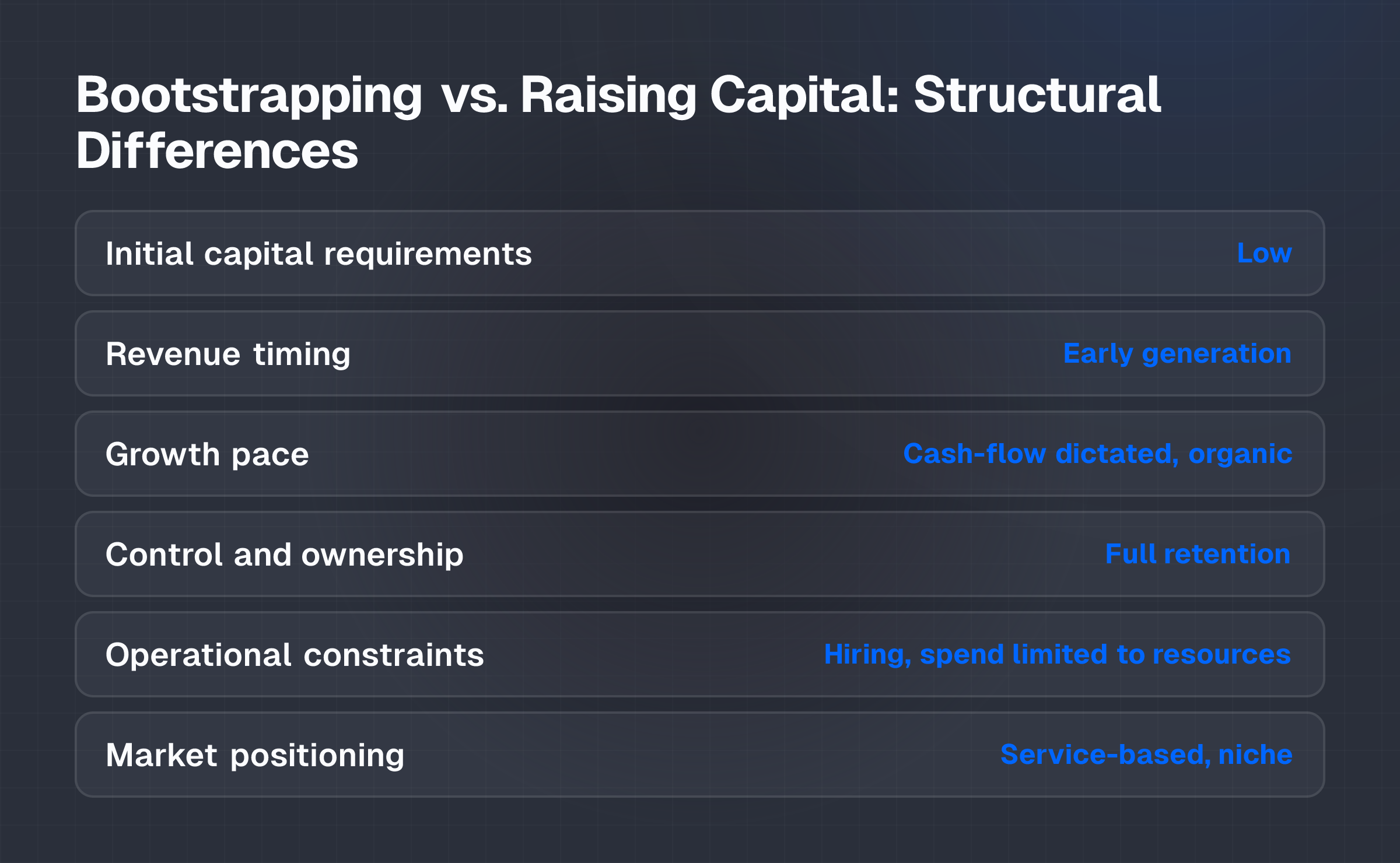
Founders across Owen's ecosystem separate into two operational paths based on business model requirements.
Bootstrapping: Suitable for businesses with low initial capital requirements, clear early revenue generation, and service-based or niche-market positioning. Bootstrapped founders retain complete control and ownership, maintain full decision-making autonomy, and grow at a pace dictated by cash flow and profitability. This approach prioritises self-sufficiency and avoids external obligations but constrains hiring, marketing spend, and product development to available resources. Growth is typically organic and slower, allowing the founder to remain hands-on across all operations.
Raising Capital: Necessary for capital-intensive models requiring substantial upfront investment in technology, regulatory infrastructure, or broad-scale market penetration before generating meaningful revenue. External funding enables accelerated growth, aggressive hiring and marketing, and rapid market expansion. Owen notes that for a business "ready for the next level," with "real users, cash flow," external capital combined with operational support, "the playbook, the network and AI built in", enables rapid, often exponential scale. Raising capital involves ceding a portion of ownership and control to investors, introducing obligations to deliver returns and potentially requiring alignment with investor expectations and timelines.
Portfolio examples: FunderPro, co-founded by Owen and launched in March 2023, scaled to pay "$22M+" to traders within its first operational period, and simultaneously launched with significant brand positioning ("sponsors Ferrari F1 academy driver Ollie Bearman"), indicating capital deployment for rapid market presence and scale. Deus X Pay, relaunched in December 2024 in the institutional stablecoin-payments space and now handling "Billions" in annualised volume, operates as infrastructure-heavy fintech with regulatory registrations (such as FINTRAC), a business model that typically necessitates considerable initial and ongoing capital investment to build compliant systems.
In both cases, the capital decision followed from business-model requirements rather than founder preference. Infrastructure-heavy fintech and rapid-scale trading platforms inherently require external funding because compliance, technology, and market penetration demands exceed what organic revenue can support in the early phases.
What it does not show
This evidence doesn't prove that raising capital leads to long-term success. It doesn't prove bootstrapping is more sustainable.
Survivorship bias affects both groups. Founders who raise capital and achieve visibility are more visible than those who raise and fail. Bootstrapped founders who reach scale are more visible than those who bootstrapped and didn't. The research doesn't isolate which founders achieved profitability, which returned capital to investors, or which required follow-on funding. It doesn't establish causation between capital decision and outcome; it identifies structural fit and operating differences.
The data doesn't show that bootstrapping is more capital-efficient or that raising capital wastes resources. A bootstrapped business may operate in a market where capital efficiency is high; a well-funded business may operate in a market where rapid spend is necessary to compete. Both models can be operationally sound within their respective contexts.
The research also doesn't control for founder skill, market timing, product-market fit, or competitive dynamics. Capital decision is one variable among many. It doesn't determine success alone.
Operational implications
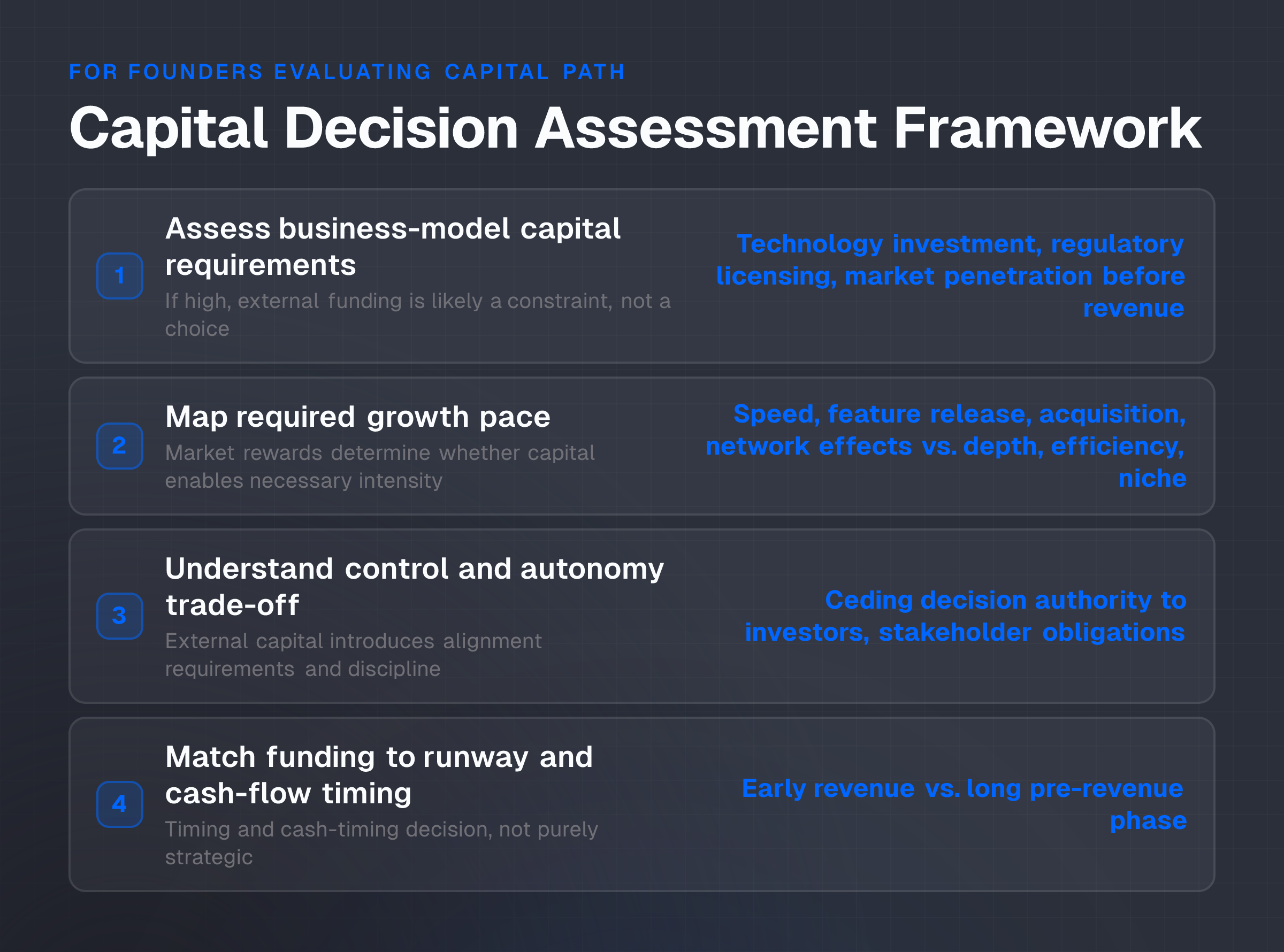
For founders evaluating this decision:
Assess business-model capital requirements first. If your business requires significant upfront technology investment, regulatory licensing, or extensive market penetration before revenue, external funding is likely a business constraint, not a strategic choice. Attempting to bootstrap in this context may delay market entry and allow competitors to establish dominance.
Map the growth pace you need. If your market rewards speed, rapid feature release, aggressive customer acquisition, or network effects, raising capital enables the operational intensity required. If your market rewards depth, efficiency, or niche penetration, bootstrapping may be sufficient and preserve ownership.
Understand the trade-off in control and autonomy. Raising capital means ceding decision authority to investors and potentially misaligning business strategy with founder vision. This isn't inherently negative; investor discipline and resources can prevent founder overreach. Founders who prioritise autonomy should recognise that external capital introduces stakeholder obligations.
Match funding to runway and cash-flow timing. A bootstrapped business with early revenue can remain bootstrapped if cash flow sustains operations and growth. A capital-intensive business with a long pre-revenue phase requires external funding to avoid founder burnout or runway depletion. This is a timing and cash-timing decision, not purely a strategic one.
Limits and last-verified date
Last verified: November 11, 2026
The specific operating data from the 40+ fintech founders in Owen's ecosystem isn't detailed publicly; this brief draws conclusions from analysed patterns within that dataset. The nature of the operating metrics, revenue growth rates, profitability, runway, team size, and the exact criteria distinguishing bootstrapped from funded operators within the dataset aren't disclosed. The research doesn't include counter-evidence or explicit controls for survivorship bias and founder selection effects; these limitations should be considered when interpreting the findings.
This article doesn't cover the performance, retention, or exit outcomes of businesses in either category. It doesn't track whether external capital requirements changed over time as businesses matured.
Next step
For founders in capital-intensive markets, fintech, payments, regulated trading platforms, the operative question isn't whether to bootstrap but whether your specific business model can support the runway until cash flow covers operations. Funding your startup: exploring options for raising capital outlines the decision framework for evaluating external funding at different stages. For those assessing business fundamentals before a capital decision, how founders make operating decisions with incomplete data covers the framework for structuring decisions when full information is unavailable. Founder decision-making: what to keep and delegate examines control trade-offs once capital is deployed. Operators seeking to understand investment thesis and model selection can review profitable prop platforms: Owen's investment thesis for perspective on how capital decisions align with business-model sustainability.