
A founder's operating system, the framework and practices used to direct a company, determines who holds authority and how decisions get made. The choice between consolidating control at the center or distributing it across teams isn't binary. It shifts as the business grows.
Early-stage startups typically benefit from consolidated control, where the founder retains most decision-making authority and drives a singular vision. As operations scale and complexity increases, distributed control becomes necessary to avoid bottlenecks and unlock team ownership. The right model depends on company stage, team capability, market dynamics, and the nature of decisions being made.
This article offers a practical framework for deciding which decisions founders should retain, delegate or escalate. It forms part of Owen’s Founders Series, covering the operating decisions behind building and scaling companies.
The short version: Recognizing when founder-led control becomes a bottleneck
In the early phase of a business, seed or initial startup, consolidated control works. A single decision-maker can iterate on product-market fit, establish operations, and secure early partnerships without the friction of committee approval. Fast and clear.
But as team size grows and operations become more complex, maintaining that concentrated authority creates a bottleneck. Strategic decisions still need founder input or approval, but daily operational and tactical decisions must move to the teams performing them. The transition isn't about the founder stepping back; it's about the founder stepping into the right decisions and empowering others on the rest.
What problem we were solving
The core tension is this: founders succeed early by being involved in everything, but that same involvement that worked at 5 people fails at 50. When a business reaches the growth stage, adding staff, opening new markets, scaling product features, the founder who insists on approving every workflow decision, vendor contract, or team-level problem becomes the constraint.
Work waits. Skilled people leave. Innovation stalls because local expertise can't be acted upon without climbing back to the founder for sign-off.
The problem isn't control itself. It's knowing which decisions belong at the center and which belong at the edges. Strategic decisions that shape the long-term direction, vision, core product direction, major investments, fundamental culture, often need founder approval or at least founder voice. Operational and tactical decisions, daily workflows, team problem-solving, localized market responses, belong with the people executing them. Without a clear model for which is which, founders either over-centralize and slow the business, or under-delegate and lose quality.
The constraint or trade-off
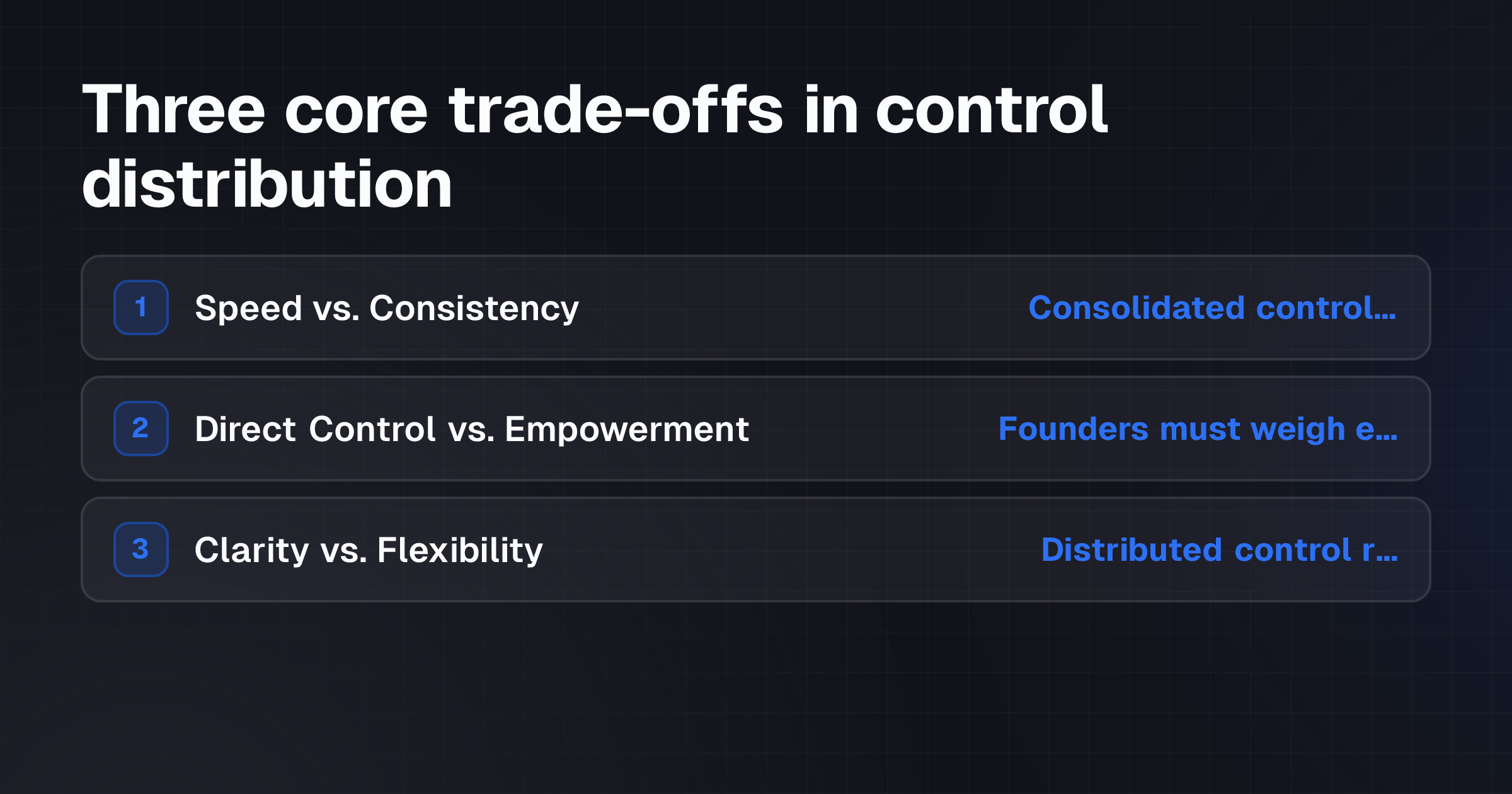
Three core trade-offs emerge when shifting toward distributed control:
Speed vs. Consistency. Consolidated control can deliver uniform decisions and swift, top-down direction. Everyone knows what the founder wants. But that model doesn't scale; the founder's calendar becomes a chokepoint. Distributed control allows fast local execution, teams don't wait for approval, but introduces risk of inconsistent messaging, conflicting priorities, or operations that drift from company values without clear frameworks to guide them.
Direct Control vs. Empowerment. Founders must weigh the emotional comfort of direct authority against the operational benefits of empowering teams. When teams own their decisions and outcomes, they develop judgment, take initiative, and feel ownership of results. But distributed authority also means accepting decisions you might have made differently, and living with the outcomes.
Clarity vs. Flexibility. Distributed control requires explicit frameworks, which types of decisions stay centralized, which get delegated, how conflicts escalate, what communication channels matter. Clear structures enable delegation. Vague delegation breeds chaos and frustration (a failure mode sometimes called "pseudo-distribution", delegating tasks without actual authority). But over-structured frameworks can also become rigid and slow when markets shift or new conditions emerge.
What we decided and why
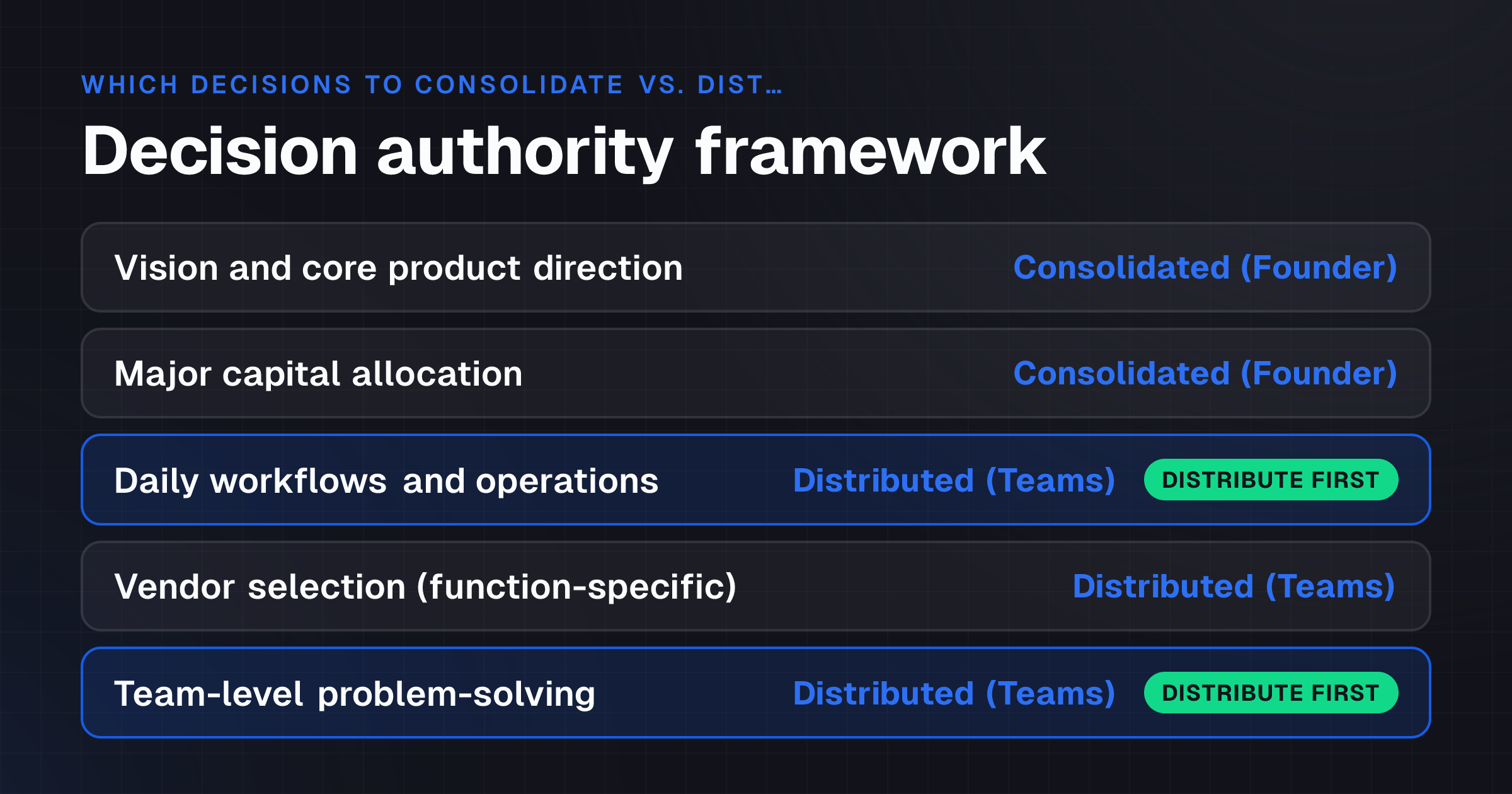
Navigating this transition requires assessing five factors in order:
1. Current stage and organization size. Early-stage businesses (seed, pre-product-market-fit) default to consolidated control. The founder is the primary decision-maker, driving vision and execution. As the organization scales, teams grow, operations fragment across functions, revenue reaches a level where one person can't cognitively manage all moving parts, the need for distribution emerges. Mature or established enterprises generally require distributed control to sustain growth and respond effectively to diverse markets and customer needs.
2. Nature of the decisions and tasks. High-stakes strategic decisions, vision, core product direction, major capital allocation, are candidates for consolidated founder input or approval, especially when they directly impact long-term direction. Operational and tactical decisions, daily workflows, team-level problem-solving, vendor selection for specific functions, are ideal candidates for distribution. Decisions requiring specialized expertise should be delegated to subject matter experts; their local knowledge and depth typically produce better outcomes than founder oversight. For a concrete infrastructure decision, see the build-versus-buy guide for prop firm trading infrastructure.
3. Team capability and culture. A team with a culture of trust, psychological safety, and demonstrated autonomy is ready to manage distributed responsibilities. High-performing, experienced teams can operate without constant founder input. Newer, developing, or less experienced teams may require more consolidated guidance and oversight initially, with gradual distribution as judgment and capability mature.
4. Industry and market dynamics. Rapidly changing markets and competitive landscapes favor distributed control, teams at the front lines can respond faster to shifts without waiting for founder approval. Highly regulated industries may require more centralized compliance oversight. Markets where speed and local adaptation are competitive advantages push toward distribution.
5. Communication and alignment infrastructure. Distributed control only works if decision rights, communication channels, and escalation paths are explicit. A company without clear operating rhythms, decision frameworks, or alignment mechanisms will suffer from "pseudo-distribution", delegated tasks without actual authority, leading to frustration and misalignment. For the supporting workflows, see how back-office systems connect tools, automation and team handoffs.
What happened
Two concrete examples illustrate how this decision played out in practice:
Early consolidation, then managed distribution. When FunderPro launched in March 2023, founder-led consolidation made sense. A single vision, rapid iteration on product offerings, and direct founder involvement in partnership deals allowed for quick establishment of the prop firm's operating model. That tight control was appropriate for defining product-market fit and early operations. As the firm scaled and served more traders, the same consolidated model would have created bottlenecks, every feature request, payout dispute, or trader question would flow back to the founder.
Distribution at scale. TradeLocker, which operates across 20+ brokers and 80+ prop firms, illustrates a more distributed model. A platform serving that many partners and customers can't operate with single-founder decision-making for daily execution. The appointment of an external CEO, Ex-IG CTO Dom Bradley in July 2025, reflects an explicit shift from founder-led operations to distributed leadership. Different functions (mobile app development, broker integrations, customer support, compliance) operate with their own decision authority, escalating only when decisions cross functional boundaries or impact strategy.
What happened in both cases: the founders didn't disappear from the business. They remained involved in vision, major product decisions, and strategic partnerships. But they released day-to-day operational authority to teams, creating space for those teams to move fast and own outcomes.
What we would do differently
Three adjustments would have accelerated the transition:
Define decision rights explicitly, earlier. Many founders drift into distributed control reactively, when something goes wrong, they suddenly realize they never clarified which decisions belonged where. Starting with an explicit framework of decision types and authorities, even as early as the seed stage, makes the transition smoother. It prevents the false distribution (delegating tasks without authority) that creates frustration.
Communicate the reasoning, not just the decision. When a founder says "you have authority over X," team members often still wait for permission or assume they'll be overruled. Explaining why that decision belongs with the team, what information they have that the founder lacks, what speed or local judgment matters, builds confidence. The audience for this communication isn't just the team; it's the broader organization, so that people understand the operating model, not just their own box.
Build feedback loops, not just delegation. Distributed control works only if the founder has a way to see what's happening, notice drift, and course-correct without micromanaging. Weekly metrics, regular one-on-ones with team leads, transparent dashboards, or monthly operating reviews all serve this function. The absence of feedback loops is why some distributed models fail, the founder can't tell if decisions are being made well or badly until something breaks.
Expect reversals. Some decisions that should have been distributed need to be pulled back, either because team judgment wasn't ready or because market conditions shifted. This isn't a failure; it's normal. Having a non-shaming way to recentralize a decision category (without the founder saying "I told you so") preserves trust and keeps the model flexible.
The transferable lesson
The lesson is structural, not about any single founder or company: the founder's job changes as the organization grows, and the operating system must change with it. At seed, the founder's job is to be the primary decision-maker and executor. At scale, the founder's job is to set the decision framework, hire and develop people who can make decisions within it, review outcomes, and intervene only on the decisions that matter most to long-term direction.
This shift isn't optional. Founders who refuse to distribute control hit a natural ceiling, either because they burn out, or because they can't attract and keep the talent needed to scale. Teams with no decision authority don't stay, or they stay and perform at lower levels. Conversely, founders who distribute control too early or without clear frameworks create chaos and confusion.
The working principle is: consolidate decisions that shape direction and values; distribute decisions that execute direction. Direction includes vision, core product strategy, major investments, and fundamental culture choices. Execution includes workflows, vendor management, tactical customer solutions, and local market adaptation. The founder still owns the outcomes of both, but operates through different levers.
A second principle is build the feedback loop before you need it. Don't wait until something breaks to find out whether distributed decisions are working. Transparent metrics, regular reviews, and open escalation channels let a founder see and adjust without abandoning delegation.
Next step
For founders and operators assessing their own operating system: conduct a brief audit of your current decision load. List the decisions you made (or felt you needed to approve) last week. Sort them into two categories, those that shape direction and those that execute it. Look for recurring operational decisions that wait for your approval even though a capable owner could make them within agreed limits. Track the delay, the consequence of a wrong decision and how easily it could be reversed before deciding what to delegate. If you've distributed decisions without clear authority or feedback, you're probably suffering from pseudo-distribution. Start by clarifying the boundary between the two, document it briefly for your team, and run one cycle of feedback to see whether it holds.
The right model will shift again as the company grows. That's expected. What matters is that the shift is intentional, communicated, and aligned to the stage and complexity of the business you're building.