
I do not back a prop platform simply because it has a compelling challenge model or a large social following. I look for evidence that the business can operate through market cycles: real revenue, disciplined payout exposure, reliable infrastructure and a team that can make hard decisions when growth slows.
This is an operating framework, not investment advice or a claim that every profitable platform is a better opportunity. Early-stage companies can be the right fit in other circumstances. The purpose here is to explain the evidence I would need before deciding where to spend time, capital or operating support.
The evidence I need before I take the conversation seriously
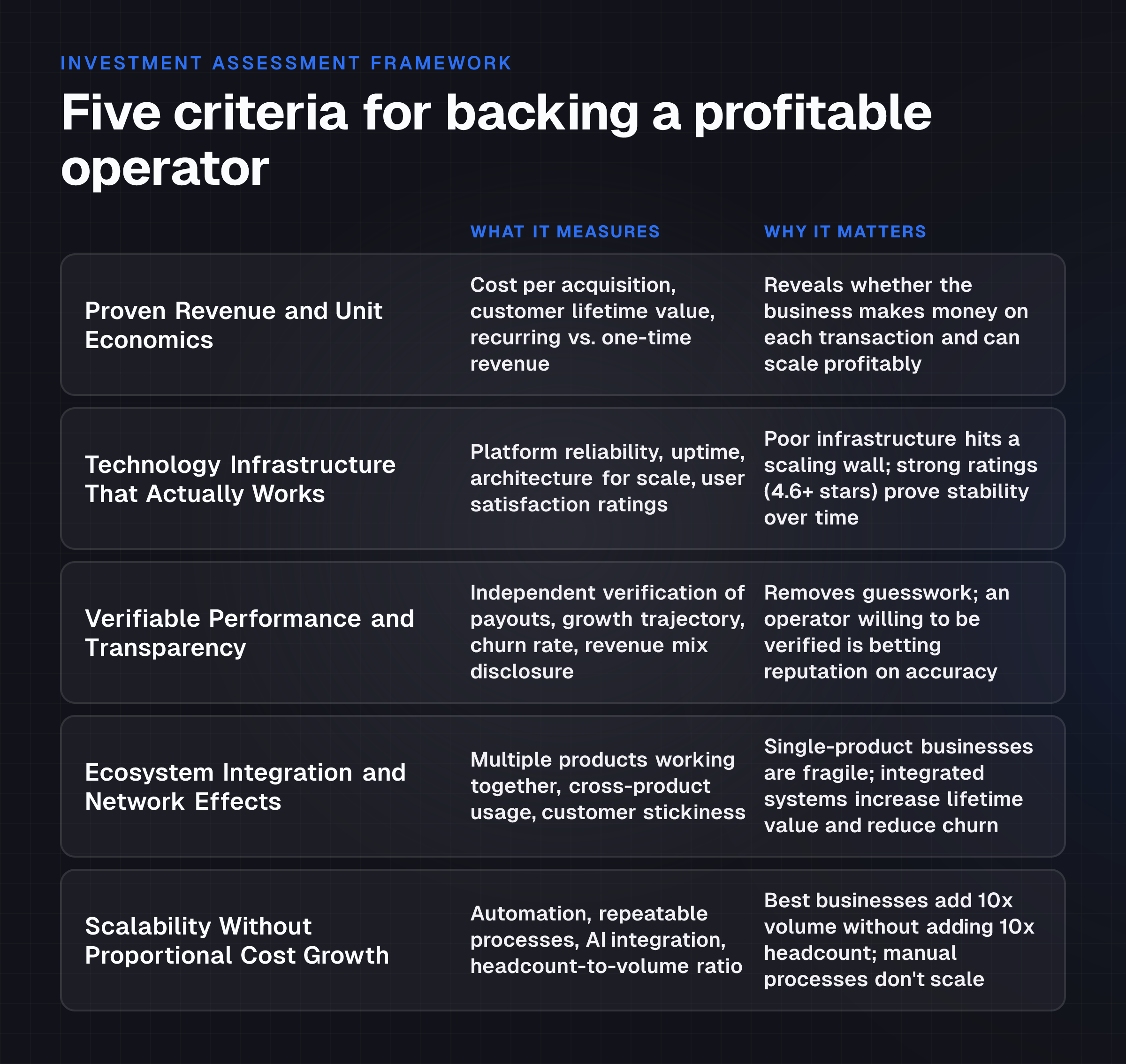
When I assess a profitable operator, I work through five concrete criteria. A founder or operator reading this can use them to self-assess or to understand what a capital partner is likely to scrutinize.
1. Proven Revenue and Unit Economics
Revenue alone isn't enough.
I need to see whether the business makes money on each transaction or user, and whether it can scale that profitably, which means understanding the cost structure: What does it cost to acquire a customer, how much do they spend, and do they come back? For a payments company like DeusXPay, which handles billions in annualised volume, the unit economics come down to transaction throughput and fees. For a prop platform like TradeLocker, which runs on 80+ prop firms with a 4.6-star Trustpilot rating, the unit economics include per-user licensing, support overhead, and the stability of that recurring base.
If an operator can't explain their unit economics in plain terms, that's a flag. If they won't share them, that's a bigger one.
2. Technology Infrastructure That Actually Works
Trading platforms, payment systems, and user-facing services live or die on infrastructure. TradeLocker was built as a no-download web platform with TradingView charting specifically to solve the problem that brokers and prop firms faced, they needed something reliable and easy to deploy. That deliberate design is part of why 80+ firms chose to run on it.
Infrastructure costs money to build and more money to maintain. An operator who has cut corners on infrastructure will hit a scaling wall or face reliability problems that no amount of marketing can fix. A strong Trustpilot rating, like TradeLocker's 4.6 stars, reflects both user satisfaction and operational stability over time.
3. Verifiable Performance and Transparency
In prop trading, the ultimate test is payouts.
FunderPro has paid $21M+ to funded traders, and the WhatProp cert engine has independently verified $21.9M across those payouts. That verification matters because it removes the guesswork. When an operator is willing to have their payouts independently verified, they're betting their reputation on accuracy. That's the kind of operator worth backing.
Transparency extends beyond payouts. Can they show you the growth trajectory? The churn rate? The revenue mix? An operator hiding metrics is an operator who knows something you don't.
4. Ecosystem Integration and Network Effects
A single product in a competitive market is fragile. A portfolio of products that work together creates stickiness and increases customer lifetime value.
The portfolio spans TradeLocker (platform), FunderPro and FunderPro Futures (funding), DeusXPay (payments), and education ventures, with millions of users across the ecosystem. When a trader funds an account via FunderPro and trades on TradeLocker and receives payouts through DeusXPay, each part of that ecosystem strengthens the others.
Does the operator have one hit product, or are they building an integrated system where multiple offerings feed into each other?
5. Scalability Without Proportional Cost Growth
The best businesses are those where you can add 10 times the volume without adding 10 times the headcount.
Automation and AI can lift operational margins significantly, AI installations have lifted margins by an average of 15% across the portfolio. But that only works if the underlying business is built for scale. An operator still manually processing payouts or customer support is not scalable. One who has built automation and repeatable processes is.
How the Call Gets Made: From Unit Economics to the Cheque
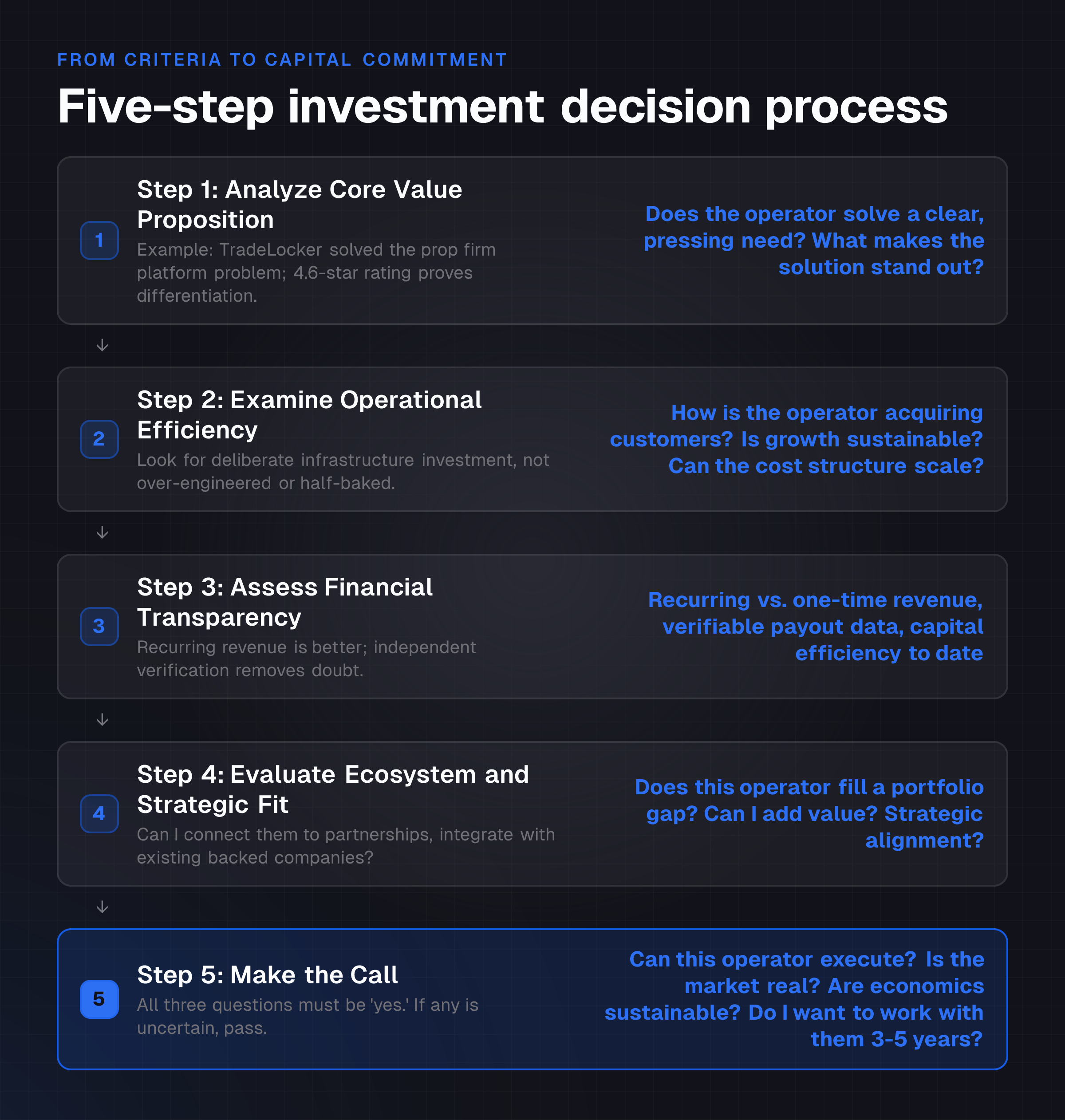
When I move from criteria to the actual investment decision, the process is structured but not mechanical. Here's how it works.
Step 1: Analyze the Core Value Proposition
Does the operator solve a clear, pressing need?
TradeLocker solved the problem that prop firms and brokers faced: they needed a reliable, modern trading platform they could deploy without building it themselves. DeusXPay solved the problem of processing payments across global users and high transaction volumes. That's a clear need in both cases.
What makes the solution stand out? Is it cheaper, faster, easier to use, more reliable, or some combination? TradeLocker's Trustpilot rating of 4.6 stars tells me the users think it's worth paying for and worth recommending. That's differentiation in practice.
Step 2: Examine Operational Efficiency
How is the operator acquiring customers?
Are they growing sustainably, or are they burning capital on one-time marketing spends? Is the business built so that it can handle more users without the cost structure breaking? I look at whether the operator has invested in infrastructure deliberately, not over-engineered, not half-baked, but fit for purpose and scalable.
Step 3: Assess Financial Transparency
For any deal, I want to see:
- Recurring vs. one-time revenue streams (recurring is better)
- Verifiable payouts or performance data
- How the operator has funded growth to date and whether that capital is generating returns
Step 4: Evaluate Ecosystem and Strategic Fit
Does this operator fill a gap in the portfolio?
Can I add value by connecting them to other businesses or insights? Will they thrive because they integrate with what's already backed, or because they're independent enough to stand alone?
Step 5: Make the Call
Once I've worked through those, I either commit capital or I pass.
The decision comes down to this: Can this operator execute? Is the market real? Are the economics sustainable? And do I want to spend the next 3-5 years alongside this team? If the answer to all three is yes, I move forward. If any of them is uncertain, I pass.
What Happens After the Cheque: Building Alongside the Operator
Backing a profitable operator is not passive.
After investment, the work involves actively identifying problems, connecting operators with partnerships, and helping them think through scaling challenges. The role is less "board observer" and more "operating partner." AI systems have been installed across the portfolio. Platforms have been connected with payment infrastructure. Traders have been introduced to funding companies and funding companies to marketing channels. The value is in operational insight and network, not in strategy advice from a distance.
For the operator, this means access for the practical problems, scaling support, integrating new features, navigating a new market. For me, it means only backing operators I genuinely want to work alongside over years, not just collect a return from.
What I Pass On: Red Flags in Operator-Backed Deals
There are consistent patterns that serve as warning signs. Here's what makes me walk away.
Hype Over Sustainable Growth
Some operators promise exponential returns without a clear business model or path to profitability. They're betting on the market expanding, not on their ability to make money. That's speculation, not business building.
Infrastructure Cut Corners
An operator who has skimped on technology infrastructure or payments infrastructure will hit a scaling wall.
Their platform will slow down under real load. Their transactions will fail at scale. Those failures cost, in customer churn, in reputational damage, in having to rebuild from scratch. I pass on those operators, even if their early metrics look good.
Lack of Transparency
If an operator won't disclose key metrics, churn, payout data, cost structure, they're either hiding something or they don't have reliable data.
Either way, I'm not comfortable backing them. Operators worth backing will share real numbers, even the ones that aren't perfect.
Over-Reliance on a Single Product or Customer
A business that depends entirely on one product, or where one customer represents more than 20-30% of revenue, is vulnerable to market shifts or customer loss. Diversification within an ecosystem mitigates that risk. An operator who can't articulate how they reduce that risk is a pass.
User Experience That Doesn't Match the Product Sophistication
Even with the most advanced technology, if the interface is confusing or the experience is poor, users will leave.
TradeLocker's 4.6-star Trustpilot rating reflects the opposite, users are happy enough to say so publicly. An operator whose product is technically sound but whose users complain constantly is building on a shaky foundation.
Unwillingness to Adapt or Learn
Markets change. Competitors emerge. Regulation shifts.
An operator who is rigid about their approach or dismissive of feedback is setting themselves up to be disrupted. I back operators who are confident in their direction but flexible in their methods, and who genuinely listen to their users and to the operators around them.
FAQs
What's the difference between backing a profitable operator and backing a pre-revenue startup?
Pre-revenue businesses are bets on potential; you're paying for the founder's vision and the market size. Profitable operators are bets on execution; you're paying for proof that the operator can build, ship, and make money. The risk profile is completely different.
With a profitable operator, you're reducing execution risk because it's already been proven. You're still taking market risk, the business could stall or be disrupted, but you're not betting on whether the operator can actually build something.
How much transparency should I expect to see before investing?
Any operator worth backing should be willing to share unit economics, churn rates, revenue mix, and (if they handle payouts) independently verified payout data.
They don't need to share every internal email, but the core financial picture and operational metrics should be clear. If an operator won't share this with you before you invest, they won't share it after either, which means you'll never truly know whether your capital is working.
What's the most important red flag you watch for?
Unwillingness to be verified or transparent about results.
If an operator is handling money, whether as a payments company, a prop firm, or a funding platform, and they won't allow independent verification of their claims, walk away. FunderPro's $21.9M in independently verified payouts matters because it removes doubt. An operator's confidence in their track record should match their willingness to prove it.
How long does it typically take to evaluate a deal like this?
For a profitable operator with good data, I can form a view in 2-4 weeks.
That requires time to work through the unit economics, understand the infrastructure, see the user feedback, and usually take a few meetings with the team. If an operator can't or won't provide that data quickly, that's also a signal. Operators who are proud of their business make it easy to verify.
Why does ecosystem fit matter if the operator is already profitable?
Because profitability alone doesn't guarantee growth.
An operator who can integrate with other businesses, or who fills a gap that amplifies the value of existing products, has a much clearer path to scale. If the portfolio is trading platforms and funding, an operator who brings payments infrastructure is more valuable than an operator with an equally profitable but isolated product. Integration creates network effects that pure profitability alone does not.
Can you back an operator in a space you don't already operate in?
Yes, but it's riskier because you can't add as much operating value.
Staying mostly within fintech, trading, and payments works because the infrastructure, the regulatory landscape, and the unit economics are understood territory. If backing an operator in a completely foreign space, reliance falls purely on their execution and the market validation, which means the role shrinks. It might still happen, but the operator would need to be exceptionally proven and the market need exceptionally clear.