
Founders face a recurring constraint no planning eliminates: critical operating decisions must often be made before complete information is available. Market signals may be ambiguous, customer demand unproven, competitive moves unpredictable. The founders who navigate this successfully don't wait for certainty. They acknowledge the gap, formulate testable hypotheses, prioritize the most critical missing information, and move forward in deliberate steps designed to generate new data. This approach, grounded in what researchers call "effectual logic," treats each decision as an experiment rather than a final commitment.
Understanding how founders make these decisions under incomplete data is essential for operators, investors, and strategic partners who must evaluate business choices, assess risk, and know when a founder's conviction is backed by rigor versus when it reflects untested assumptions.
The short version: Acting on conviction when demand signals are unclear
FunderPro launched in March 2023. The prop trading market was established but competitive.
The decision to enter the space and commit significant resources, including sponsorship of Ferrari F1 academy driver Ollie Bearman, was made without waiting for exhaustive market research or a guaranteed demand signal. This reflects a founding principle: if waiting for perfect information means missing a market window, the cost of inaction may exceed the cost of calculated action.
By December 2024, FunderPro had expanded to offer FunderPro Futures, demonstrating an iterative approach in which early decisions generated real-world feedback that informed the next move.
What problem founders were solving
Founders building fintech and trading platforms operate in markets where customer needs evolve faster than traditional research cycles can capture.
The problem is structural. By the time comprehensive market data exists, competitors may have already secured customer relationships, partnerships, or regulatory positions. Waiting for demand to become undeniable often means entering too late.
The alternative carries its own risk. Acting on incomplete information can misallocate resources, launch features customers don't want, or miss market shifts that invalidate initial assumptions. The real problem isn't choosing between perfect data and none, it's deciding how to act responsibly with partial information and designing decisions so they generate the feedback needed to adapt quickly.
The constraint or trade-off
Three primary trade-offs shape this decision-making context.
Speed versus accuracy. A decision made quickly with 60% of the information may capture a market window but lack the nuance that would make execution smoother. Waiting for 90% certainty often means a competitor has moved first. The market has shifted. Founders must choose which incompleteness they can tolerate.
Resource allocation under uncertainty. Committing capital, team capacity, or brand credibility to a bet based on partial information risks those resources if assumptions prove wrong. Yet not committing anything means not testing whether the assumption is valid. The constraint is that some resources must be at risk to learn whether the bet was sound.
Opportunity cost of further research. Time spent validating assumptions is time not spent building, shipping, or selling. In fast-moving markets like prop trading and fintech, this trade-off is particularly acute. The research on founder decision-making notes that effectual logic, focusing on what can be controlled and taking action with available means, often outperforms exhaustive prediction-focused planning.
What founders decided and why
The evidence points to a consistent decision framework founders employ under these constraints.
First, acknowledge and define what's missing. Rather than assuming certainty or waiting passively, founders explicitly identify which pieces of information are unavailable and whether the decision can be postponed. If it can't, because a market window is closing or a partnership opportunity expires, the decision proceeds despite the gap.
Second, formulate testable hypotheses and list underlying assumptions. This step shifts thinking from "What do we know?" to "What are we assuming, and how could we test it?" For a prop firm launch, assumptions might include: "Traders will prefer this risk model over competitors," "Brand partnerships will drive customer acquisition," or "Expanding from challenges to futures will attract a different trader segment." Stating these explicitly allows the team to recognize bias and to design feedback loops.
Third, prioritize acquisition of the most critical missing information. Instead of comprehensive market research, founders focus on high-impact, low-cost methods: direct customer interviews (even a small sample), competitive observation, limited pilot programs, or expert advice from networks.
TradeLocker's decision to ship its iOS app within three months of launch (June 2023, following its March 2023 launch) reflected a hypothesis that mobile access would be critical. Rather than study the question, the team prioritized building and measuring real user adoption.
Fourth, employ heuristics and analogies where quantitative data is scarce. Pattern recognition from past experience, "Similar products succeed when they prioritize X" or "This reminds me of the moment when Y market tipped", is legitimate input when it's acknowledged as intuition, not fact. The constraint is that heuristics should inform but not substitute for testing.
Fifth, structure decisions as reversible experiments. Instead of a single large bet, decisions are staged into smaller steps, each designed to generate new information without catastrophic loss if the assumption is wrong. FunderPro's launch in March 2023 was followed by the December 2024 expansion to futures. A staged approach that allowed the core model to validate before committing to a new product line.
What happened
FunderPro's trajectory illustrates both the success and the discipline required by this framework.
March 2023 launch. The firm entered a competitive market with a significant brand investment (Ferrari F1 academy driver sponsorship) despite incomplete demand signals. This decision reflects conviction, grounded, presumably, in founder insight about market gaps or customer segments. But it also carried execution risk.
December 2024 futures expansion. Rather than a single static offering, FunderPro evolved its product line. This suggests that the March launch generated real data on customer behavior, preferences, and use cases, data that informed the decision to expand into derivatives beyond spot trading.
Real-world feedback loop. Each iteration created conditions for new information to flow back into the operating model. Customer onboarding patterns, trading behavior, and retention metrics would have revealed which initial assumptions held and which needed refinement.
The research identifies a critical cognitive bias to watch: founders can mistake anecdotal evidence for statistically significant data, or discount negative signals that contradict initial hypotheses. The framework mitigates this by building explicit feedback loops and defining metrics for success or failure before launching an experiment.
What founders would do differently
The research identifies several failure modes that founders should actively guard against.
Avoid analysis paralysis without sacrificing discipline. The bias toward action is healthy when paired with clear decision criteria. Before launching an experiment, define what result would trigger a pivot, what cost is acceptable, and what timeline allows for course correction. Without these anchors, "bias toward action" becomes reckless.
Test assumptions explicitly, not implicitly. It's easy to assume that launching a product and observing customer uptake tests the core hypothesis. In reality, customer adoption reflects many variables: marketing reach, product design, timing, pricing, and sometimes pure luck.
Founders should isolate which assumption each experiment is designed to test. If the goal is to validate that traders prefer a certain risk model, a pilot with a specific trader segment is more informative than a broad launch.
Seek disconfirming evidence. The natural bias is to interpret results as validation of the initial hypothesis. Instead, founders should actively ask: "What would it look like if this was wrong?" and "What evidence would contradict this assumption?" TradeLocker's rapid mobile deployment (June 2023) was data-driven, but the question should also have been: "What if traders don't actually want mobile access, or what if the web platform was sufficient?" Negative feedback would have been as valuable as positive.
Diversify information sources. Relying on a single founder's intuition, a single customer conversation, or a single competitor analysis creates fragility. The framework strengthens when multiple perspectives challenge the hypothesis. This also guards against overconfidence bias, a documented risk when a founder has had previous success.
The transferable lesson
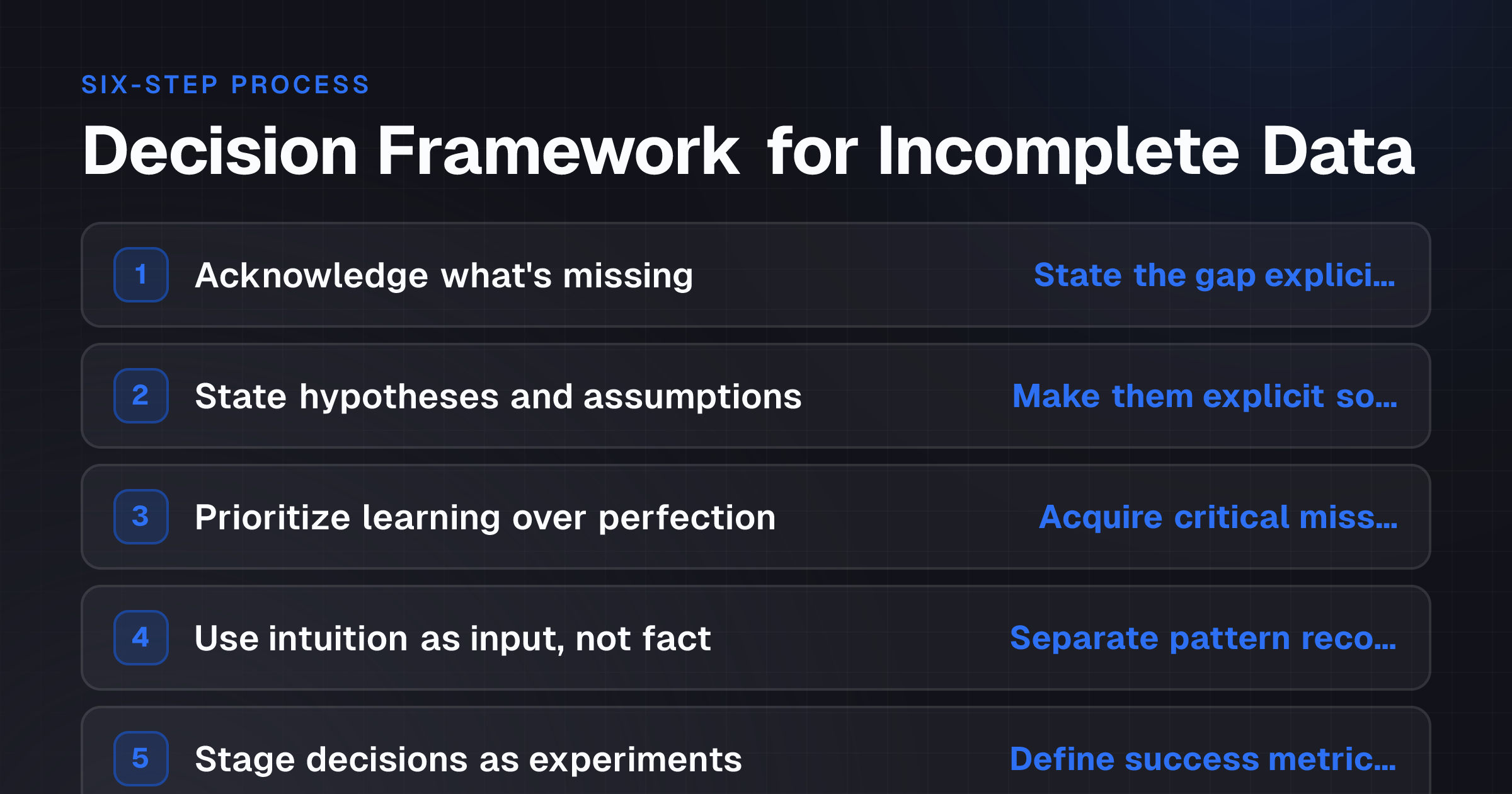
The core insight transcends prop trading or fintech: When demand signals are unclear, the question isn't whether to decide under uncertainty, but how to structure the decision so it generates the information needed to adapt.
This applies whether the decision is about market entry, product features, team structure, or pricing. The process has a consistent shape:
- Acknowledge what's missing rather than pretending clarity exists.
- State hypotheses and assumptions explicitly so they can be tested and revised.
- Prioritize learning over perfection: acquire the critical missing information through scrappy, low-cost methods.
- Use intuition and pattern recognition as input, not as fact. Separate "This resembles a situation that succeeded" from "This will succeed."
- Stage decisions as experiments with defined success metrics and acceptable loss thresholds.
- Build feedback loops so each decision generates data for the next one.
The goal isn't to eliminate uncertainty, that's impossible in dynamic markets. It's to shift from passive waiting for perfect information to active generation of the information needed to adapt.
Founders who execute this well tend to move faster than competitors still debating what is unknowable, and they accumulate real-world data that competitors can only guess at.
Next step
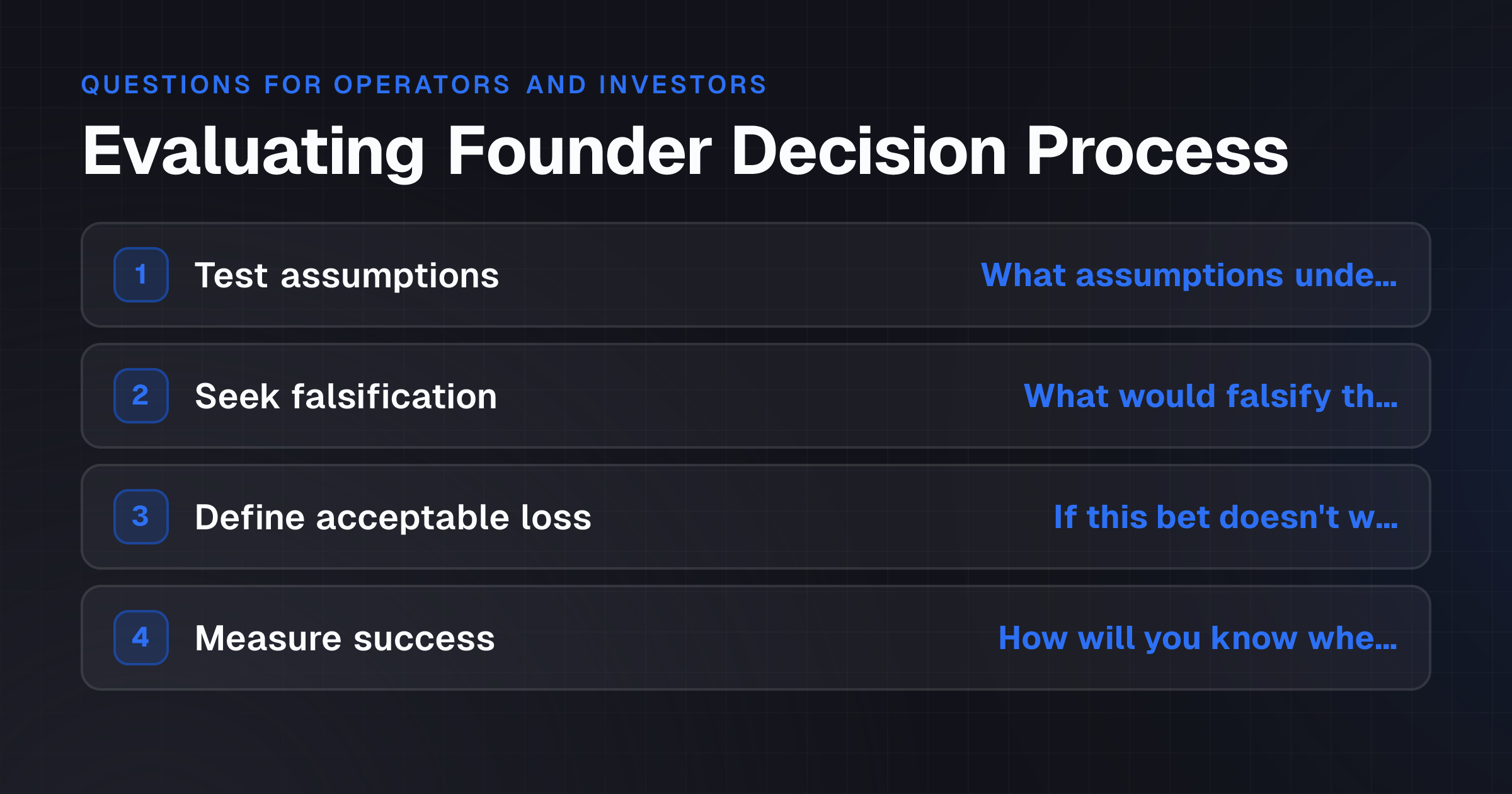
For operators and investors evaluating a founder's decision under incomplete data, the practical step is to examine their process, not just their conviction.
Ask:
- What assumptions underlie this decision, and how are you testing them?
- What would falsify this hypothesis, and are you monitoring for that?
- If this bet doesn't work as planned, what's the cost and what's your exit?
- How will you know whether this decision was right, and on what timeline?
Founders with clear answers to these questions, even if the information remains incomplete, are operating within a disciplined framework. Those who can't articulate the assumptions or the feedback loops are making bets, not decisions. The difference matters, especially when capital, team time, and customer trust are at stake.
The full picture is in the AI ROI in fintech: P&L, governance and scale decisions guide.