
Fintech operators deciding between internal AI development and external vendor partnerships should choose based on three factors: the complexity and uniqueness of the workflow, the timeline to deployment, and the depth of available engineering talent. Internal builds offer control, defensibility, and customization but demand significant upfront investment and longer time to market. External partnerships accelerate deployment and reduce operational burden but introduce vendor lock-in risk, less control over intellectual property, and potential integration friction with legacy systems.
The right decision depends on your specific automation need. Not a universal rule. A fraud detection system protecting proprietary data might justify internal development; a customer support chatbot deployed in weeks might not. This framework helps you compare both paths across measurable criteria.
Quick answer: When to build versus buy AI automation
The choice isn't binary. It depends on whether the automation task is standardized or proprietary, how quickly you need deployment, whether your team has AI engineering capacity, and how tightly the solution must integrate with your core systems. Understanding these variables helps operators avoid the most common failure: deploying an AI tool that technically works but doesn't align with business constraints or operational reality.
Who this decision is for
This framework applies to fintech founders, product leaders, and operators who are evaluating how to implement AI automation, whether in fraud detection, transaction processing, customer support, compliance monitoring, or other operational workflows. You're making this decision if:
- Your team has identified a repetitive, data-intensive workflow that could benefit from automation.
- You're comparing the effort and cost of building a solution in-house versus licensing one from a vendor.
- You need to justify the decision to stakeholders, investors, or your executive team.
- You're uncertain about integration complexity, total cost of ownership, or the risk of vendor dependency.
This decision applies equally to established fintechs with engineering teams and to early-stage operators with limited internal capacity.
The decision criteria: What matters most
Evaluating internal development versus external partnerships requires assessing six dimensions.
Automation scope and standardization. Define whether the task is standardized (suitable for off-the-shelf solutions) or proprietary (requiring custom models or deep integration). A standardized compliance report might use a vendor's template. Fraud detection tied to your unique customer cohort or transaction patterns likely requires internal development.
Time to market urgency. External vendors often deploy functional solutions in weeks; internal teams typically require months for model development, testing, and integration. If you need automation live in 60 days, a vendor solution is more realistic.
Integration complexity. Assess how tightly the AI solution must connect to your existing systems, core banking platforms, trading engines, payment gateways, compliance dashboards. Simple API connections to a vendor are faster than building custom data pipelines and authentication layers.
Internal engineering capacity. Evaluate whether your team includes data scientists, machine learning engineers, and infrastructure specialists with headroom to own an AI project. Hiring for these roles can extend timelines by 3-6 months and increase costs by 30-50% per engineer.
Data governance and security posture. Consider whether the solution will handle highly sensitive data (customer PII, transaction details, trading signals). Vendor solutions may require data export or storage in third-party environments; internal builds offer complete control over data residency and audit trails.
Long-term competitive value. If the automation represents a competitive advantage, unique risk models, proprietary customer insights, or operational cost reduction that competitors can't replicate, internal ownership may justify higher upfront investment. Standardized automations offer less defensibility.
Options and trade-offs: Build internal vs. partner with a vendor
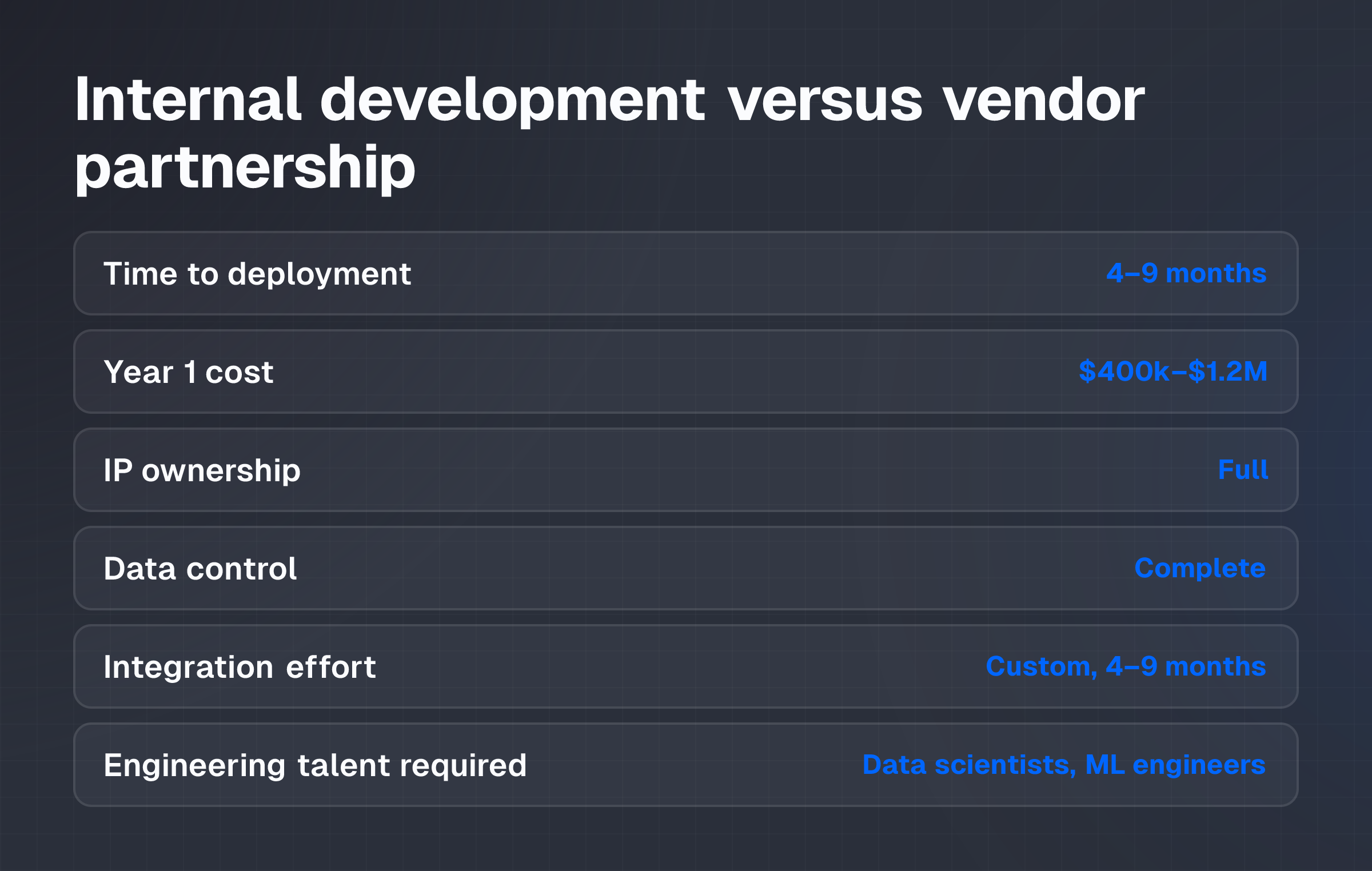
Internal AI workflow development
Advantages:
Full intellectual property ownership and control over the model's evolution. Deep customization: the solution reflects your specific business logic, data characteristics, and compliance requirements. No vendor lock-in; you own the code, data, and model weights. Potential competitive moat: unique algorithms or data-driven workflows competitors can't easily replicate. Complete control over data handling, residency, and compliance audit trails.
Disadvantages:
Higher upfront costs: hiring data scientists (typically $120k, $250k annually), ML engineers, and infrastructure staff; purchasing compute, storage, and monitoring tools. Longer time to market: model development, testing, validation, and integration typically require 4-9 months for a production system. Ongoing operational burden: maintenance, retraining, debugging, and adapting models as your business evolves.
Recruitment and retention risk: AI talent is competitive; turnover can stall projects or introduce knowledge gaps. Requires strong data governance practices; poor data quality directly undermines model performance and compliance.
External vendor partnership
Advantages:
Faster deployment: vendor solutions often go live in 4-12 weeks. Lower initial capital outlay: typically subscription-based ($5k, $50k monthly, depending on scale and customization). Access to specialized expertise and established best practices in fintech compliance, fraud detection, or other domains. Reduced operational overhead: vendor handles maintenance, updates, and infrastructure scaling. Lower recruitment burden; your team doesn't need to hire AI specialists immediately.
Disadvantages:
Vendor lock-in: switching providers is costly and disruptive; you may be trapped by proprietary data formats, integrations, or contractual terms. Less control over intellectual property: the vendor owns the model; your competitive advantage depends on execution, not the algorithm itself.
Integration friction: off-the-shelf solutions may not map cleanly to your unique workflows or legacy systems. Data security concerns: data leaves your infrastructure; compliance with regulations like GDPR, CCPA, or local fintech rules requires explicit vendor contractual guarantees. Dependence on vendor roadmap: new features, improvements, or bug fixes follow the vendor's priorities, not yours. Potential cost escalation: as you scale, per-transaction or per-user fees can grow significantly; total cost can exceed internal development within 2-3 years.
Cost, risk and implementation implications
Cost modeling: Total cost of ownership
Internal development cost structure:
Year 1 typical range: $400k, $1.2M (one full-stack team: 1-2 data scientists, 1 ML engineer, 1 infrastructure engineer, plus compute and tools). Includes salaries, cloud infrastructure (compute, GPU, storage), software licenses (notebooks, experiment tracking, version control), and contingency. Year 2-3 operating costs: $300k, $600k (ongoing team salary, infrastructure, retraining, maintenance). Payoff timeline: ROI typically realized within 18-36 months if the automation reduces manual costs or unlocks new revenue.
External vendor cost structure:
Year 1 typical range: $60k, $240k in subscription fees plus integration costs ($20k, $100k one-time). Per-transaction or per-user fees may apply; model costs over time as transaction volume grows. Year 2-3 costs: subscription fees continue; no salary overhead but increasing variable costs at scale. Payoff timeline: ROI faster initially (faster deployment means faster cost savings), but cumulative cost may exceed internal build within 24-36 months.
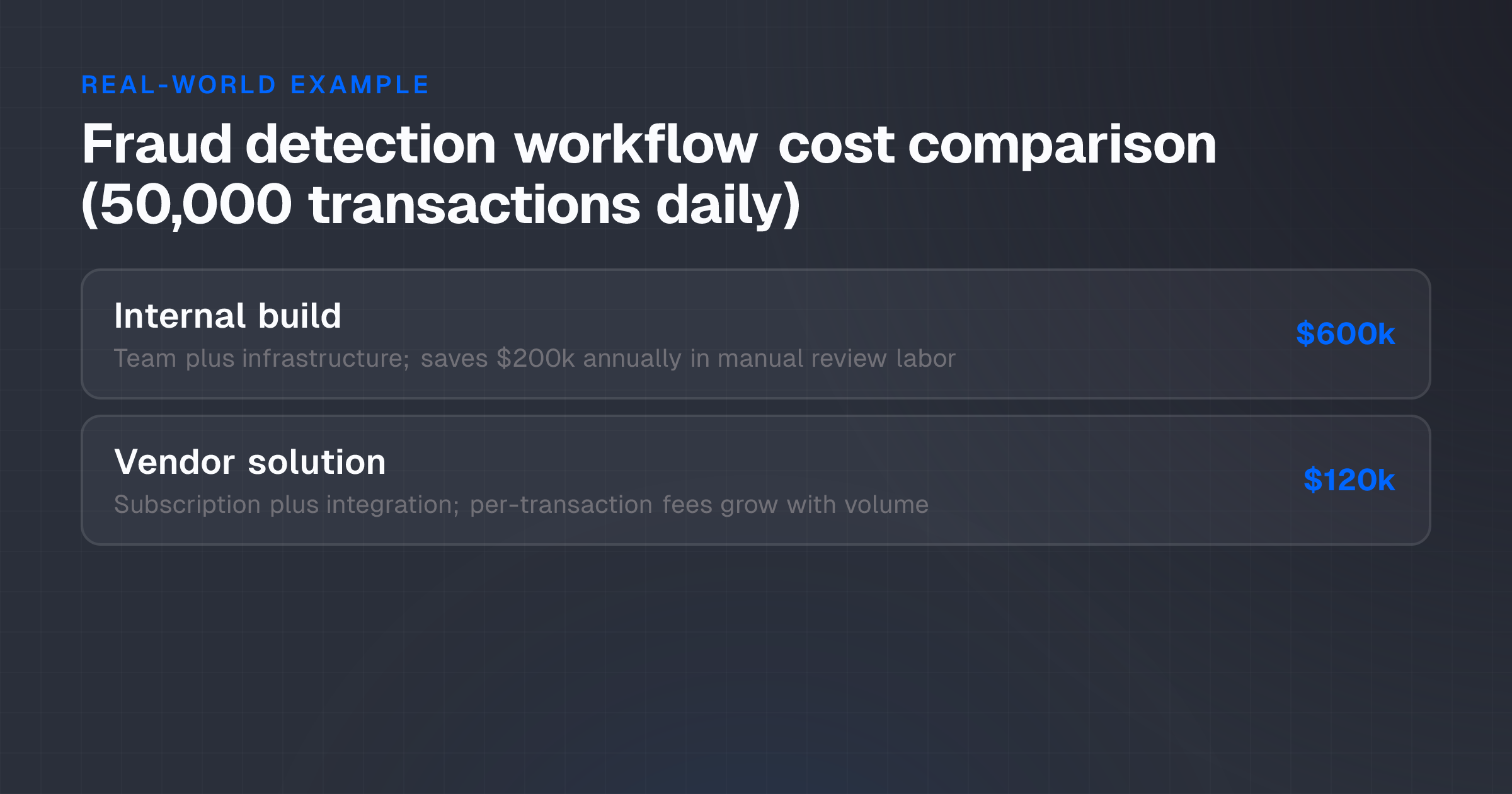
Real-world comparison: A fraud detection workflow processing 50,000 transactions daily:
Internal build: $600k Year 1 (team plus infrastructure), $400k Year 2-3; saves $200k annually in manual review labor. Breakeven within 2-3 years.
Vendor solution: $120k Year 1 (subscription plus integration), $180k Year 2-3 as volume grows (higher per-transaction fees); saves $200k annually in labor. Breakeven within 6-12 months, but cumulative cost reaches $600k-plus by Year 3.
Choose internal if you plan to scale the workflow significantly and retain proprietary advantage. Choose vendor if cost predictability and speed matter more than long-term cost or control.
Implementation and integration risks
Internal development risks:
Data quality risk: AI models depend on clean, representative training data. Poor data governance leads to biased, inaccurate, or non-compliant models. Mitigation: establish rigorous data audits and labeling standards before building.
Timeline slippage: Hiring delays, model performance plateaus, or unexpected integration challenges can extend deployment by 2-6 months. Mitigation: scope tightly; prototype with smaller datasets first.
Team attrition: Loss of a key data scientist or ML engineer can halt progress and orphan the project. Mitigation: document models and processes; cross-train team members.
Regulatory compliance risk: Custom models must meet explainability, bias testing, and audit requirements. Non-compliance can block deployment. Mitigation: involve compliance early; build interpretability and audit trails into the model.
Vendor partnership risks:
Integration complexity: Vendor APIs may not align with your system architecture; custom connectors, data transformations, or workarounds required. Mitigation: test integrations in sandbox before committing.
Vendor dependency: Vendor bankruptcy, feature discontinuation, or pricing increases leave you exposed. Mitigation: evaluate multi-year contract terms, data export guarantees, and exit strategies before signing.
Data security and privacy: Vendor processes your sensitive data off-premises; compliance breaches or data misuse are your liability. Mitigation: audit vendor security certifications (SOC 2, ISO 27001); require data processing agreements and audit rights.
Performance mismatch: Vendor model may underperform on your specific transaction patterns, customer base, or edge cases. Mitigation: require pilot phase with realistic data volume and SLA commitments.
When to verify before committing
If choosing internal development:
Confirm that your hiring timeline can deliver qualified data scientists and ML engineers within 2-3 months, or identify existing team capacity. Audit your data infrastructure: do you have clean, labeled historical data in sufficient volume (typically 10,000-100,000-plus examples for supervised learning)? Define measurable success criteria: reduction in processing time, fraud rate, manual review load, or error rate. Without specific targets, ROI is hard to prove. Establish a governance framework: who approves model changes? How are new versions tested? How is model performance monitored in production?
If choosing a vendor:
Request a pilot with your real data (subject to NDA) to test integration complexity and performance. Most vendors offer 30-60 day trials. Verify data handling: where is data stored? How long is it retained? What encryption and access controls are in place? Is data export possible if you terminate the contract?
Review contract terms: cancellation clauses, price escalation caps, SLA commitments, liability limits. Negotiate data portability and a reasonable exit window. Check references: ask the vendor for 2-3 customers in similar fintech verticals; ask about integration effort, ongoing support quality, and whether they remained customers beyond Year 2.
Confirm compliance status: does the vendor hold relevant certifications (SOC 2 Type II, ISO 27001, GDPR compliance)? Have they been audited by regulators in your jurisdiction?
Which option fits which situation
Choose internal development if:
The automation task is highly proprietary and tied to your competitive advantage (e.g., a custom risk model based on your unique customer data). You need to process sensitive data and require complete control over residency, encryption, and audit trails. Your organization has or can recruit qualified AI engineering talent within 2-3 months. You plan to iterate rapidly and evolve the model significantly over 3-plus years.
Total implementation costs are justified by projected annual savings or revenue uplift exceeding $300k. Regulatory requirements demand explainability, auditability, or algorithmic transparency that off-the-shelf solutions don't provide.
Choose an external vendor if:
The automation workflow is standardized and similar across many fintech operators (e.g., basic KYC/AML screening, account reconciliation, customer support ticketing). Deployment speed is critical: you need the workflow live within 60-90 days. Your team lacks AI expertise and can't hire quickly. You prefer predictable monthly costs and reduced operational burden.
The workflow doesn't handle extremely sensitive proprietary data, or the vendor's security posture meets your compliance requirements. You want to pilot automation quickly before committing internal resources to build.
Hybrid approach:
A growing number of fintechs start with a vendor solution for speed and proof-of-concept, then transition to internal development once the workflow is mature, the business case is proven, and team capacity exists. This de-risks the decision: you learn whether automation works for your business before investing in hiring and infrastructure.
What to verify before deciding: The checklist
Before committing to either path, validate the following:
Automation scope is crisp. You can describe the input data, the decision or task the AI performs, and the measurable output. Vague goals ("improve efficiency") lead to failed projects.
Success metrics are defined. Reduction in processing time by X%, error rate below Y%, or cost savings of $Z annually. Without metrics, you can't measure ROI or know when to stop iterating.
Data quality is adequate. For internal builds, you have clean, labeled historical data. For vendor pilots, you have test data that mirrors your production volume and characteristics.
Team capacity or hiring is realistic. Internal builds require dedicated engineering time; confirm your team has capacity or hiring can deliver within your timeline.
Integration requirements are mapped. Identify the systems the AI solution must connect to, the APIs or data formats available, and any custom work required.
Compliance and security are non-negotiable. Confirm that internal or vendor data handling meets your regulatory obligations (GDPR, CCPA, fintech-specific rules in your jurisdiction).
Budget authority is secured. Whether internal or vendor, confirm stakeholders have approved the cost and the timeline.
Vendor, if chosen, is assessed on more than price. Evaluate security certifications, support SLAs, contract terms, and customer references.
Next step
Start with the automation need: define the specific workflow you want to automate, the input data, the decision or task, and the measurable outcome. Then work through the decision criteria above, scope, timeline, team capacity, and integration complexity, to narrow the choice.
For internal builds, consult AI Automation for Non-Technical Founders: A Practical Guide and Which Business Processes Should You Automate First? to validate whether the workflow is worth building internally.
For vendor evaluation, use Why Fintech Teams Reject AI Tools After Pilot Phase to understand common integration and adoption pitfalls, and How to Measure AI ROI in Fintech: A Practical P&L Framework to model the financial case for either decision.
Document your assumptions: the cost of your engineering team, the expected timeline, the compliance constraints, and the competitive value of the automation. Revisit these quarterly; market conditions, team capacity, or regulatory changes may shift the decision.