
Start with low-risk, high-repetition processes, automated reconciliation, data validation, sanction screening, before moving to complex, judgment-heavy workflows. Fintech operators should sequence AI rollouts by process risk and team capacity, not by promised revenue impact. Phasing prevents compliance, operations, and risk teams from being overwhelmed by automation they cannot monitor or explain to regulators.
The question is not whether AI can automate a task, but whether your team can safely measure, review, and govern it without breaking under volume. This article outlines the decision sequence for deploying AI in a way that keeps humans ahead of the machine.
Quick answer: Start with repetitive, measurable processes before expanding to higher-stakes decisions
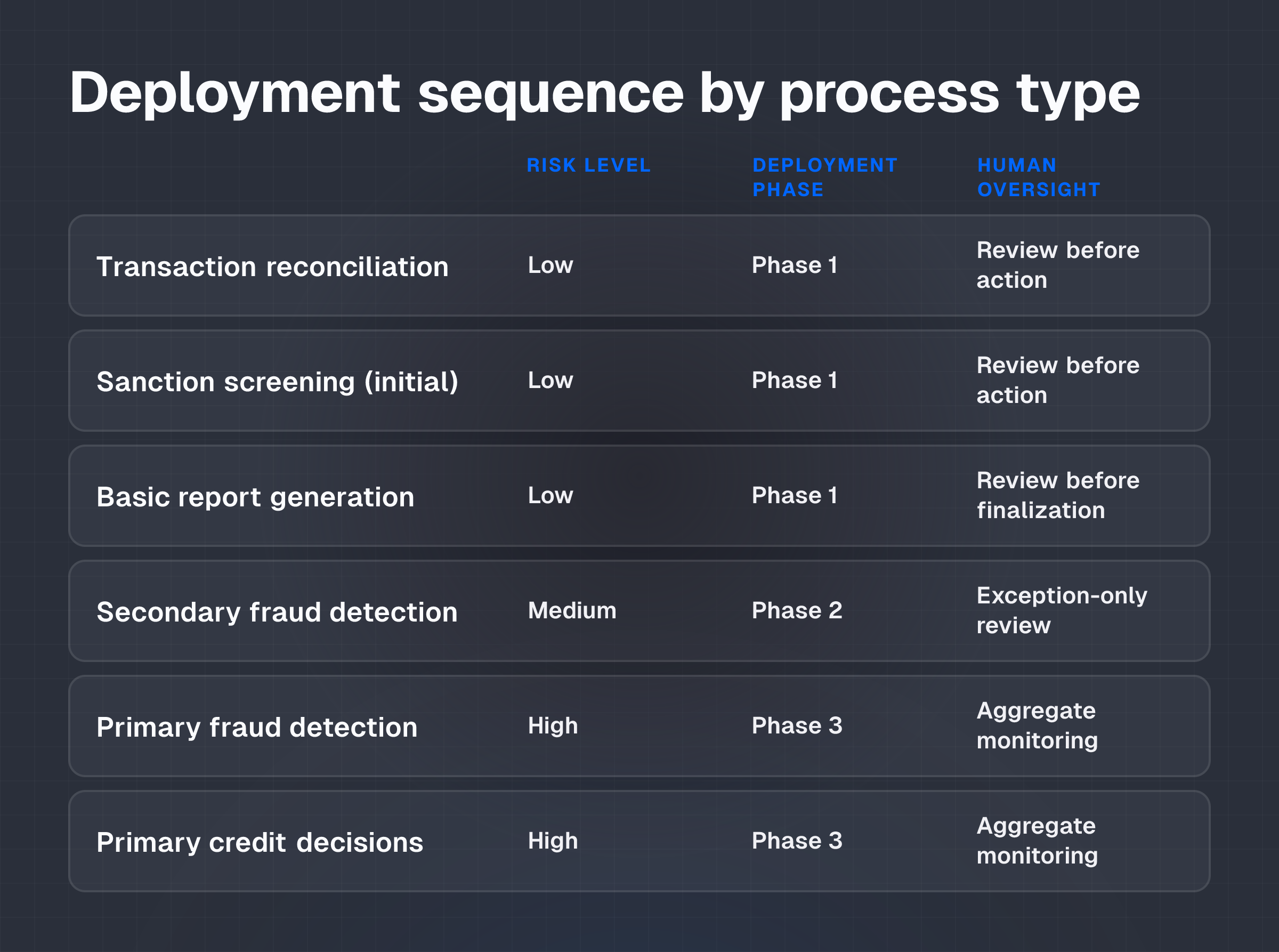
Deploy AI first to low-risk, high-repetition back-office tasks. Data entry. Transaction reconciliation. Basic report generation. Initial sanction screening.
These processes offer measurable efficiency gains, 20-30% in early-stage deployments, according to Accenture 2023 research, without overwhelming your compliance and risk teams. Only after establishing confidence in AI behavior and human oversight capabilities should you expand to more complex, higher-impact workflows.
The sequencing protects three things: your team's capacity to understand and govern the AI, your ability to explain decisions to regulators, and your organization's resilience if errors occur. Speed of implementation should follow speed of learning, not speed of promised ROI.
The business problem: Team capacity as the limiting factor in AI scale
Fintech operators typically fall into one of two traps. They either deploy AI broadly to chase revenue impact quickly, overwhelming compliance teams with monitoring tasks they weren't trained for. Or they move too slowly, missing efficiency gains because they over-engineer governance before understanding what they're governing.
The real constraint isn't technology availability.
It's the ability of your operations, compliance, and risk teams to understand AI behavior, detect errors, and justify outcomes to regulators, all while maintaining existing workflows. When AI is introduced to too many processes at once, these teams can't keep up. Errors go undetected. Audit trails become unclear. Regulatory exposure rises.
A lower transaction cost doesn't automatically mean a lower total operating cost. If deploying AI requires hiring additional compliance staff, extending review timelines, or paying for rework from model errors, the apparent efficiency gain disappears.
The useful sequence starts by identifying processes where errors are visible and recoverable, where human oversight is simple to integrate, and where the business has clear tolerance for a defined error rate. Once teams are confident in that environment, expansion to riskier areas becomes manageable.
Where AI helps and where it doesn't
AI is effective in fintech where processes are repetitive, high-volume, and have clear pass/fail or quantifiable outcomes. It's fragile where processes require unexplained judgment, have direct regulatory consequences, or operate on poor-quality data.
Where AI works well (early deployment candidates)
Transaction reconciliation and data entry validation. Accenture's 2023 research on AI in financial services found that automating these tasks yielded average efficiency gains of 20-30% in the initial phase, with lower implementation risk. Errors are detectable and correctable. Human reviewers can easily spot when the AI makes a mistake.
Initial sanction screening of new accounts or transactions. AI can flag names against sanction lists as a first pass, with human analysts reserved for edge cases and exceptions. The outcome is binary, flagged or not, measurable, and doesn't require the AI to make a final decision.
Basic report generation and compliance documentation. If historical data is clean and templates are standardized, AI can produce drafts that humans review before finalization. This preserves human authority while removing repetitive work.
Processes with well-defined KPIs and readily available historical training data. Deloitte's 2022 research on AI in financial services noted that processes with these characteristics show faster time-to-value for AI deployments. Secondary fraud detection (supporting human investigators, not replacing them) and credit scoring for simple, low-value products fit this category.
Where AI struggles or shouldn't go first
Primary fraud detection or primary credit decisions. These carry direct client impact and high reputational risk. If the AI is wrong, the damage is immediate and visible. Regulatory scrutiny is severe. These belong in later phases, once teams have built confidence elsewhere and governance is mature.
Processes involving poor or inconsistent data. AI systems are only as good as the data they're trained on. If historical data is messy, incomplete, or biased, the model will generate unreliable results. This forces extensive manual intervention, frustrating teams and negating efficiency gains.
Workflows where the AI's decision can't be explained or audited. If compliance and risk teams can't articulate why the AI made a decision, they can't explain it to regulators. Complex, opaque models create regulatory vulnerability. Early deployments should favor interpretable models and human-in-the-loop designs.
Processes where the business has no established error tolerance. If a single mistake would cause a compliance violation or client harm, the process is too risky for early AI adoption. Move it to later phases after you've proven your governance model works.
Implementation model: Human-in-the-loop deployment first, autonomous decisions later
The most effective initial deployment model integrates human oversight into every AI decision, rather than replacing human judgment entirely. IBM's 2021 white paper on responsible AI adoption in finance highlighted the "human-in-the-loop" approach as critical for early-stage deployments. This design reduces burden on compliance teams by providing clear audit trails and review opportunities before decisions are finalized.
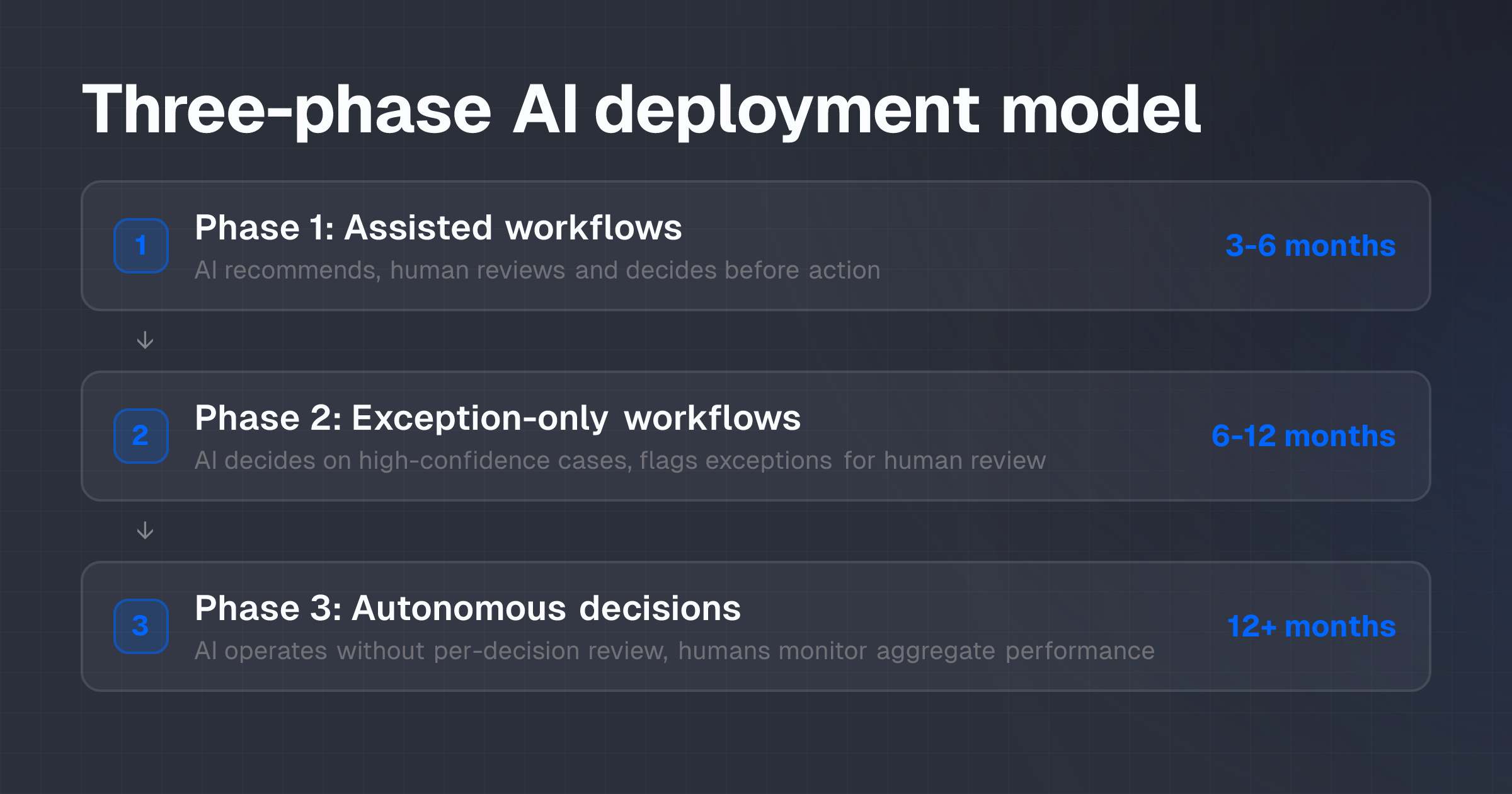
Phase 1: Assisted workflows (human review before action)
The AI processes data and recommends a decision, approve, flag, reject. A human reviewer sees the recommendation, reviews the underlying data, and makes the final decision. The AI learns from feedback over time.
This phase typically lasts 3-6 months, depending on process volume.
Examples: AI flags a transaction as potentially sanctioned; a compliance analyst reviews the flag and approves or rejects the transaction. AI validates customer data against internal records; an operations associate reviews exceptions and corrects errors. AI generates a compliance report; a manager reviews and signs off before distribution.
Phase 2: Exception-only workflows (human review after action)
The AI makes decisions automatically on high-confidence cases and flags exceptions for human review. Over time, as confidence in the model grows and its error rate remains low, the threshold for automatic decisions can rise.
Examples: AI automatically approves transactions above a confidence threshold, say, 98%+. Anything below that threshold is flagged for manual review. AI automatically validates routine customer documents and flags discrepancies for an analyst to investigate. AI generates standard reports automatically and notifies teams only if anomalies are detected.
Phase 3: Autonomous decisions (human governance, not human review)
Once the AI has proven stable performance over time and governance is mature, the model can operate without per-decision human review. Human oversight shifts from approving individual decisions to monitoring aggregate model performance, retraining on new data, and detecting drift.
This phase requires a clear audit trail for every decision the AI makes, searchable and exportable for regulatory review. Defined performance thresholds and automated alerts if the model breaches them. Regular retraining schedules and version control for model updates. A process for rolling back the model if performance degrades.
Most fintech operations shouldn't move to Phase 3 until at least 6-12 months of stable Phase 2 operation is documented.
Controls, governance and human review: Building the oversight framework
Governance isn't a document. It's a system of checks, thresholds, and human decision points that keep AI behavior visible and controllable.
Minimum controls for early-stage deployments
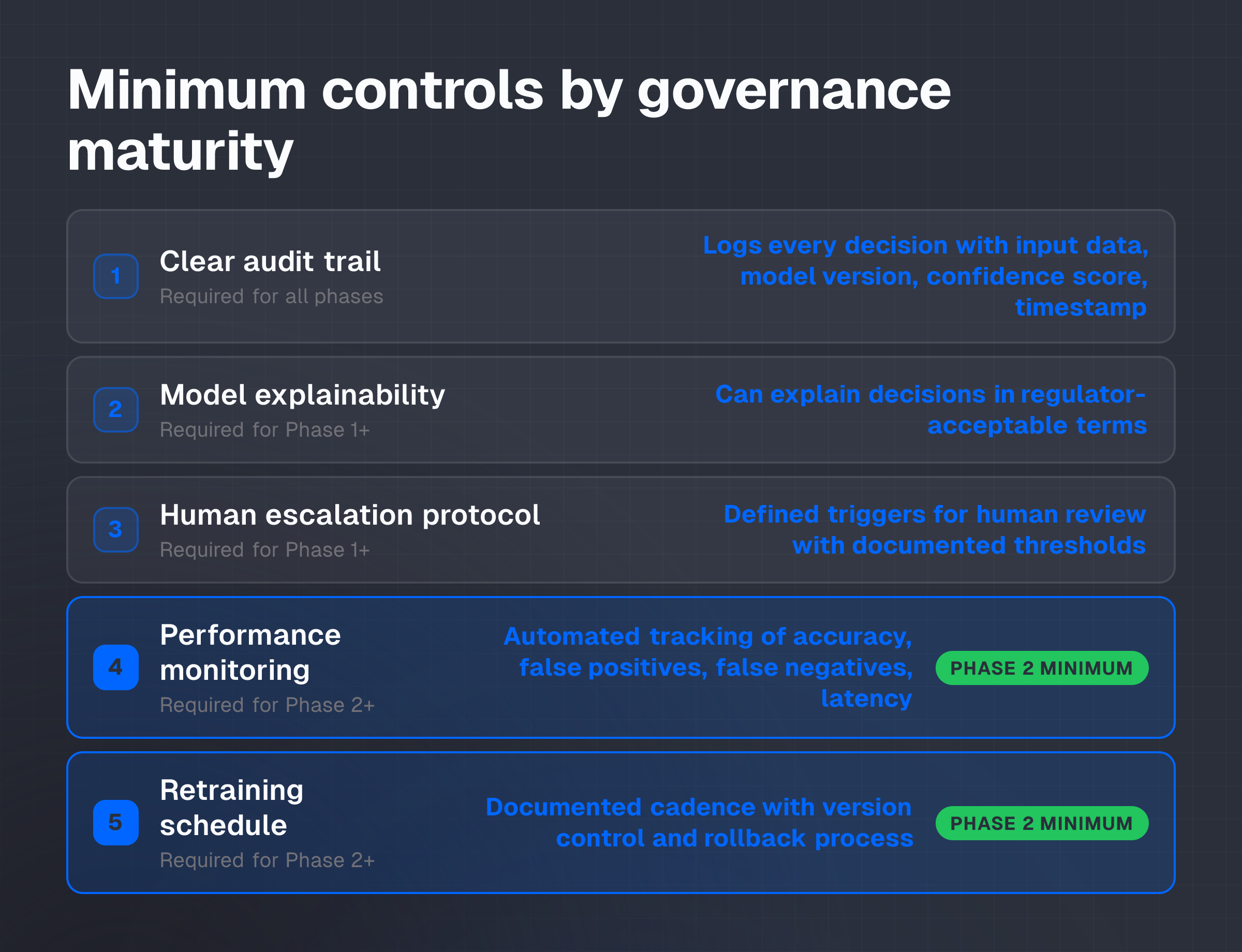
Clear audit trail. Every decision the AI makes, including the input data, the model version, the confidence score, and the timestamp, must be logged in a way that a regulator can review years later. If the AI can't tell you why it made a decision, compliance can't defend it.
Model explainability. Operators should understand how the AI reaches its conclusions. This doesn't require perfect transparency into every mathematical parameter, but it requires the ability to explain the decision in terms a regulator or auditor would accept. Avoid opaque black-box models in early phases.
Human escalation protocol. Define what triggers human review. A data point outside normal ranges? A confidence score below a threshold? A flagged exception category? The protocol should be simple enough that operators can explain it and consistent enough that regulators can verify it.
Performance monitoring. Track accuracy, false positive rates, false negative rates, and decision latency over time. If the AI's accuracy drops below a defined threshold, a human should be alerted to investigate. If latency increases, the AI is taking longer to decide, that may signal data quality issues or model drift.
Retraining schedule. Define how often the AI model will be retrained on new data. If the financial environment or regulatory rules change, the model may become outdated. Establish a cadence, monthly, quarterly, annually, and document when retraining happens and why.
Governance maturity levels
Immature governance (high risk): No documented audit trails. No performance thresholds. No clear escalation protocol. No retraining schedule. This is the state before AI deployment. Don't proceed to deployment until you move beyond this.
Developing governance (acceptable for Phase 1): Audit trails exist but may not be complete. Performance thresholds are defined but not automated. Escalation protocols exist and are followed manually. Retraining is ad-hoc based on observed issues.
Mature governance (required for Phase 2 and beyond): Audit trails are complete, centralized, and searchable. Performance thresholds are automated with alerts. Escalation protocols are documented and enforced. Retraining is scheduled and versioned. Regulatory requests for model documentation can be fulfilled within days.
PwC's 2023 report on AI in banking emphasized that successful scaling of AI in critical areas like advanced fraud detection or personalized financial advice relies heavily on mature governance, including clear ethical guidelines, data privacy protocols, and continuous model monitoring. Without these, compliance teams face exponential increases in oversight challenges.
Cost and measurement framework: What to track before and after deployment
Before deploying AI, establish a baseline for the current state: how long processes take, how many errors occur, how many manual review hours are required, and what the labor cost is. After deployment, measure the same metrics to understand whether the AI is actually saving time or money.
Baseline metrics (measure before AI deployment)
Process cycle time: How long does it take to complete one instance of the process? If it's reconciling 1,000 transactions, how many hours does it take? What's the cost per transaction?
Error rate: What percentage of decisions or data entries are incorrect and require rework? What does rework cost?
Manual review hours: How many hours per week does the team spend reviewing, checking, or correcting the process?
Compliance exceptions: How many exceptions, complaints, or regulatory issues arise from the current process? What's the cost of resolution?
Post-deployment metrics (measure after AI is live)
AI decision rate: What percentage of decisions does the AI make without human review, or with review only after the fact?
AI accuracy: On the decisions humans do review, what percentage of AI recommendations are correct? What percentage require correction or reversal?
Cycle time improvement: Has the time to complete the process decreased? By how much?
Labor cost reduction: Have manual review hours decreased? By how much? This isn't the same as cycle time; a faster process may still require the same number of reviews.
Rework and exceptions: Have errors decreased, or have they shifted to new areas?
Regulatory or compliance issues: Have AI-related errors created new compliance exceptions or regulatory flags?
The cost reality
Deploying AI typically involves upfront costs: data engineering, model training, integration, staff training, and governance setup. These costs may not be recouped for 6-18 months, depending on process volume and labor costs.
A financial services firm automating a high-volume, low-complexity process, invoice reconciliation, for example, might see ROI within 6-9 months. A firm deploying AI to a low-volume, high-complexity process like complex underwriting might take 12-24 months or longer.
The article "AI Deployment Costs: What 40+ Fintech Rollouts Actually Cost" provides specific payback periods and deployment costs observed across fintech operations, helping operators budget realistic timelines.
Chasing revenue impact first
Operators often assume that deploying AI to customer-facing, revenue-generating processes will yield the fastest payback. In reality, these processes are the riskiest and most resource-intensive to govern. A mistake in personalized lending advice or fraud detection can trigger regulatory fines or client lawsuits. The compliance team suddenly faces exponential review volume, conflicts arise, and the rollout stalls.
Efficiency gains in back-office processes are less glamorous but far easier to implement, measure, and defend. Once the team has proven they can govern AI reliably in a low-risk environment, moving to higher-stakes areas becomes feasible.
Neglecting staff training and change management
Operators often assume that deploying AI requires only technical integration. In reality, the team using the AI, operations, compliance, analysts, must understand how it works, when to trust it, when to escalate, and how to explain it to others. If staff aren't trained or involved in the rollout, they'll resist it, work around it, or cause it to fail through misuse.
Effective rollouts budget 20-30% of implementation time for training, documentation, and team feedback loops.
Underestimating data quality requirements
AI systems are only as good as the data they're trained on. If historical data is incomplete, biased, or inconsistent, the model will produce unreliable results. This forces extensive manual intervention, undermining the efficiency case.
Before deploying AI, audit the quality of the data the model will use. If data quality is poor, spend time cleaning and standardizing it first. This is unglamorous but necessary work.
Deploying too many initiatives at once
If a compliance or operations team is managing five AI projects simultaneously, none of them will receive adequate attention. Errors in one project distract from another. Training falls behind. Governance gaps widen.
A lean team should typically manage 1-2 AI initiatives concurrently. Once those are stable, 6+ months of Phase 2 operation documented, the team can take on the next initiative.
Using opaque or unexplainable models
If the AI can't articulate why it made a decision, compliance can't defend it to regulators. Complex neural networks or ensemble models may be accurate, but they're often unexplainable. Early deployments should favor simpler, interpretable models: decision trees, logistic regression, or rule-based systems. Once teams are confident in the governance model, they can graduate to more complex models if accuracy gains justify it.
Ignoring regulatory requirements
AI deployment in fintech is subject to existing regulations on fair lending, anti-discrimination, data privacy, and market manipulation. Deploying AI without understanding the regulatory implications of the process being automated can create compliance violations.
Involve compliance and legal teams before deployment, not after.
Implementation checklist: Steps before and during rollout
Use this checklist to ensure your team is ready to deploy AI safely and measure its impact.
Pre-deployment (4-8 weeks before go-live)
- Identify the process. Document the current workflow, inputs, outputs, decision points, and error points. Why is this process a good candidate for AI? What efficiency or risk problem does it solve?
- Audit data quality. Examine the historical data the model will train on. Is it complete? Are there systematic gaps or biases? Would cleaning or augmenting the data improve model performance? Budget time for data engineering if needed.
- Define success metrics. Establish baseline measurements: cycle time, error rate, labor cost, compliance exceptions. Agree on thresholds for acceptable AI performance, 95%+ accuracy, <2% false positive rate, for example. How will success be measured post-deployment?
- Design the human-in-the-loop workflow. Which decisions will the AI make, and which will humans make? At what confidence threshold does the AI escalate to human review? Who is responsible for that review, and how much time is it expected to take?
- Document the audit trail. Specify what data will be logged for every AI decision: inputs, model version, confidence score, timestamp, human action if any, and outcome. How will audit logs be stored, accessed, and retained?
- Establish governance controls. Define performance thresholds, accuracy, latency, false positive/negative rates, escalation protocols, monitoring dashboards, and retraining schedules. Who monitors the AI? How are alerts handled?
- Train the team. Conduct training sessions with operations, compliance, and risk staff on how the AI works, when to trust it, what to escalate, and how to explain it. Provide written documentation and a clear escalation contact.
- Conduct a pilot. Deploy the AI to a small subset of the process, 5-10% volume, for 2-4 weeks. Monitor performance, gather feedback, and refine the model and workflow before full deployment.
Deployment week
- Brief leadership. Ensure senior management understands what the AI will do, the expected timeline to ROI, the risks, and the governance in place. Clarity prevents panic if issues arise.
- Go live. Deploy the AI to the full process, or in phases if volume is very high. Monitor performance closely during the first week.
- Establish daily check-ins. For the first 2-4 weeks, hold daily stand-ups with operations, compliance, and the AI team to surface issues, resolve conflicts, and adjust workflows if needed.
- Log everything. Ensure audit trails are complete and accessible. If an error occurs, you should be able to trace it to the specific input, model decision, and human action.
Post-deployment (ongoing)
- Weekly performance reviews. Track accuracy, false positive/negative rates, cycle time, and labor cost. Compare to baseline. Are thresholds being met?
- Monthly governance review. Audit a sample of AI decisions and human reviews for consistency and correctness. Are escalation protocols being followed? Are there gaps in governance?
- Quarterly retraining. As new data accumulates, retrain the model and evaluate whether performance has improved or degraded. Update the model version and document the change.
- Regulatory readiness. Ensure audit trails, model documentation, and performance metrics can be produced for regulatory review on demand. Test your ability to respond to a regulator's data request in one business day.
If you're looking to track and manage deployment across multiple business systems, the 8WTC App can help organize workflows and compliance documentation as part of a broader operational stack.
Next step: Start with one process, measure rigorously, then expand
The most common mistake is deploying AI to multiple processes at once in search of quick ROI. This overwhelms teams and creates governance gaps.
Instead, identify one low-risk, high-repetition process, deploy AI with clear human oversight, measure the outcome rigorously, and document what you learn. Only then move to the next process.
The sequence isn't determined by promised efficiency gains. It's determined by the ability of your team to understand, monitor, and explain the AI. Once that capability is proven, expansion becomes feasible. Once that capability is lacking, rollout will stall.