
As a solo founder, you operate under constant tension: every hour spent on repetitive tasks, compliance work, or specialized technical problems is an hour you cannot spend on strategy, fundraising, or product vision. The critical inflection point arrives when staying lean becomes costlier than hiring, when a skill gap or operational bottleneck directly threatens revenue, growth rate, or your ability to execute on a strategic opportunity. This decision framework helps you assess whether your business has reached that threshold, what role to fill first, and what financial and operational conditions must be true before you make the hire.
This article draws on the brand's published materials and verified public sources. Data was last verified on 26 October 2026.
Quick answer: When to transition from solo to first hire
You're ready to hire your first operator when one of these conditions holds: a specific task or skill gap consumes more than a proportional share of your time and is repeatable or delegable; you can articulate a measurable business outcome the hire will unlock (revenue, cost savings, or risk mitigation); and your unit economics support the fully-loaded cost of that hire for 6-12 months without materially increasing burn rate or jeopardizing runway. If none of these conditions are present, staying solo remains the lower-risk option.
Who this decision is for
This decision applies to solo founders and founder-operators in fintech, trading, or payments-related businesses who are evaluating their first significant hire.
You're likely profitable or near break-even. You generate recurring revenue or have a clear unit economics model. You face either a capacity constraint that's slowing growth or a technical skill gap that prevents execution on a critical strategic initiative. You may have considered this hire before but lack a structured way to evaluate it.
This framework isn't for founders in very early pre-revenue or pre-product stages; those situations typically call for co-founder partnerships or strategic advisors rather than employees.
The decision criteria
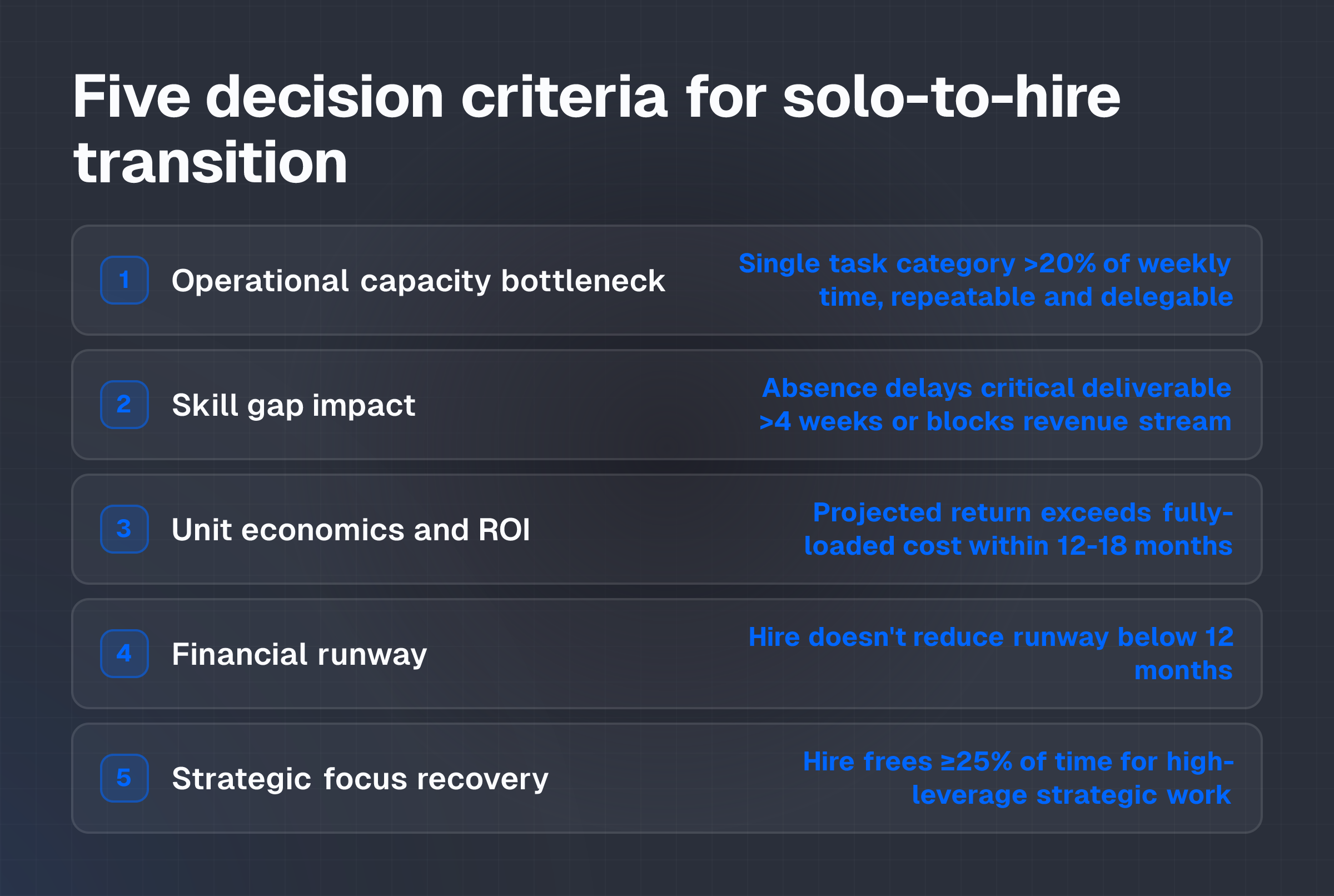
Evaluate the solo-to-hire decision against five measurable criteria:
Operational capacity and bottleneck severity
Identify tasks that consume a disproportionate amount of your time and meet at least one of these conditions: they recur weekly or more frequently; they don't require your specific judgment or strategic input; or they prevent you from working on revenue-generating or risk-critical activities.
Examples include repetitive customer support inquiries, data entry, routine compliance reporting, or deployment and infrastructure tasks.
The threshold: when a single category of task accounts for more than 20% of your operational week and can't be automated or eliminated, and when that task directly supports a measurable business function (customer retention, product updates, regulatory compliance).
Skill gap impact on growth or risk mitigation
Assess whether your business is hindered by a capability you don't possess. Examples include advanced technical development (full-stack AI-enabled features, as indicated by hiring signals in fintech), regulated compliance expertise, or specialized sales or partnership development.
The threshold: when the absence of that skill delays a critical deliverable by more than 4 weeks, blocks entry to a new market or revenue stream, or increases compliance or operational risk above acceptable levels.
Unit economics and ROI feasibility
Calculate the fully-loaded annual cost of a new hire (base salary, benefits, employment taxes, workspace, tools, overhead allocation). Then project the quantifiable return: revenue the hire will enable (e.g., volume of new customers or accounts managed), cost savings from automation or process improvement, or risk avoided through specialist expertise.
The threshold: when the projected return exceeds the hire's cost within 12-18 months, or when the hire directly unlocks external funding that justifies the expense.
Financial runway and burn impact
Determine your current monthly burn rate and remaining runway.
Model the cash impact of the new hire's fully-loaded cost. The threshold: the hire doesn't reduce runway below 12 months, or the hire's presence allows you to raise funding that extends runway materially.
Strategic focus recovery
Assess how much time you currently spend on non-core, non-strategic tasks versus high-leverage activities (fundraising, partnerships, product direction, customer acquisition strategy).
The threshold: when a hire would free at least 25% of your time for strategic work, and that time directly supports a major growth or fundraising initiative.
Options and trade-offs
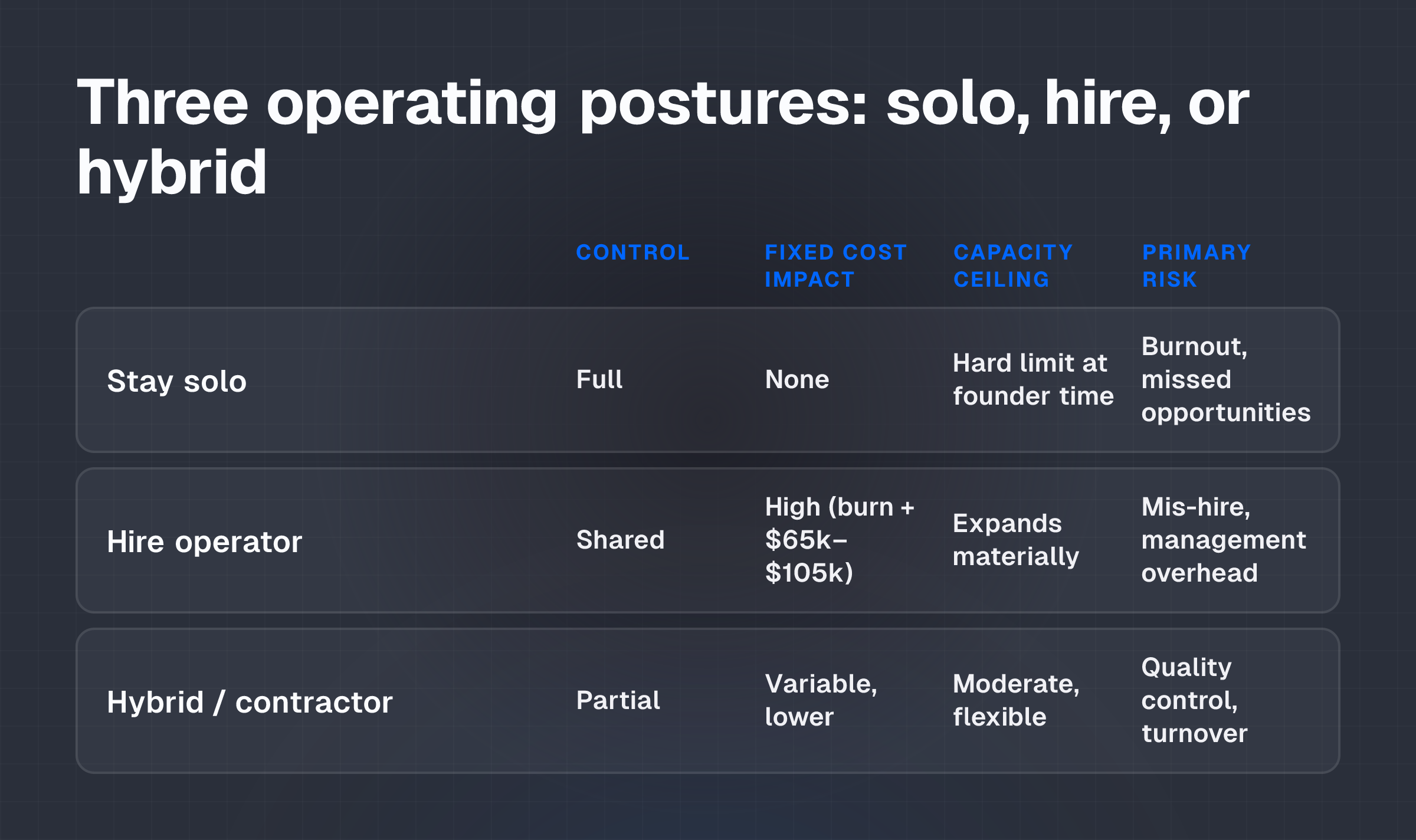
You have three main operating postures: stay solo and optimize processes; hire an operator and delegate execution; or pursue a hybrid model (part-time hire, contractor, or AI automation). Each carries distinct trade-offs.
Option 1: Stay solo, optimize processes
What it means: Tighten routines, automate repeatable tasks where possible, and continue operating as a solo founder. Eliminate lower-priority work to create capacity.
Trade-offs:
- Advantage: Preserve full control, avoid hiring and management overhead, keep burn rate constant, and retain all decision-making authority.
- Disadvantage: Capacity ceiling limits growth; strategic focus remains fragmented; founder burnout risk increases over time; skill gaps remain unaddressed; market opportunities may pass while you handle operational minutiae.
When this works: Early-stage, pre-revenue or low-revenue businesses with simple operations; when the identified skill gap isn't critical to near-term growth; when runway is tight and funding isn't imminent.
Risk: Delaying a necessary hire too long can exhaust the founder, degrade product or customer experience, and cause you to miss a market inflection point that competitors with team capacity do capture.
Option 2: Hire an operator
What it means: Bring on a first employee, typically a generalist operator, a specialist technician, or an operations lead, to handle specific repeatable tasks or to fill a critical skill gap.
Trade-offs:
- Advantage: Unlock capacity beyond yourself; address skill gaps directly; enable focus on strategy; signal growth and capability to customers and investors; create accountability and structure beyond founder.
- Disadvantage: Increase fixed cost and burn rate; management overhead; risk of mis-hiring; loss of control over execution; hiring and onboarding take time and attention.
When this works: When you have validated unit economics, when a specific role and measurable outcome are clear, when runway supports 12+ months of the hire's cost, and when the hire directly enables a growth opportunity or risk mitigation.
Risk: Hiring too early (before you have money or defined role outcomes) wastes capital and creates cultural misalignment; hiring the wrong person can amplify inefficiency.
Option 3: Hybrid, contractor, part-time, or automation
What it means: Outsource specific tasks to a contractor or part-time hire; implement workflow automation (AI, no-code tools, scripting); or use a combination.
Trade-offs:
- Advantage: Lower fixed cost; flexibility; no management overhead; can terminate if not working; preserve lean culture.
- Disadvantage: Contractors lack long-term commitment and institutional knowledge; part-time hires may not provide enough capacity; automation requires upfront investment and may not cover all repeatable work; quality control can be harder; you still retain some operational load.
When this works: When the bottleneck is narrow and time-bound (e.g., 3-6 months of extra help during a product launch); when the skill gap can be addressed by a specialist on a project basis; when you want to test a repeatable task before hiring full-time.
Risk: Relying too heavily on contractors can leave you vulnerable if they leave; automating incorrectly can create new problems; the hybrid approach can become costlier than a full-time hire if you string together multiple part-time resources.
Fully-loaded cost of a first operator
A first hire is almost always more expensive than you initially model.
Beyond base salary, include:
- Employment taxes and statutory contributions (typically 15-25% of salary depending on jurisdiction)
- Benefits (health, pension, paid leave, training budget)
- Workspace, equipment, and tools
- Management time and onboarding (assume 20-30 hours founder time in first month)
- Overhead allocation (portion of accounting, legal, infrastructure costs)
Example: A full-time operator at a $50,000 annual base salary in a standard fintech market typically costs $65,000-$75,000 fully loaded. A $70,000 salary-grade hire costs $90,000-$105,000 total.
This article doesn't cover exact tax or employment law; consult local employment regulations and a payroll professional for your jurisdiction.
Timing risk: hiring too early vs. too late
Hiring too early (insufficient revenue or runway):
- You burn cash faster than business can sustain.
- Hiring becomes a forced expense rather than an enabler.
- The hire may be underutilized or a poor fit, wasting capital.
- Negative psychology: early failure erodes founder confidence and team morale.
Hiring too late (past the inflection point):
- Founder burnout, decision fatigue, and quality degradation.
- Missed market opportunities; competitors with team capacity move faster.
- Customer experience declines; support and product suffers.
- Compounded: hiring under crisis conditions often produces mis-hires.
- Institutional knowledge remains concentrated in founder, creating fragility.
The inflection window is typically 3-6 months wide: you can identify it through measurable growth rate, revenue velocity, and capacity utilization, but the longer you delay past that window, the costlier the catch-up hire becomes.
Implementation: from decision to day one
Define the role with precision. Write a clear role description, key responsibilities, and measurable outcomes. Example from fintech: "Full-Stack JavaScript Developer / WordPress Developer, AI Centric Opportunity" signals technical development capability, platform expertise, and AI integration, three specific gaps.
Recruit and hire (4-8 weeks typically). Allow time for sourcing, screening, interviews, reference checks, and offer negotiation.
Onboard and integrate (4-12 weeks). Budget founder time for training, feedback, and cultural integration. Don't expect full productivity in week one.
Monitor and adjust (first 90 days). Track whether the hire is closing the gap you identified. Set clear performance milestones. Be prepared to act quickly if fit is poor.
Cultural and organizational risk
Early hires heavily shape company culture.
A poor fit or misalignment on values or work style can undermine team morale and future hiring. This is where role clarity, reference checks, and values alignment in interviews matter most. Reference Entrepreneurship: Your To-Do List When Choosing the Right Team for a structured approach to team-building decisions.
Scenario 1: You're profitable or close to break-even, with clear unit economics
Situation: Monthly revenue is >$20,000; you can model the revenue per customer or per transaction; runway exceeds 18 months.
Best fit: Hire an operator or specialist.
Reasoning: You have financial stability to absorb the hire's cost. Unit economics let you forecast ROI. The hire can be structured around a specific outcome and measured against it.
Implementation note: Prioritize hiring for the function that directly generates or protects revenue (sales, customer success, technical delivery, or compliance risk).
Scenario 2: You've identified a specific, recurring bottleneck
Situation: A task or skill gap consumes 15-30% of your time weekly; it's repeatable and not strategic; you can articulate what success looks like if someone else handles it.
Best fit: Hire or contract for that specific function.
Reasoning: Clarity on the problem makes hiring efficient. You're not hiring for "general help" but for a measurable outcome.
Implementation note: Start with a contractor or part-time hire to test the role, then convert to full-time if the fit is right and runway supports it.
Scenario 3: You're not yet profitable but have a clear growth opportunity
Situation: Revenue is early-stage (<$10,000/month); runway is 12-18 months; a specific hire would unlock a material opportunity (e.g., technical capability to launch a critical feature, sales expertise to land a major customer, compliance expertise to enter a new market).
Best fit: Hire only if the hire directly enables fundraising or a revenue inflection.
Reasoning: You can't afford the hire on current cash; the hire must justify itself by enabling growth or investor confidence.
Implementation note: Negotiate a salary and terms that reflect this constraint (e.g., lower base, performance bonus, or sweat equity). Be explicit about this with candidates; transparency attracts founders and risk-takers aligned with your stage.
Scenario 4: You have high founder capacity but a critical skill gap
Situation: You're not overworked, but you lack a specific expertise (advanced AI, regulated compliance, payments infrastructure) necessary to move forward; external funding or a strategic partnership depends on demonstrating that expertise in-house.
Best fit: Hire the specialist.
Reasoning: The hire isn't about capacity; it's about credibility and execution capability. This is often a founder's first non-operator hire, a senior specialist, not a generalist.
Implementation note: Consider a fractional or advisory role first if full-time capacity isn't immediately needed. Reference Choose a Business Mentor: A Founder's Decision Framework for a related framework on advising and supporting roles.
Scenario 5: You're past inflection but haven't yet hired
Situation: Revenue is growing >50% month-over-month; founder is working 60+ hour weeks; customer feedback is starting to flag service quality; competitors are moving faster.
Best fit: Hire immediately, and prioritize speed over perfection in role definition.
Reasoning: You've passed the inflection point. Delaying further increases burnout and opportunity risk. Speed matters more than finding the "perfect" hire.
Implementation note: Hire for immediate pain (customer support, product updates, operations) and plan a second hire within 3-6 months. Expect higher than normal mis-hire risk due to speed; mitigate with short probation periods and clear success metrics.
What to verify before deciding
Before committing to hire, check these conditions:
Runway still covers 12+ months of operations after the hire. Model the full-time hire's cost and confirm your cash horizon. If runway drops below 12 months, raising funding is now a prerequisite to hiring.
The role is specific, not vague. Write a one-page role description that answers: What are the top 3 measurable outcomes this role will deliver? How will you know in 90 days if this hire is working? What tasks move off your plate? If you can't answer these clearly, the hire is premature.
You have a sourcing and hiring process ready. Don't hire in crisis mode. Have a recruitment channel (agency, network, job board) and a vetting process (screening questions, technical or skills assessment, reference checks, cultural fit interview). A hasty hire is often a costly one.
Unit economics support the hire's ROI. If revenue per customer is $100 and the hire costs $1,000/month fully loaded, the hire must either enable 10+ new customers per month or unlock a cost saving or risk mitigation equivalent to that. If you can't draw that connection, the hire is speculative.
You can articulate the hire's first 90-day priorities. Before you hire, have a 90-day roadmap for the role. This protects you and the candidate from misalignment and sets early momentum.
You have time and mental space to manage. Hiring and onboarding take founder time. If you're already at capacity, adding a direct report will initially increase your workload before it decreases it. Budget for this. Reference Founder Decision-Making: What to Keep and Delegate for a framework on delegation readiness.
You've checked reference and cultural fit rigorously. The first hire shapes culture more than hire #10. Invest in reference checks and a structured interview process that assesses values alignment, not just skills. One mis-hire at this stage can set a poor precedent.
Next step
If you've confirmed all seven conditions above, move to recruiting and hiring.
If you haven't, identify which condition is the blocker and address it. Common blockers are:
- Runway is tight: Revisit fundraising options or defer the hire 3-6 months.
- Role is still vague: Spend a week shadowing the bottleneck tasks and writing a precise role description.
- Unit economics are unclear: Model your revenue, cost per customer, and hire's cost; if they don't connect, the timing is wrong.
- You can't articulate 90-day priorities: This often means you need a co-founder or advisor, not an employee. Consider Choose a Business Mentor: A Founder's Decision Framework as an alternative.
When all conditions are met, your hire will have clear outcomes, runway to prove themselves, and a founder who's ready to manage them. That's the foundation for a successful first operator and the start of scaling beyond solo.