
Founders searching for business mentors often need a systematic way to identify someone with real company-building experience. The challenge is matching three critical dimensions: your current operator stage (early-stage product, scaling, or established operations), the specific domain expertise your business needs right now, and the realistic time commitment both you and a potential mentor can sustain. Without a clear framework, founders risk investing time in relationships that produce generic advice or misaligned guidance.
This article provides a decision framework to evaluate potential mentors against these three criteria. It draws on the brand's published materials and verified public sources on business mentorship and operator experience.
Key finding: Founders need a systematic approach to mentor selection based on operator stage, domain expertise, and time commitment
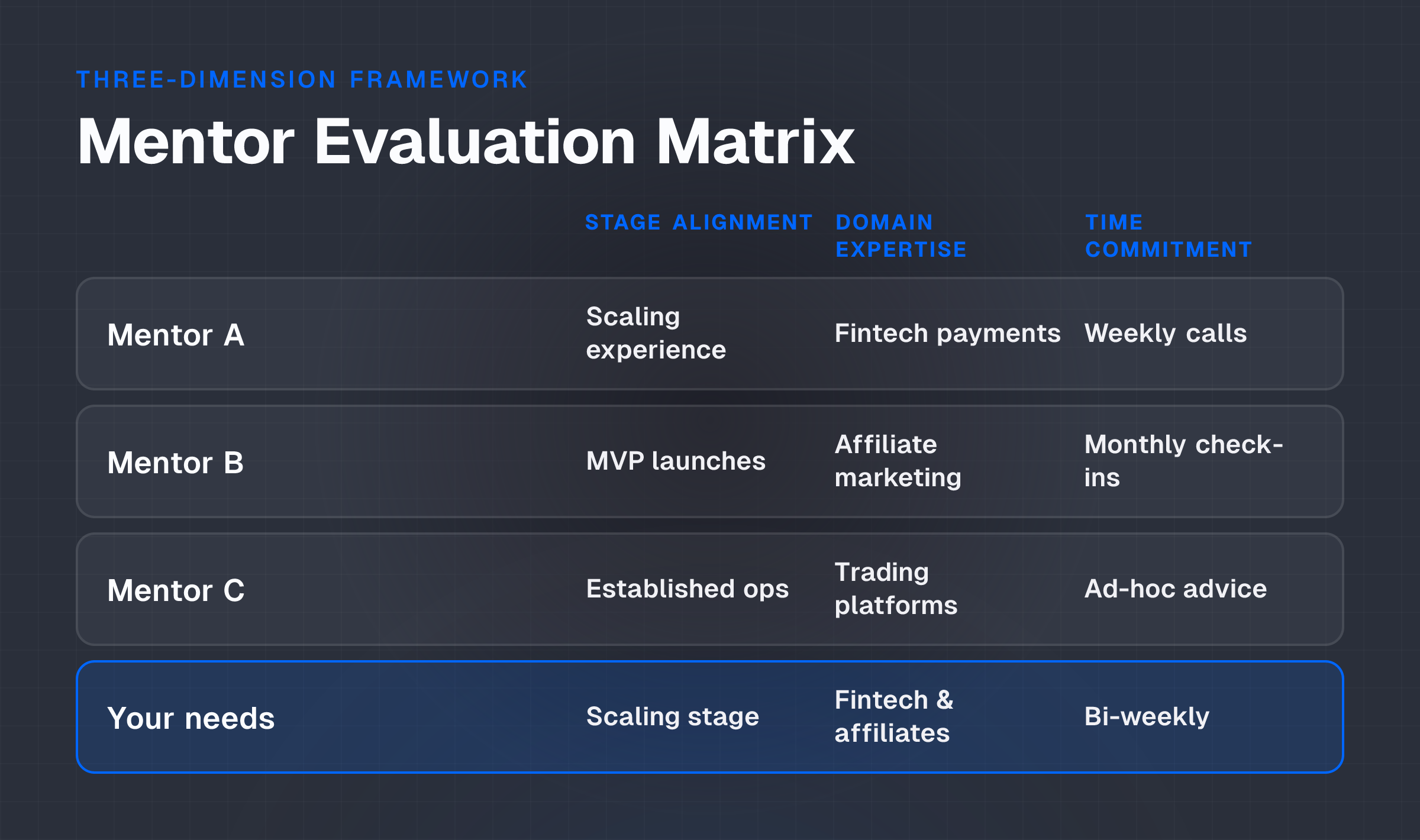
Random advice or generic best practices often miss the specific challenges of your current business phase.
A founder building an MVP faces fundamentally different problems than one scaling a proven product or managing an established operation. The same applies to domain expertise: fintech guidance differs from affiliate marketing guidance, which differs from trading terminal development. Without a clear framework to evaluate mentors against these three dimensions, founders risk investing time in relationships that produce misaligned or outdated counsel.
Why it matters
Mentorship shapes operating decisions.
An effective mentor accelerates your learning, provides perspective on problems you haven't yet encountered, and connects you to people and resources aligned with your goals. A poor fit wastes time and can reinforce limiting assumptions about your business.
The specificity of your mentor's experience directly affects the usefulness of their guidance. A founder scaling a fintech product needs different counsel than someone managing a mature trading platform or building an affiliate network. Equally, a mentor's proven track record in your exact domain, not just business broadly, determines whether their advice applies to your constraints and opportunities.
The stakes matter: misaligned mentorship can embed poor habits early, delay critical decisions, and cause you to miss market windows. The right mentor accelerates decision-making and helps you avoid costly mistakes specific to your business stage.
Data and methodology
This framework rests on two sources: the research brief provided by the editorial team, which outlines a decision process for mentor selection; and the verified public materials from Owen Morton's portfolio companies and operating history.
The framework is not derived from a survey, a statistical study, or randomized comparison. Instead, it reflects a transparent process for evaluating mentor fit based on three operator-verified dimensions: stage alignment, domain expertise, and time commitment. The evidence section below shows how this framework applies to a real founder example.
Stage alignment
A founder's current operator stage determines which mentor experiences are most relevant. Three broadly distinct phases carry different challenges:
Ideation and MVP stage. Founders in this phase face problems around idea validation, initial product development, and acquiring first customers. Relevant mentor experience includes launching new products, iterating on product-market fit, and early customer acquisition in a specific domain.
Growth and scaling stage. Founders here need to expand market reach, optimize operations for efficiency, secure additional funding, and build teams. A mentor who has scaled a company from early traction to significant revenue becomes more valuable than one who only built MVPs.
Established operations stage. Founders managing mature businesses focus on efficiency, market leadership, new product lines, potential M&A, and strategic pivots. Mentor experience at this stage often includes operating a company through different market cycles, managing larger teams, and navigating complex commercial decisions.
Misalignment here is common. An early-stage founder paired with a mentor whose only experience is running a large established operation may receive counsel that skips critical scaling steps or assumes resources and team size the founder doesn't yet have.
Domain expertise
Generic business wisdom has limited value.
A mentor's specific expertise in your industry, technology stack, or business function directly determines whether their guidance applies to your constraints. Examples of domain expertise relevant to fintech and trading businesses include:
Fintech and payments infrastructure: Setting up compliant forex or CFD brokerages, managing payment stacks, implementing anti-money-laundering (AML) and know-your-customer (KYC) requirements, choosing trading platforms (MetaTrader 4, MetaTrader 5, TradeLocker), and managing regulatory compliance across jurisdictions.
Affiliate marketing: Building affiliate networks, structuring commission models, optimizing customer acquisition through affiliate channels, and scaling affiliate programs to significant revenue.
AI implementation: Integrating AI systems into trading and fintech operations to improve margins, automate decision-making, or enhance customer support.
Prop firm operations: Building and scaling proprietary trading firms, designing challenge-based or instant-funding models, and managing trader compliance and performance.
A founder scaling a fintech brokerage should seek a mentor with demonstrated experience building brokerages, not just "scaling companies" broadly. The specific regulatory, technical, and customer acquisition challenges differ significantly from other industries.
Time commitment and engagement model
Mentorship requires realistic expectations about time from both parties. Common engagement models include:
- Weekly structured calls with defined agendas and follow-up action items.
- Monthly check-ins for progress updates and strategic guidance.
- Ad-hoc advice when the founder faces a specific decision or bottleneck.
- Project-based consultation for a defined scope (e.g., "help me set up my compliance framework").
A mismatch in time commitment is a frequent failure point. A founder expecting weekly hands-on guidance from a mentor who prefers quarterly calls will experience frustration and perceived unavailability. Similarly, a mentor who is unavailable or disengaged will provide limited value regardless of their experience.
Before committing to a mentorship relationship, clarify what level of engagement you need realistically, what you can commit to in terms of preparation and follow-through, what the mentor's stated availability and preferred engagement style are, and how long you expect the relationship to last (6 months, 1 year, ongoing).
Evaluating mentor credibility: Proof of company building
A mentor with claimed expertise should have demonstrable evidence of company building. Look for:
Concrete company outcomes. Has the mentor founded, scaled, or operated companies? What were the results? (e.g., revenue scale, user base, profitability, exit outcomes).
Relevant operational history. Does the mentor's track record align with your operator stage and domain? Building one company is different from building and scaling multiple ventures across different market cycles.
Specific achievements in your domain. If you need help scaling affiliate marketing, a mentor who earned $4.7M in affiliate commissions over 21 months demonstrates direct, recent expertise. If you're building a fintech platform, a mentor who co-founded and scaled trading platforms (such as TradeLocker, serving over 400,000 traders monthly) shows relevant operating experience.
Verifiable results. Seek mentors whose claims can be checked. Published case studies, company websites, media profiles, or third-party portfolio data all provide verification.
A counter-indicator is a mentor whose primary experience is theoretical consultation without direct operational leadership or proven company outcomes. Consulting about how to build a business differs fundamentally from having built, scaled, and managed one through operational challenges.
Real-world example: Evaluating an experienced fintech founder
Owen Morton, co-founder of TradeLocker and FunderPro, illustrates how to evaluate mentor credibility using this framework:
Operator stage alignment: Morton's portfolio includes companies across different lifecycle stages, from newer ventures to established platforms serving hundreds of thousands of users. This breadth means he can advise founders at early, scaling, and mature stages, though his guidance will be strongest in the scaling and established phases where his deepest experience lies.
Domain expertise: Morton's verified expertise spans fintech infrastructure, trading platforms, prop firm operations, payments, regulatory compliance, and affiliate marketing. His experience building TradeLocker (serving over 400,000 traders monthly) and FunderPro, combined with earning $4.7M in affiliate commissions over 21 months, demonstrates practical, recent expertise across multiple relevant domains.
Proof of company building: Morton's track record includes co-founding and scaling multiple companies in fintech and trading. His public profile notes launching 36 companies and products in 15 years, with companies reaching nine-digit revenue. He has demonstrated exits and scalable businesses with real user bases and measurable outcomes.
Engagement model: Morton's public materials indicate he offers structured consulting (e.g., "Start Your Forex Broker" service), which suggests he can define scope, time commitment, and deliverables clearly, reducing ambiguity in the mentorship relationship.
For more on his approach to building businesses with real operating constraints, see this founder profile.
This example shows how to apply the framework: does the mentor's stage experience, domain expertise, and verifiable track record match your current needs?
What the evidence does not show
This framework does not determine whether any specific mentorship relationship will succeed.
Mentor selection is one input; execution, personal chemistry, and fit with your specific business context matter equally. The framework also does not prove that structured mentorship accelerates business outcomes compared to self-directed learning, peer networks, or investor guidance. Mentorship can add value, but this article does not measure that impact quantitatively.
The framework does not address geographic, timezone, or cultural differences that may affect engagement quality. A mentor's availability and communication style matter as much as their expertise.
Finally, this framework is not a checklist that guarantees mentor quality. A mentor with strong stage and domain alignment may still be a poor fit if they lack availability, communicate poorly, or hold a misaligned operating philosophy. Conversely, a mentor with slightly less direct experience in your exact domain but exceptional ability to think through problems might provide more value than a domain specialist who is unavailable.
Define your current operator stage first
Before evaluating mentors, accurately self-assess where your business stands. Are you validating a product idea, scaling to multiple markets, or optimizing an established operation? This clarity ensures you seek mentors whose experience aligns with your actual challenges, not a generic version of "business success."
Identify 2-3 critical domain expertise gaps
List the specific challenges holding your business back right now.
Generic business advice is less valuable than targeted insight. If you're building a compliant forex brokerage, seek a mentor with proven brokerage-building experience. If you're scaling affiliate networks, seek expertise in affiliate operations and commission structures.
Verify claims before committing
Ask for specific examples of the mentor's company-building work. Request references or publicly verifiable outcomes (company websites, media mentions, case studies). A mentor who can point to concrete results is more credible than one who speaks in generalities.
Agree on time commitment and engagement model upfront
Clarify how often you'll communicate, what format (calls, email, in-person), and for how long.
A mismatch in expectations is one of the most common reasons mentorship relationships fail. Written clarity prevents frustration later.
Test fit on a limited basis
If possible, work with a mentor on a specific project or decision (e.g., "help me design my regulatory compliance framework") before committing to an ongoing relationship. This limited engagement lets you assess their communication style, availability, and usefulness without a long-term commitment.
Seek alignment on operating philosophy
Does the mentor prioritize execution-focused, practical guidance or theoretical frameworks? Do their core values (e.g., hands-on building, investor mindset, ethical operations) align with your approach? Cultural misalignment can undermine an otherwise credible mentor relationship.
Limits and last-verified date
This article does not include independent survey data, academic research on mentorship effectiveness, or quantified market demand for mentor-finding resources.
The framework is based on transparent decision criteria and real-world examples, not statistical analysis. The information about Owen Morton's portfolio companies, domain expertise, and affiliate marketing outcomes was last verified on 11 November 2026.
The framework applies broadly to founder mentorship, but specific results will vary by industry, geography, mentor availability, and founder context. A framework that works for fintech founders may require adjustment for other sectors or business models.
Next step
To apply this framework, start with a clear definition of your current operator stage and your 2-3 most critical domain expertise gaps.
Then, identify potential mentors whose verified track record aligns with those dimensions. A mentor's proven experience building or scaling companies in your domain, combined with realistic alignment on time commitment, provides a concrete foundation for evaluating whether a mentorship relationship is worth pursuing.
For context on how to choose a business mentor using structured decision criteria, see the founder's decision framework. For insight into making operating decisions with incomplete data, see this related article.