
Mentorship has become increasingly central to early-stage business success. Google Trends data shows a 200% rise in searches for "how to start a side business" and an 80% rise in "how to find a mentor in business," reflecting growing demand for guidance among founders managing ventures alongside other commitments. The core question is whether this guidance actually accelerates learning and reduces costly early mistakes. The research evidence suggests it does.
A 2014 study by Endeavor Insight in collaboration with the Ewing Marion Kauffman Foundation found that 70% of mentored businesses survive beyond five years, compared to roughly 35% of non-mentored businesses. This isn't luck. It's structural advantage: mentors help founders make sharper decisions about market fit, resource allocation, and operational priorities during the vulnerable early stage when a single wrong decision can consume months of limited time and capital.
The short version: How mentorship de-risks early side business decisions
Founders running side ventures face a narrow window to validate ideas and prove viability before committing full-time.
A mentor with relevant domain experience can accelerate this validation by providing critical external perspective on business concepts, operational bottlenecks, and strategic direction, reducing both the time spent on weak ideas and the likelihood of operational missteps that waste resources when time and capital are scarce.
What problem we were solving
Side business founders operate under unique constraints. Limited hours. Limited capital. Limited margin for error before they must return focus to their primary job. They must compress months of typical startup learning into weeks or months of part-time work.
The research identifies four core problems that mentorship addresses:
Idea validation without wasted runway. Founders often spend significant time and resources on business concepts that lack genuine market fit or face overlooked competitive obstacles. A mentor with experience in the founder's target market can identify fatal flaws early, saving months of misdirected effort. The 2012 Small Business Administration (SBA) and Small Business Development Centers (SBDC) study showed that businesses receiving mentoring and advice had significantly higher success rates, particularly in developing sound business plans, the foundation that prevents execution on a flawed premise.
Operational guidance under resource constraints. Side business founders must prioritize ruthlessly. They can't afford to hire specialists in each domain, so they need guidance on which operational decisions matter most and which can wait. This includes choices about customer acquisition strategy, basic financial management, and technology selection.
Network access. Early-stage founders often lack connections to potential partners, early customers, or advisors with specific expertise. A mentor can bridge this gap, connecting the founder to resources and opportunities that would otherwise take months to discover independently.
Decision confidence amid uncertainty. Founders building part-time lack the safety net of a co-founder or leadership team to stress-test decisions. A mentor provides an external, experienced voice to validate strategy or surface blind spots before implementation.
The constraint or trade-off
Mentorship isn't a frictionless accelerant. Several structural trade-offs exist:
Time cost. Finding a mentor, establishing the relationship, and maintaining regular contact requires consistent time investment from both parties. A mismatch in availability or communication expectations can render the relationship ineffective. For a side business founder already time-constrained, this isn't trivial.
Context-dependent advice. Mentors draw on their own experience, which may not map directly onto the founder's situation. A mentor who built a successful B2C consumer brand may offer insights that don't translate to B2B SaaS or fintech contexts. The right choice depends on the company's geography, risk exposure, team capacity and implementation constraints.
Dependency risk. If a founder becomes overly reliant on a mentor for decisions, they may not develop the judgment and confidence needed to make autonomous decisions as the business scales. The goal of mentorship should be empowerment, not dependency.
Lack of structure. Informal mentorship relationships often lack clear objectives, accountability measures, or regular check-in cadence. Without structure, the relationship can drift, and neither party derives full benefit. Conversely, highly structured formal programs may feel impersonal or insufficiently tailored to the founder's specific stage and challenges.
Founder disregard for feedback. Mentorship only works if the founder acts on the advice given. Founders who seek mentorship but ignore counsel, either because they disagree or because they lack the courage to pivot, negate the relationship's purpose.
What we decided and why
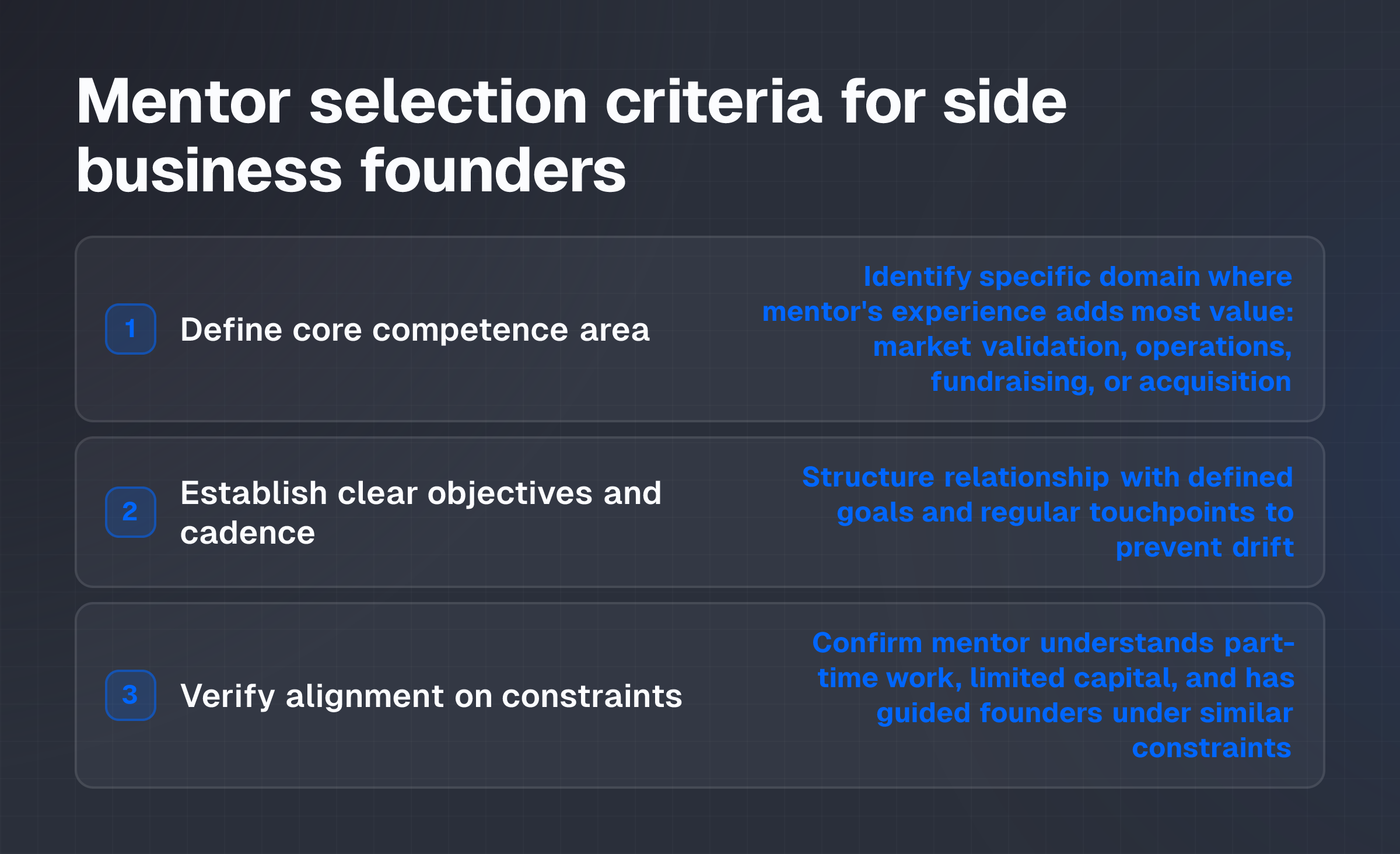
The research doesn't describe a single founder's decision but rather the structural case for mentorship as a de-risking tool. The underlying operating principle is clear:
For side business founders, prioritize finding a mentor with direct experience in your specific business domain or market over a generalist mentor.
The research indicates that the greatest value from mentorship comes not from generic business wisdom but from domain-specific insight that helps avoid predictable mistakes in your exact context.
This means:
Define the mentor's core competence. Identify the specific area where the mentor's experience will add the most value: market validation, operational execution, fundraising, or customer acquisition. Don't seek a mentor who's broadly successful but rather one who has succeeded in your specific challenge area.
Establish clear objectives and cadence. Structure the relationship with defined goals (e.g., validate product-market fit in 60 days, reach $X in revenue, resolve Y operational challenge) and regular touchpoints (e.g., monthly video calls, async feedback on specific decisions). Structure prevents drift.
Verify alignment on risk and constraint. Before committing to mentorship, confirm that the mentor understands the founder's unique constraints, part-time work, limited capital, existing job commitments, and has experience guiding founders under similar constraints. A mentor's advice optimized for a well-funded startup may be poor guidance for a bootstrapped side venture.
The evidence suggests this approach increases the odds of the mentorship relationship driving measurable progress rather than consuming time without return.
What happened
The research cites outcomes from formal mentorship studies and programs but doesn't describe a single founder's implementation narrative. The empirical pattern is consistent:
The 2014 Endeavor Insight and Kauffman Foundation study found that 70% of mentored businesses survive beyond five years, versus approximately 35% of non-mentored businesses. This isn't a small difference; it represents a doubling of survival probability.
The National Mentoring Resource Center (NMRC) frequently highlights the role of mentors in developing problem-solving skills and critical thinking, capabilities that translate directly to operational decision-making in side businesses, where each choice must be made with incomplete information and limited resources.
The Kauffman Foundation research also consistently points to network access as a significant benefit of mentorship. This matters because early-stage founders, particularly those operating part-time from outside major business hubs, often lack access to potential customers, collaborators, or resource providers. A mentor's network can compress what might otherwise take months into weeks.
What the research doesn't quantify directly is the reduction in specific early-stage mistakes, missed market opportunities, operational inefficiency, or premature scaling. The data points to increased survival and faster business plan development, which imply mistake avoidance, but don't isolate individual error categories or measure decision quality improvement at the granular level.
What we would do differently
The research identifies several gaps that would improve mentorship outcomes if addressed:
Formal vs. informal mentorship clarity. Most research focuses on structured mentorship programs. Side business founders often rely on informal relationships with advisors, former colleagues, or peers. More explicit guidance on how to structure informal mentorship relationships, how often to meet, what to prepare, how to extract specific feedback, would help founders maximize informal relationships without expecting the infrastructure of formal programs.
Mentor selection criteria for side founders. While general advice exists (seek someone with relevant domain experience), specific vetting criteria for side business founders are limited. A founder might develop a checklist: Does the mentor have experience advising part-time founders? Have they worked in resource-constrained environments? Do they understand your specific industry or customer segment? More explicit criteria would reduce the risk of mismatches.
Quantifying decision quality. The research points to outcomes like survival rate and business plan quality, which imply better early decision-making. But direct measurement of whether mentored founders make higher-quality early decisions than non-mentored peers, controlling for founder skill and industry, remains elusive. Capturing this would strengthen the case for mentorship investment.
Accountability mechanisms. The research notes that founders sometimes seek mentorship but don't act on advice. Establishing clearer accountability structures, documented decisions, agreed-upon metrics, regular review of advice implemented versus ignored, might increase follow-through and ROI on the mentorship relationship.
The transferable lesson
The core lesson extends beyond side business founders to any operator building under resource constraint.
Expertise access matters more than you realize early on. When resources are limited, the quality of your early decisions compounds. A mentor can't double your effort, but they can meaningfully improve the direction in which you expend effort. The 70% survival rate for mentored versus 35% for non-mentored businesses isn't a small edge; it reflects the cumulative impact of better early strategic choices, faster course correction, and avoidance of predictable pitfalls.
This logic applies beyond side businesses. Early-stage founders in any context, bootstrapped startups, new product lines within larger firms, or market entry into unfamiliar geographies, benefit from mentorship when they're most uncertain and have the least margin for error. The return on mentorship investment is highest when capital and time are most scarce.
Select for domain alignment, not just success. A mentor who succeeded in one context (e.g., building a consumer brand) may offer poor guidance for a different context (e.g., B2B SaaS). The transferable principle is that mentorship ROI depends heavily on the mentor's specific domain expertise relative to your challenge. Generic business wisdom is less valuable than specific experience in your market, customer type, or operational challenge. When evaluating a potential mentor, prioritize alignment on the specific problem you're trying to solve, not just overall business success.
Structure isn't overhead; it's enablement. Informal relationships feel efficient but often drift. The research and operating experience suggest that investing in structure, defined goals, regular cadence, documented decisions, clear scope, makes mentorship relationships more effective, not less. Structure prevents both parties from wasting time on misaligned expectations.
Next step
For a founder considering mentorship or evaluating whether a current informal advisory relationship is generating value, the actionable next step is to audit the relationship against three criteria:
Domain alignment: Does the mentor have direct experience in your specific market, customer segment, or operational challenge? Or are they a generalist offering broad business wisdom?
Constraint understanding: Do they understand the specific constraints you operate under, part-time work, limited capital, existing job, time zone differences? Or is their advice optimized for a different founder context?
Structure: Do you have defined objectives, a regular meeting cadence, and documented decisions? Or does the relationship exist ad hoc, with unclear expectations on both sides?
If any of these three are weak, the mentorship relationship is likely underperforming its potential. The research suggests that even small investments in clarifying domain fit and adding structure can meaningfully increase the return you derive from mentorship, and in early-stage ventures, where every decision carries outsized weight, that return can determine whether your side business reaches viability or stalls.