The Hidden Triangle: How 3 Simple Rules Separate Profitable Traders from Gamblers
95% of traders lose money because they trade like gamblers, not operators. Here's the three-corner triangle — systematic setups, dynamic risk, rule-based management — that turns trading into a business, with a real trade…
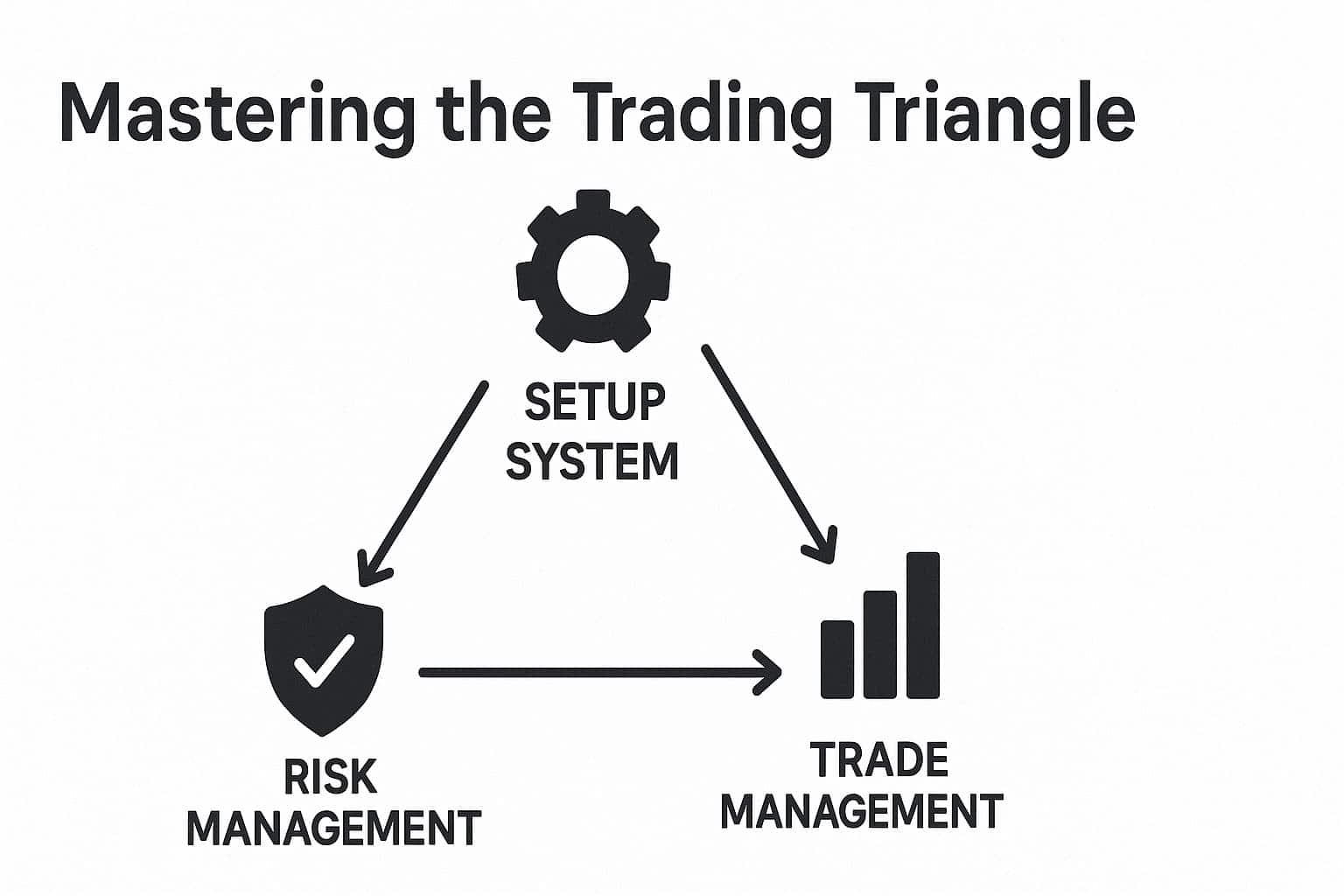
The profitable trading system in a nutshell
Here's what you'll get from this post:
- The #1 mistake that destroys 95% of trading accounts — and how a proper trading system avoids it
- The three-corner triangle that takes emotion out of trading for good
- Dynamic risk management that adapts to market conditions instead of ignoring them
- A real trade example showing the complete system in action
- Why simple, systematic approaches beat complex strategies
- How to move from gambling to a professional trading mindset
It's 2 AM. A trader stares at a screen full of red. Another losing streak. Another blown account. Another night wondering why analysis that looked brilliant on paper fell apart the moment real money was on the line.
Sound familiar?
Here's the brutal truth: 95% of traders lose money. Not because they're stupid. Not because they don't know the markets. Because they treat trading like a casino instead of a business.
Meanwhile a small group makes consistent money with a framework simple enough to draw as a triangle. Trader Dovy used this exact methodology to turn $25,000 into $250,000 in four months — verified, public results.
This is the systematic approach that separates profitable traders from gamblers.
The critical mistake most traders make
I've spent years around traders, and every community shows the same pattern. Obsessing over the latest indicator. Chasing the perfect entry. Following some guru's "guaranteed system".
They collect strategies like trophies and stay unprofitable.
The mistake? Learning individual setups without ever building a complete system.
So they master technical patterns, then panic the moment a trade moves against them. They perfect their entries but have no plan for risk. They read charts beautifully, then make emotional exits that hand the profits straight back.
Profitable trading was never about finding perfect setups. It's about a complete framework that handles everything from entry to exit — the same way successful prop trading firms use systems to manage risk and produce consistent returns.
That's the problem. The fix has been hiding in plain sight, and it's a simple geometric shape that turns chaotic trading into a business.
The Profitable Traders Triangle: three rules that change everything
The framework is called the Profitable Traders Triangle — three connected rules that turn trading from gambling into a predictable business.
It isn't another strategy. It's the same systematic approach entrepreneurs use to build ventures that actually make money.
Corner 1: a setup system that kills the guesswork
Professional traders run the same three-step process on every single trade.
Step 1: build your weekly direction.
- Look at last week's price movement
- If the previous weekly candle went up, next week is statistically more likely to go up
- That gives you a directional bias for every decision that follows
- Simple trend-following. Nothing clever. That's the point.
Step 2: find your key price zones.
- Trade the active hours only — the London and New York sessions
- Mark the areas where price bounced hard before
- Stay out during dead hours when nothing happens
- Use session indicators to spot the high-probability windows
Step 3: wait for entry confirmation.
- Drop to shorter timeframes to time the entry with precision
- Never enter without a confirmation signal: a double bottom breaking higher, a clean breakout of resistance, a clear reversal pattern
- Patience kills the fear-driven entry before it happens
That's the setup sorted. The next corner is where amateurs and professionals part ways — most traders put the same risk on every trade, and no professional fund manager would ever do that.
Corner 2: smart money risk management
This is where profitable traders leave the crowd behind. Instead of one fixed risk percentage for every trade, they adjust to conditions.
The daily market structure check:
- Is the overall trend moving in your direction?
- Are the key support and resistance levels holding?
- Everything aligned? Use full risk — typically 3%
- Structure showing weakness? Cut your exposure
The short-term momentum check:
- Check the 15-minute chart for immediate price direction
- If momentum is fighting your trade, drop risk from 3% to 2%
- That one adjustment protects capital whenever the short term conflicts with the longer-term direction
- You flow with the market instead of fighting it
The result: dynamic risk management that adapts as conditions change, not a fixed number that ignores them.
So now you have systematic entries and dynamic risk. Most traders still fail from here, because they have no plan for a trade once it's live. The third corner fixes that completely.
Corner 3: the millionaire's trade management secret
The core principle: professional traders don't guess what will happen. They react to what is happening.
The process:
- Before entering any trade, mark the previous price rejection areas between your entry and your target
- These are zones where price struggled before — it may struggle there again
- Don't try to predict. Prepare to react to what the market actually shows you
The management rules:
- Price breaks through a rejection zone cleanly → hold the full position
- Price hesitates or shows reversal signals → consider taking partial profits
- React to market behaviour. Never hope, never guess.
Emotion out, consistent decisions in — even under pressure.
Theory only takes you so far, though. Here's the triangle running on a real trade with real money.
Real-world application: a live trade example
The setup phase
- Weekly direction: consistent upward movement over multiple weeks
- Key price zone: a strong bounce area identified during New York trading hours
- Entry confirmation: a double bottom pattern with a clear breakout signal
The risk management phase
- Daily structure: overall trend moving up — green light for 3% risk
- Short-term momentum: strong downward pressure coming into the level
- Decision: risk cut to 2% because of the conflicting momentum
The trade management phase
- Two rejection zones marked between entry and target
- First zone: price broke through without hesitation — position held
- Second zone: brief resistance, then continued higher — full target reached
Every decision was rule-based. Not one was emotional.
Watch the complete trade breakdown: https://www.youtube.com/watch?v=ibXwMs4Kzwo&t=180s
Want to implement the complete system yourself? The triangle is the foundation, but the nuances take guided practice. See if you qualify for personalised mentorship — apply here.
Why this system actually works
Fair question: why does something this simple work when complex strategies fail? Human psychology and market mechanics don't change — and the triangle removes the three things that destroy most trading accounts.
Systematic consistency
- Same process every single trading day
- No guesswork, no strategy changes based on last week's results
- A clear rule for every decision
Emotion elimination
- Predetermined rules keep fear and greed out of the driving seat
- No panic exits, no FOMO entries
- Confidence comes from following a proven process, not from hoping
Capital protection
- Dynamic risk management keeps the account intact through unfavourable conditions
- Smaller losses in tough periods
- Bigger positions when the setup is ideal
And because it's percentage-based rather than fixed dollar amounts, it scales — the same system works on a small account and a large one. That mirrors how successful businesses grow: systematically, with the risk managed.
Understanding why it works matters. But what happens behind the scenes in professional trading explains why most retail education fails completely.
The underground reality
Here's what the trading industry doesn't want you to know: most successful traders run systematic frameworks exactly like this triangle.
They don't rely on:
- Magical indicators
- Gut feelings
- Secret strategies
- Perfect market timing
They do rely on:
- Clear processes
- Risk controls
- Systematic execution
- A business-like approach
The catch? Systems don't sell as well as dreams of easy money. It's easier to market a "foolproof system" than to teach disciplined methodology.
The reality: profitable trading takes one focused hour a day — but that hour has to be systematic, disciplined and consistent. It's the same lesson I've seen building a fintech ecosystem: consistent execution of a proven process beats sporadic brilliance every time.
The triangle is powerful, but it's the beginning. Professional traders add layers on top that take this foundation to institutional levels.
Taking it to the next level
The triangle you've just learned is the foundation. The complete system adds:
- Advanced multi-timeframe analysis
- Psychology management techniques
- Market sector rotation strategies
- Professional trade journaling methods
The Hidden Edge is a one-on-one mentorship where you learn the complete system directly from Dovy, who has publicly verified his results month after month.
Current student results
- Faharan: $4,000 monthly profits
- Houssam: $11,300 from a single trade
- Multiple students achieving consistent profitability
What you get
- A 90-day pathway to consistent profitability
- Personal guidance from a verified, successful trader
- Complete system implementation
- Ongoing support and feedback
One requirement: you treat this like a business. One hour a day, systematic principles, no deviation.
Every trader hits this moment eventually — keep hoping and gambling, or commit to the systematic approach. What you choose here decides everything that follows.
The choice is yours
You now know the three corners that separate profitable traders from gamblers:
- Systematic setup identification
- Dynamic risk management
- Rule-based trade management
Most traders will read this, nod along, and go back to chasing the next hot strategy.
A small percentage will take systematic trading seriously and implement it consistently. They're the ones who join the 5% who actually make money in the markets.
Trading isn't luck, intuition or the perfect indicator. It's a proven system, executed with disciplined consistency.
Ready to stop gambling and start trading like a business?
Apply for The Hidden Edge mentorship. The system is there. The only question is whether you'll commit to it.
Building something in this space?
I partner with a select few founders to scale IP-driven businesses — like the ones in the portfolio.
Apply to BuildRelated reading
NextTrade Guide: Accounts, Platforms and Costs
A practical guide to NextTrade: compare Standard, Raw and VIP accounts, MT5 and TradeLocker, trading costs, regulation and the checks to mak…
Read more→ Forex Markets & Brokers
The 3-Touch System That Made FunderPro My Best Affiliate Asset
Better links and louder banners don't move affiliate revenue — sequence does. Here's the 3-touch system that turned one FunderPro partnershi…
Read more→ Fundamentals & Strategies
How to Build a Trading Audience That Pays You Every Day
Most traders try to pull income straight out of the markets. I built around the people in them instead — and that shift turned a modest trad…
Read more→Ready to build your future?
Work with an operator who has launched, scaled and exited across fintech, payments and trading.