
AI trading journals promise to remove the busywork from trade logging and pattern analysis. The core claim is sound: AI can import trades, organize data, and flag recurring behaviors without manual data entry. Most AI journal tools conflate two different capabilities, data automation and psychological insight, and deliver reliably on only the first. True value emerges when automation handles the repetitive work while structured human reflection captures the decision context that no algorithm can reliably reconstruct.
A trader evaluating these tools should distinguish between convenience features and genuine workflow improvements, then decide whether the psychological reflection layer justifies the cost.
What AI Trading Journals Actually Do
An AI trading journal records trade details systematically and uses machine learning to organize, search, and surface patterns. The baseline capability is identical to a manual trading journal: entries include trade entry and exit prices, position size, instrument, market conditions, and trade outcome.
The AI difference is in how the data flows and surfaces.
Most tools automate data input by connecting directly to broker APIs or accepting CSV imports. Instead of typing each trade manually, the journal pulls the trade directly from the broker's execution record. This saves time. It eliminates transcription errors. The system then organizes these trades by date, instrument, outcome, and user-defined tags. When a trader wants to review, they can filter by market condition, time of day, or trade type and see results instantly, far faster than scanning a spreadsheet or handwritten log.
Pattern flagging is the second layer. AI journaling tools scan entries for recurring behaviors: high win rates at specific times of day, consistent losses on certain instruments, or frequent trades following earlier losses. Some tools assign numerical scores to emotional intensity based on keywords in trader notes. The system then highlights these patterns without requiring the trader to read hundreds of entries manually.
This is data organization and correlation. Not psychological diagnosis.
The AI identifies that a trader often adds to losing positions after 2 p.m. EST. It doesn't determine whether that behavior stems from overconfidence, impatience, or legitimate strategy adjustment. That distinction matters because the recommended correction depends on the root cause, and only the trader with full context can reliably identify it.
Where Automation Adds Real Value
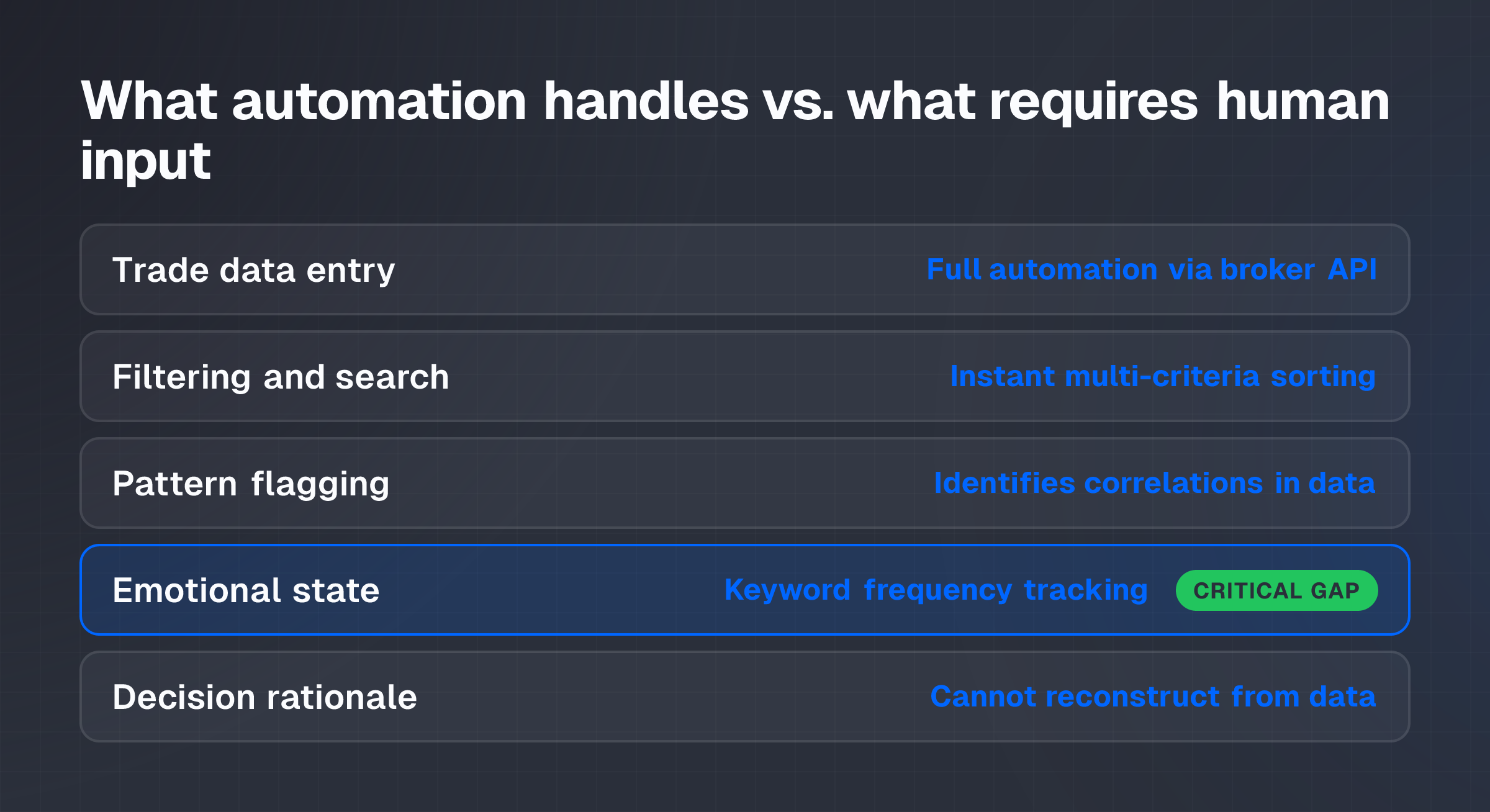
Automation saves time in two specific places: data entry and filtering for review.
A trader managing 20 to 50 trades per week faces a choice between manual logging, time-consuming and error-prone, or spreadsheet import, which is faster but passive. AI import directly from broker APIs or CSV eliminates both frictions. The trader doesn't type; the data arrives correctly formatted. This is genuine workflow improvement, not a marketing feature.
The second efficiency is searchability. A trader who journals manually or in a spreadsheet can review all August trades, but filtering by "days when I took more than five trades" or "EUR/USD entries between 8 a.m. and 10 a.m." requires manual sorting or writing custom formulas. An AI journal with tag-based filtering and search returns those results in seconds. For traders who journal consistently, this turns weekly or monthly review from a 30-minute task into a 5-minute task.
Keyword scoring also automates part of the emotional reflection process. If a trader notes "frustration" in 40% of losing trades but only 10% of winning trades, that pattern emerges without the trader manually reading each entry and tallying by hand. The system flags the correlation and lets the trader decide whether it reveals a genuine psychological trigger or is coincidental noise.
These improvements compound when a trader has hundreds of entries. The question changes from "Can I find my trades?" to "Can I recognize what I was thinking and feeling when I placed them?"
Automation handles the mechanical part. Structured reflection answers the psychological part.
What AI Cannot Do Without Human Input
AI trading journals can't reconstruct trader intention, decision rationale, or emotional state from trade data alone.
A broker API provides execution price, time, size, and outcome. It doesn't include why the trade was entered. What market signal triggered it. Whether the trader deviated from their plan. What they felt before, during, or after the trade.
Example: A trade shows entry at 1.0950, exit at 1.0925, loss of $120. The AI can flag this as a quick exit. It can't determine whether this was a planned stop-loss hit, successful risk management, a panic close driven by emotion, or a legitimate reversal signal caught in time. Each conclusion calls for a different intervention.
Similarly, AI can't assess whether a trader's journal notes are honest self-reflection or retrospective rationalization. A trader who enters impulsively might record "strong momentum on the 4-hour, confluence of moving averages" even though the actual decision was driven by seeing a peer's trade or fear of missing the move. Only the trader knows. No algorithm can fact-check the internal narrative.
Quantifying psychological state is also harder than it appears. A trader who rates their confidence level 3/5 before a trade provides data, but the system can't validate whether 3/5 that day means the same as 3/5 six months later, or whether the numerical score correlates with decision quality. Subjectivity in journaling means the AI is organizing subjective input, not measuring objective psychology.
Lastly, AI can't identify whether an observed pattern is causation, correlation, or coincidence. If a trader's journal shows that losses cluster on Fridays, the AI flags the pattern. But the AI can't tell whether Fridays cause poor decision-making, whether fewer setups occur on Fridays so the trader takes weaker trades, or whether the small sample size, four Fridays of data, makes the pattern statistically meaningless.
These gaps mean that the most valuable part of journaling, understanding the decision context and identifying the root cause of repeated mistakes, can't be fully automated. It requires the trader to answer follow-up questions, revisit their thought process, and make connections that require judgment. Trader psychology behind consistent returns doesn't emerge from data alone.
Evaluating Trading Journal Tools
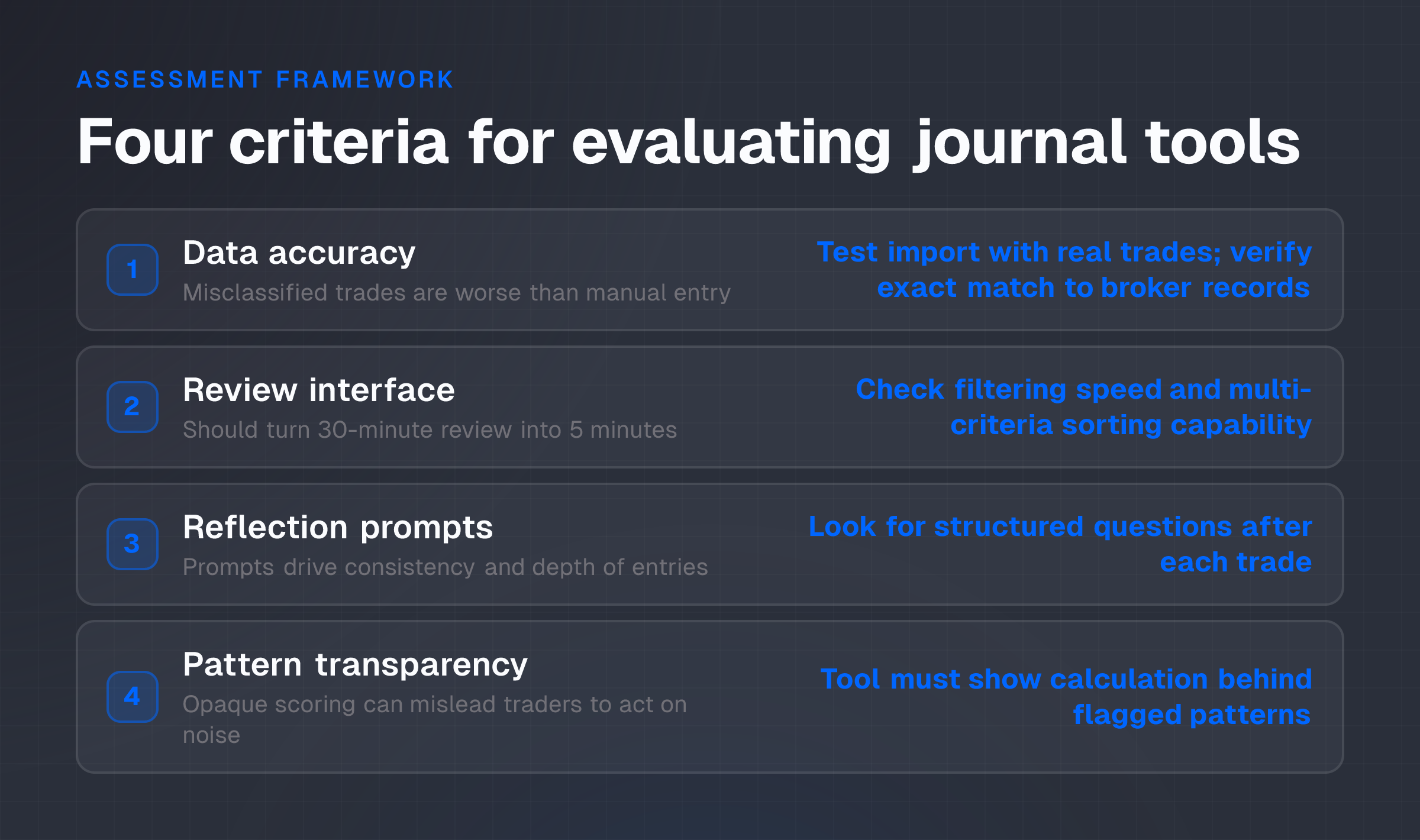
When comparing AI trading journals, focus on four criteria: data accuracy, review interface usability, reflection prompts, and the transparency of pattern-flagging logic.
Data accuracy is foundational. Does the tool import trades without errors? Does it handle partial fills, reversals, and different broker formats? Test the import with a sample of real trades from your broker and verify they match exactly. A system that misclassifies trade outcomes or misses entries is worse than a spreadsheet.
Review interface should make filtering and scanning fast. Can you sort by outcome, time of day, instrument, or custom tags? Can you jump to a specific trade, see the full entry note, and compare it to others like it? A well-designed interface saves real time during review. A cluttered one becomes another hassle to avoid.
Reflection prompts separate tools that encourage genuine psychological review from those that just store data. Does the tool ask structured questions after a loss? "Did you follow your stop-loss?" "What emotion did you feel?" Or does it leave the reflection section blank, leaving the trader to guess what to record? Prompts guide consistency and depth. Tools without them often generate poor-quality journal entries because traders don't know what to note.
Pattern-flagging transparency matters because opaque scoring can mislead. If the tool claims "You over-trade on Mondays," it should show the calculation: how many Mondays, how many trades per Monday on average, how the average compares to other days. Tools that flag patterns without showing the math risk telling traders to act on noise.
Cost is a secondary factor. Many AI journals charge monthly; some are free. Cheaper isn't better if the tool's incomplete, but expensive isn't better either. Align price to your trade volume and the specific workflows the tool automates for you.
How HybridTrader Combines Automation and Reflection
HybridTrader applies this framework by automating data import and retrieval while embedding structured reflection into the journaling workflow.
The tool connects to broker APIs to pull executed trades, then organizes them by date, instrument, and outcome. The import is automatic; traders don't manually enter trade details. The interface allows filtering and searching by multiple dimensions, supporting the common workflow of "show me all GBP/USD trades that hit my stop-loss."
HybridTrader doesn't treat journaling as optional note-taking. After each trade, the system prompts the trader with structured reflection questions: Did you follow your plan? What was your emotional state? What would you do differently? These prompts are designed to capture the decision context and emotional state at the moment when recall is fresh, before the trader forgets. This is where AI automation alone fails, the prompts ensure that context is captured, not inferred later from outcome alone.
The tool then correlates trader-supplied reflection with trade outcomes. If a trader consistently notes "overconfidence" before larger losses, the tool flags that pattern and quantifies its frequency. The pattern emerges from trader input, not from an algorithm guessing psychological state from price action or trading speed. This respects the boundary: AI handles the data; humans provide the context.
Traders can then review aggregated psychology at weekly or monthly intervals. The system shows which emotional states preceded which outcomes and lets the trader test interventions, "I will take a break after three consecutive losses." As those interventions are implemented, the journal continues to track whether the pattern changes, providing feedback on whether the intervention worked.
The design separates genuine automation, import, organization, retrieval, from genuine reflection: structured prompts, trader context, outcome correlation. Neither replaces the other.
Getting Started With Structured Trade Review
Starting a systematic review process requires setting up both the mechanics and the discipline. Begin by choosing a fixed review interval. Weekly is common and sustainable; monthly is easier to maintain but slower to reveal patterns.
Daily review often leads to burnout and over-analysis.
Before the first review, set up the journal's import and tagging system. Connect your broker API or set up a CSV import workflow. Create tags for market condition, trending, ranging, choppy, your trading style, swing, scalp, countertrend, or any other categories relevant to your analysis. Avoid excessive tags; five to ten is usually enough. The goal is to sort trades meaningfully, not to spend hours categorizing.
During the first two weeks of entries, focus on consistency. Use the same reflection prompts after each trade, even if they feel repetitive. Record your emotional state, your adherence to your plan, and what surprised you about the trade. Early entries will feel incomplete or vague. That's normal. The quality improves as you build the habit.
At your first review interval, one week in, pull the filtered data and look for patterns: the frequency of trade outcomes (what percentage wins, what percentage losses); the correlation between your emotional notes and outcomes (did frustration precede losses); and whether you deviated from your plan. Don't try to fix everything. Identify one recurring pattern that affects multiple trades.
Formulate a simple hypothesis based on the pattern. Example: "I take losses quickly on winning days but hold too long on losing days." Don't assume the cause yet. In the next review cycle, collect more data with that specific pattern in mind. If a pattern's real, it will repeat; if it was noise, it'll disappear.
After a few review cycles, three to four months of trading, reliable patterns emerge. At that point, design a specific behavioral intervention. Not a strategy change, but a process change. Example: "After three consecutive losses, I'll close the platform and return after 30 minutes." Implement it and continue journaling to track whether the pattern improves.
The time investment is real. A trader with 30 trades per week might spend 5 to 10 minutes on reflection per day and 15 to 30 minutes on weekly review. That's 2 to 3 hours per week. For traders serious about improving decision quality, that time investment typically pays off faster than chasing new strategies or increasing trade frequency.
The common mistake is logging without review, or reviewing without hypothesis testing. Data alone doesn't change behavior; reflection combined with intervention does. Automated import removes the busywork. Structured prompts remove the guesswork about what to record. But only consistent reflection and willingness to change process turns journaling from logging into genuine performance improvement.