
If you use a trading journal today, you likely spend time manually entering trades, calculating metrics, and reviewing sessions by hand. An AI trading journal automates the repetitive parts, data import, metric calculation, and pattern detection, but it can't reconstruct your emotional state, trade rationale, or decision logic without you recording that context first. The best systems combine genuine workflow automation with structured human reflection. This article explains what AI can and can't do in trading journals, how to evaluate tools in this category, and which automation genuinely saves time versus what marketing just labels as "AI."
What AI Trading Journals Actually Do: Capturing and Organizing Trade Data
An AI trading journal is software that automatically pulls trade data from your broker or platform, organizes it into a usable record, and applies algorithms to identify patterns in your performance and behavior.
This is fundamentally different from a conventional trading journal, which relies entirely on manual entry and review.
Genuine AI journaling systems perform three core functions. First, they automate data import and consolidation, pulling real-time or batch data through APIs or CSV imports, combining trades across multiple platforms into a single record, capturing order data, fills, P&L and execution details without manual entry. Second, they calculate performance metrics instantly: win rate, average gain, average loss, risk-reward ratios, drawdown, profit factor, equity curves. No spreadsheet work required. Third, they run pattern recognition and bias detection, scanning historical trades for recurring setups, entry and exit conditions, or position sizing habits that correlate with profitability or loss, then quantifying behavioral patterns like overtrading on certain days, cutting winners short, or holding losers too long.
The value proposition centers on removing the time-consuming, repetitive work that manual journaling demands. Traders can redirect the hours saved into strategic analysis rather than data entry and calculation.
Where Automation Adds Real Value: Measurable Time and Accuracy Gains
Automation delivers genuine value in workflows where repetition and calculation dominate. For traders using multiple platforms or executing high trade volumes, the time savings are substantial.
Manual journaling often requires traders to log each trade by hand, entry price, exit price, position size, date, market conditions, notes. With dozens of trades per week, this becomes a significant time drain. Automated import eliminates this step entirely, pulling data directly from the source.
Computing win rates, average profits, drawdown and profit factor manually is error-prone and time-consuming. An AI journal calculates these instantly and updates them with each new trade. This removes a bottleneck that often causes traders to skip journal review altogether.
Pattern Identification Across Large Trade Sets
A trader executing 200 trades over six months might notice they tend to cut winners short, but manually reviewing 200 entries to quantify this pattern is impractical. AI can scan all 200 trades in seconds and report: "You cut winners short on 38% of profitable trades, costing an average of 0.5R per exit. That's $8,200 in foregone profit over this period." This specificity converts intuition into actionable data.
Manual journals depend on discipline. Traders who skip entries or fail to review regularly lose the cumulative benefit of journaling. Automated systems enforce consistency by removing the friction of data entry, making regular review more feasible.
These gains are measurable. A trader who spends 15 minutes per trade logging and calculating metrics can recover hours per week through automation, time that compounds into better analysis and strategy refinement.
What AI Can't Do Without Human Input: Intent, Emotion, and Context
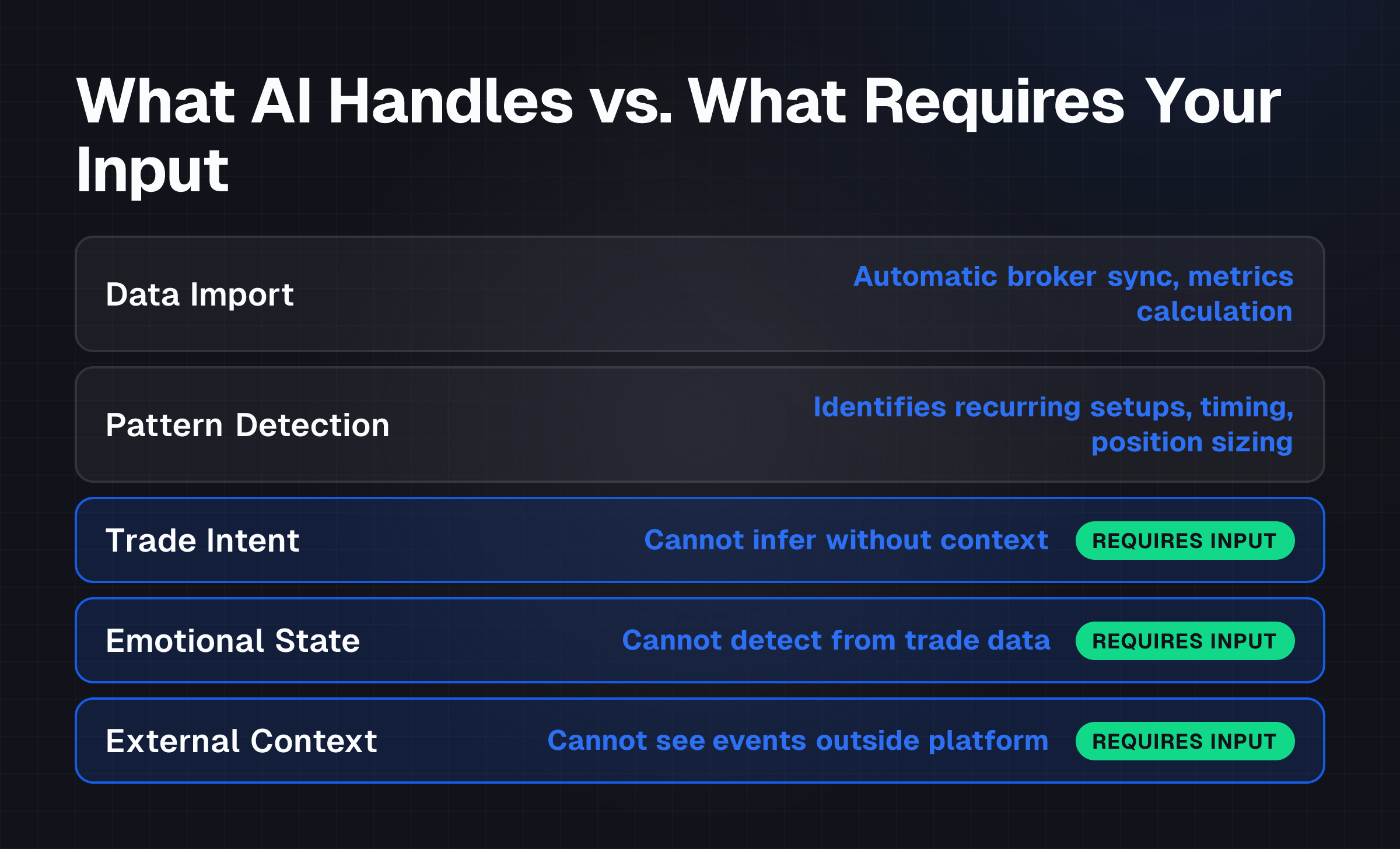
The central limitation of AI trading journals is this: they can't reliably reconstruct why you made a trade, what you felt, or what external factors influenced your decision, unless you explicitly record that information first.
The Intent Problem
AI sees that you entered at 1.2000, exited at 1.2015, and made £15. What it doesn't see without your input is whether you entered because your pre-trade plan identified this setup as high-probability, you were frustrated after a losing streak and revenge-trading, you noticed a divergence on the 15-minute chart, or you acted on a gut feeling or hunched bias.
This distinction matters enormously.
A pattern that looks profitable in aggregate might actually reflect overconfidence or emotional decision-making that will lead to losses in future trades. Conversely, a trade that loses might reflect discipline following your plan, which deserves reinforcement. AI can't tell the difference without context.
Your emotional and psychological state during a trade directly shapes your decision quality, but it leaves no footprint in the trade data itself. An AI journal can identify that you took larger positions after wins and smaller positions after losses, but it can't determine whether this was intentional risk management or unconscious tilt-driven behavior without you stating it.
AI sees trade data. It doesn't see that you were trading during a central bank announcement, a news flash, a platform outage, or a period when you were sleep-deprived or distracted. These factors often determine outcome in ways that have nothing to do with your edge. Failing to record them means the AI may incorrectly attribute causation to your setup or entry signal.
The Black Box Risk
Some AI models identify correlations that are real but not causal. For example, AI might detect that you make more profit on Tuesdays than Fridays and suggest trading more on Tuesdays. Without human scrutiny, a trader might follow this pattern and discover it was random noise, not an edge. The trader lost time and real capital chasing a statistical phantom.
The best AI journals prompt traders to record this context in a structured, brief format, two to three sentences on intent, emotion, and external factors. This recorded context then informs the AI's analysis and prevents misinterpretation of your data.
Evaluating Trading Journal Tools: A Framework for Distinguishing Real Automation from Superficial AI
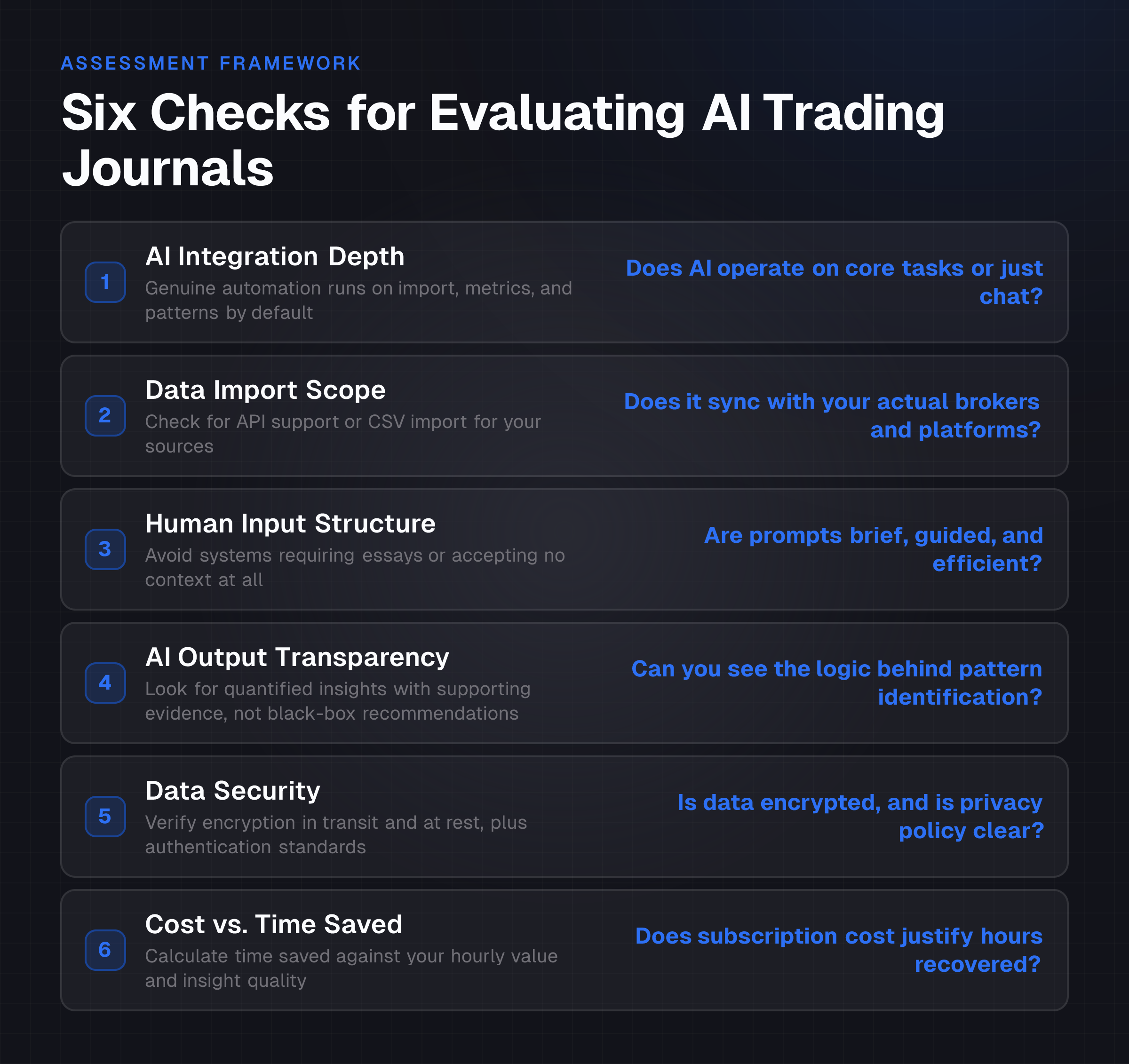
Not all products labeled "AI trading journal" deliver genuine automation. The following framework helps traders separate platforms that meaningfully reduce workflow friction from those that simply add a chatbot to a conventional journal.
Assessment 1: Where Does the AI Integrate?
Genuine workflow automation means AI operates on core journaling tasks: data import, metric calculation, pattern detection. These functions are automated by default; the trader doesn't manually trigger them. The system learns from the trader's historical data to refine insights over time. Results are quantified and presented with supporting evidence.
Superficial AI addition means AI primarily serves as a conversational interface or chatbot. Data entry and metric calculation remain manual or semi-manual. The AI answers general questions about trading but doesn't analyze the trader's specific trade history. Pattern identification relies on pre-set rules rather than adaptive algorithms.
Assessment 2: Data Import Scope
Check whether the platform integrates with the brokers and platforms you actually use. Genuine automation supports multiple data sources, ideally via API for real-time sync or CSV import for platforms without API access. Platforms that require manual data entry or support only one broker aren't truly automating your workflow.
Assessment 3: Human Input Requirements and Structure
A well-designed AI journal doesn't eliminate all human input. Instead, it structures the input to be efficient and useful. Look for pre-trade prompts that capture intent before a trade executes, post-trade reflection fields that are short and guided for emotion, decision rationale and context (not essay-length reviews), and optional deep-dive sections for trades that warrant deeper analysis or require pattern investigation.
Avoid systems that either demand extensive written reflection after every trade or accept no human input at all. The former defeats the efficiency gain; the latter produces flawed analysis.
Assessment 4: Transparency in AI Output
When the system identifies a pattern or recommends an action, can you see the logic?
A dashboard showing "You cut winners short 38% of the time, costing 0.5R average" is transparent. A black-box recommendation to "trade this setup more often" is not. Request documentation on how the system identifies patterns and whether it can explain its conclusions in plain language.
Assessment 5: Data Security and Privacy
Trading data is sensitive. Verify that the platform encrypts data in transit and at rest, uses industry-standard authentication, and has a clear privacy policy. Ask whether data is stored on shared infrastructure or isolated environments, and whether the provider has independent security audits.
Assessment 6: Cost-Benefit Analysis
Subscription costs for AI journals typically range from modest monthly fees to annual plans. Weigh this against the time saved and the quality of insights. A tool that saves five hours per month at an average trader's hourly value may justify a $50/month subscription, but only if the insights lead to measurable improvements in decision-making or performance.
How HybridTrader Combines Automation and Reflection: A Case Study
HybridTrader is an AI trading journal that applies the principles outlined above. Owen is a partner and investor in HybridTrader and may earn from sign-ups, so readers should evaluate it against the same criteria applied to any other trading journal.
HybridTrader's core premise is to "price every bad habit to the dollar" and connect "behavior to live market context." This framing signals an emphasis on quantifying the psychological and contextual factors that conventional journals often overlook.
Automation Features
The platform supports live sync from 50+ trading platforms and brokers, as well as CSV import for platforms without direct API access. This eliminates manual data entry at scale. The performance dashboard automatically calculates and visualizes metrics including win rate, profit factor, average R-multiple, drawdown and equity curves without trader intervention. Bias and behavior quantification uses historical trade data to identify recurring patterns in position sizing, entry and exit timing, and trading frequency, then quantifies the financial impact of each pattern.
Structured Human Input
Rather than requiring essay-length trade notes, HybridTrader prompts traders to record pre-trade intent (the setup or signal that triggered the trade), emotional state (brief notation of emotional context, confident, uncertain, frustrated), market context (external events or conditions relevant to the trade), and post-trade reflection (a short summary of what went well or poorly in execution).
This structure keeps reflection time to minutes per trade while capturing the contextual data that AI alone can't infer.
The system then feeds recorded context back into its analysis. If a trader notes they were "revenge-trading" after a loss, HybridTrader can flag that pattern and quantify its cost separately from high-conviction, plan-based trades. This prevents the AI from misattributing outcomes to setups when the real driver was emotional state or external noise.
Actionable Output
Rather than vague recommendations, HybridTrader generates specific insights: "Your average win on breakout trades is 1.8R when entry is within 5 pips of resistance; outside that range, you average 0.4R. Your pre-trade game plan, built from your own data, should prioritize resistance breakouts within that band." This is transparent, testable, and grounded in the trader's own historical performance.
HybridTrader demonstrates that effective AI journaling requires both genuine automation and structured, brief human reflection. The automation removes the friction that causes traders to skip journaling; the reflection ensures the AI's analysis is grounded in trader intent and context rather than confusing correlation with causation.
Getting Started With Structured Trade Review: Building a Reflection Habit That Works With Automation
Adopting an AI trading journal isn't a replacement for discipline; it's a tool that supports disciplined review when the system is designed to minimize friction.
Step 1: Choose Based on Your Current Pain Point
Before selecting a tool, identify the specific aspect of journaling that drains the most time or causes you to skip review entirely. Is it data entry? Metric calculation? Pattern identification?
Select a platform that automates your biggest bottleneck. If you execute 50 trades per week across multiple platforms and manually consolidate them, data import automation delivers immediate value. If your data entry is already organized but you struggle to identify patterns, prioritize a platform with robust analytics.
Step 2: Set Up Data Feeds First
Once you've selected a platform, configure all data imports before you begin trading with it. Test the connection with a small trade to verify the data arrives correctly. A broken data feed will discourage you from using the tool, negating its benefit.
Step 3: Create a Short Reflection Template
With the AI handling metrics and data organization, use the human input fields to record intent, emotion and context in 30-60 seconds per trade. A simple format works best:
- Intent: "Breakout above 1.2050 resistance; plan entry within 5 pips"
- Emotion: "Confident; had confirmed this level yesterday"
- Context: "No major news; normal volatility"
- Execution: "Entered at 1.2051, exited at 1.2010 loss; slipped on entry"
This brevity is key. Traders who attempt detailed written reflection every trade abandon the journal within weeks. The structured, short form works because it reduces friction while capturing signal.
Step 4: Review on a Regular Cadence
Set a fixed time for review, weekly for most traders, daily for high-volume traders. Let the AI's dashboard and pattern detection guide your review. Spend time understanding why certain patterns emerged and whether they reflect edge or bias. Use the Efficiency Audit framework to assess which insights are actionable versus which are noise.
Step 5: Test Insights Against New Trades
The most valuable AI journals generate testable hypotheses. If HybridTrader or a similar tool identifies that your breakout entries are more profitable when they occur within a specific time window or price range, trade that hypothesis consciously on your next 10 trades. Record whether the pattern holds. If it does, you've found an edge worth refining. If it doesn't, you've learned that the pattern was historical noise, not a reliable signal.
This cycle of quantification, testing and refinement is where AI journaling adds real value beyond the initial time savings.
Key Takeaways
Genuine AI journaling automates data import, metric calculation and pattern detection. This removes the repetitive work that causes traders to skip journaling entirely. Platforms that add only a chatbot to a manual journal aren't delivering this benefit.
AI can't reconstruct trader intent, emotional state, or market context without explicit recorded input. The best systems prompt for brief, structured reflection that captures this information efficiently.
Common mistakes include expecting AI to replace human judgment, neglecting to provide human context, and choosing superficial AI solutions. Traders who record intent and emotion alongside trade data get far more accurate pattern identification.
Evaluate tools using a framework that assesses data import scope, human input structure, AI transparency and cost-benefit. Not all platforms labeled "AI journals" deliver genuine automation.
The adoption challenge isn't the tool; it's maintaining a reflection habit that works with automation. Short, structured templates that take 30-60 seconds per trade are far more sustainable than lengthy written reviews.