
Choosing a startup funding path requires matching three factors: your business model's capital needs, your growth ambitions, and your personal tolerance for financial risk and loss of control. Bootstrapping, angel investment, and venture capital each enable different trajectories. The choice isn't about finding the "best" option, it's about identifying which trade-offs fit your situation now and where you want to be in three to five years.
This piece walks through a decision framework designed for fintech founders and product leaders evaluating how to fund early growth. Data last verified 12 November 2026.
Quick answer: Matching funding to business model and risk tolerance
The funding path depends on three core variables.
How much capital does your business require upfront to generate revenue? How quickly do you need to scale to capture market share? And how much control and personal financial risk are you willing to accept?
Bootstrapping works for lean, revenue-generating businesses where you can tolerate slower growth and personal financial exposure. Angel investment and venture capital suit capital-intensive businesses or those needing rapid expansion, but they require accepting dilution, shared decision-making, and pressure to hit growth milestones that satisfy investor return expectations. Debt funding lets you retain full ownership but saddles you with repayment obligations regardless of profitability.
The right answer depends on where your business sits on each axis.
Who this decision is for
This framework applies to founders and early-stage operators in fintech, payments, trading platforms, and similar businesses where capital requirements vary widely and growth velocity matters. It also applies to operators deciding whether to pursue external funding or maintain independence.
The framework assumes you have some form of business idea or initial traction, not a purely conceptual stage, and that you understand whether your business model requires significant upfront investment before generating revenue.
The decision criteria
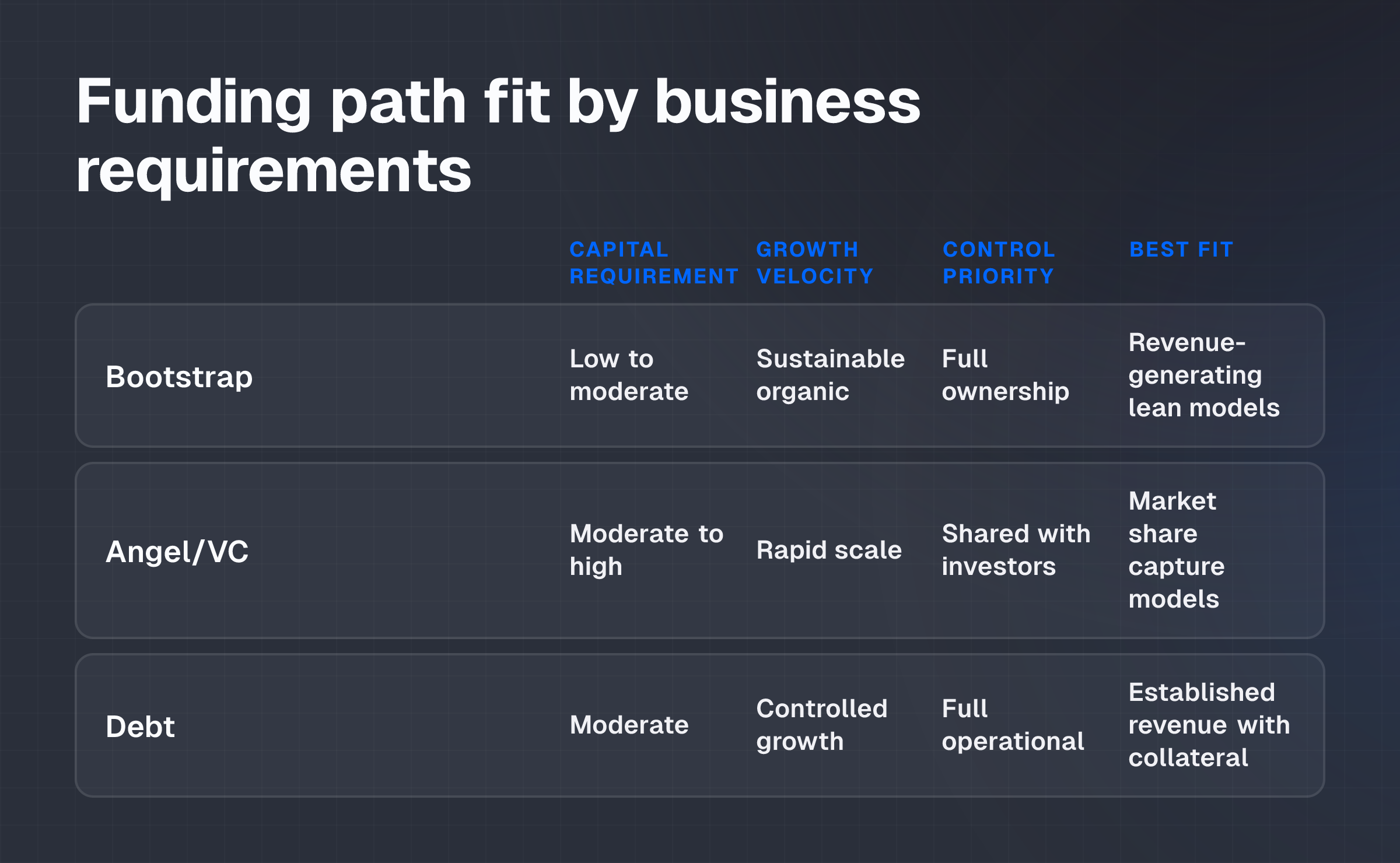
Before comparing funding paths, assess your business across three dimensions.
Capital requirements and revenue timing
Determine whether your business can generate revenue quickly with minimal upfront investment, or whether it needs substantial capital before customers can be acquired or the product delivered.
Service-based businesses, software tools, and affiliate-driven models typically sit at the low-capital end. Hardware, biotech, complex trading platforms, and large-scale marketplace infrastructure sit at the high end. The key question isn't whether your business can grow without external funding, but whether it can generate early revenue without it. This determines whether bootstrapping is viable or whether you need external capital to bridge the gap.
Growth velocity expectations
Define whether you're pursuing sustainable, organic growth, prioritizing profitability and independence, or rapid, high-scale growth that prioritizes market share capture and speed.
This shapes the funding decision. If market dynamics reward first-mover advantage or network effects require critical mass quickly, slower growth may cede your opportunity to competitors. If your market rewards incremental improvement and customer loyalty, sustainable growth may work. Be explicit about this choice; it often determines whether external capital makes sense at all.
Personal risk tolerance and control desires
Clarify whether you want full ownership and decision-making control, are willing to share control with investors in exchange for capital and strategic guidance, or need to maintain control while minimizing personal financial exposure.
Bootstrapping gives full control but puts your personal savings and creditworthiness at risk. Equity funding distributes financial risk but distributes control too. Debt funding lets you retain operational control but adds legal obligations and collateral risk.
None is objectively better. The right choice depends on what matters most to you.
Bootstrapping: Self-funded early growth
Bootstrapping means funding your startup using personal savings or revenue generated from early sales, without taking on external investors or debt.
Pros:
- Full ownership and control of strategic decisions
- No debt repayment obligations or equity dilution
- Focus on profitability and unit economics from day one
- Customer validation through paid adoption, not investor conviction
Cons:
- Slower growth due to limited capital
- Personal financial risk; your savings directly back the company
- Limited ability to hire, market, or invest in product development quickly
- Potential founder burnout managing cash flow manually
Trade-offs: You trade speed for independence.
Bootstrapped businesses often reach profitability faster because they must; they can't burn cash indefinitely. But they often reach scale slower because they can't outspend competitors on talent acquisition, marketing, or product development.
Evidence: Revenue from early sales or service delivery validates that customers will pay. Lean operations with reinvested profits demonstrate the ability to grow without external capital.
Equity funding: Angel investors and venture capital
Equity funding means selling a percentage of your company to investors, angel investors for smaller early checks, venture capital firms for larger, later-stage rounds, in exchange for capital, strategic connections, and often board seats.
Angel investors are high-net-worth individuals who typically write smaller checks (the $25K-$500K range varies by investor and jurisdiction), often provide operational mentorship, and may take equity or convertible debt.
Venture capital firms deploy larger capital amounts to companies with demonstrated product-market fit or strong founding teams, typically in exchange for meaningful equity stakes and governance rights.
Pros:
- Significant capital for rapid product development, hiring, and market expansion
- Access to investor networks, strategic introductions, and business guidance
- Reduced personal financial risk; losses are shared among investors and founders
- External validation of the business model and team
- Ability to move faster than bootstrapped competitors on product and market expansion
Cons:
- Dilution of ownership; each round reduces your equity percentage
- Loss of unilateral decision-making authority; investors expect board seats and approval rights
- Pressure to hit growth milestones and return multiples that satisfy investor expectations
- Long fundraising cycles, often three to six months, distract from product and operations
- Potential misalignment between founder vision and investor return expectations
- Difficult exit paths; investors typically expect acquisition or eventual IPO, not a profitable private company
Trade-offs: You trade ownership and control for capital and risk-sharing.
Venture funding accelerates growth but locks you into a high-growth trajectory. Walking away from a venture-backed company or pivoting significantly becomes harder once investors have capital at stake.
Evidence: A detailed pitch deck, business plan demonstrating market opportunity, term sheet outlining equity percentage and investor rights, defined product milestones, and founder background and prior track record.
Debt funding: Loans, lines of credit, and revenue-based financing
Debt means borrowing money that must be repaid with interest, without giving up equity.
Traditional bank loans require collateral, often personal guarantees, equipment, or real estate, a solid business plan, and proof of creditworthiness. They're often difficult for early-stage, pre-revenue startups to secure.
SBA loans (Small Business Administration loans) are government-backed loans designed for small businesses, offering more flexible terms than traditional bank loans, though still requiring a business plan and often collateral.
Lines of credit provide flexible borrowing up to a set limit, allowing you to draw and repay as needed; useful for managing cash flow or covering short-term shortfalls.
Revenue-based financing ties repayments to a percentage of future monthly or annual revenue, scaling obligations with business performance. It avoids equity dilution but requires demonstrable revenue or a clear path to it.
Pros:
- Retain full ownership; no equity dilution or loss of control
- Interest payments are often tax-deductible for certain business structures
- Predictable repayment schedule, for traditional loans and lines of credit, aids financial planning
- Revenue-based financing aligns repayment with business performance
Cons:
- Repayment obligations exist regardless of profitability; a downturn doesn't reduce what you owe
- Collateral requirements put personal or business assets at risk
- Covenants (restrictive clauses) may limit hiring, spending, or strategic pivots
- High interest rates for early-stage companies or those without proven revenue
- Difficult to secure before establishing revenue history or collateral value
- Less strategic support or network access than equity investors typically provide
Trade-offs: You trade access to patient capital and strategic guidance for financial independence.
Debt is cheaper than equity in the long run if you can service it, but it's riskier in downturns and offers no benefit beyond capital.
Evidence: Loan agreement, collateral documentation, personal credit history, revenue statements for revenue-based financing, and a repayment schedule.
Bootstrapping
Implementation: Begin with personal savings or early service revenue. Reinvest profits into product and hiring. Scale hiring and investment as cash allows.
Cost: Direct cost is low, no interest or equity dilution, but opportunity cost is high. Slow growth may mean losing market share to better-funded competitors.
Risk: Personal financial risk is high. If the business fails, your personal savings are lost. Cash flow management requires discipline; running out of cash ends the company.
Timeline: Profitability can be reached quickly, but scale takes longer.
Angel and venture capital
Implementation: Develop a pitch deck and business plan. Build initial traction, revenue, user growth, or strong team signal, if possible. Pitch to angel networks, accelerators, or VC firms. Negotiate term sheet. Close funding. Spend capital to hit growth milestones.
Cost: Equity dilution, typically 10-30% per round for early rounds, varies by investor and market, reduces your future ownership.
Secondary costs include legal fees (the $5K-$15K range for term sheet and related docs varies by jurisdiction and complexity), accounting, and investor relations time. No direct cash payment, but opportunity cost is high if you miss product-market fit.
Risk: Business risk is shared with investors, reducing personal financial exposure.
However, growth pressure can push the company into unsustainable spending or strategy misalignment. Investor-founder disputes can paralyze decisions.
Timeline: Fundraising takes two to six months. Capital is deployed immediately, accelerating product development and growth. Scale can be achieved in 12-24 months if execution succeeds.
Debt funding
Implementation: Prepare financial statements and a business plan. Apply to banks, SBA programs, or alternative lenders. Secure collateral if required. Close the loan. Repay on schedule.
Cost: Interest payments, rates vary widely; early-stage or high-risk businesses face 8-20% APR or higher, depending on lender and market; this article doesn't cover current rates, plus collateral may be required, putting assets at risk. Legal and origination fees run $500-$3K, varies by lender and loan size.
Risk: Repayment obligations are fixed; business downturns don't reduce what you owe.
If revenue dries up or the business pivots, you still must service debt. Collateral loss is real. Personal guarantees mean lenders can pursue personal assets if the business can't repay.
Timeline: Loan approval takes two to eight weeks, varies by lender and loan type. Repayment begins immediately, creating ongoing cash obligations.
Which option fits which situation
| Situation | Best fit | Why |
|---|---|---|
| Low capital needs, profitable quickly | Bootstrapping | Revenue covers operations and reinvestment; no external capital needed. |
| Service-based, low overhead | Bootstrapping | Profitability reachable without external funding. Early clients fund growth. |
| Capital-intensive product (hardware, biotech, trading platform) | Equity funding | Requires substantial upfront investment before revenue is possible. Bootstrapping not viable. |
| Market opportunity with first-mover advantage | Equity funding | Speed matters. Venture capital allows faster hiring, product development, and market expansion. |
| Founder wants full control, can tolerate slow growth | Bootstrapping or debt | Equity funding trades control for capital. Bootstrapping or careful debt use preserves autonomy. |
| Founder wants capital but can't secure debt terms | Equity funding | Equity is more accessible to early-stage companies without revenue or collateral. |
| Proven revenue, predictable growth, profitable trajectory | Debt or revenue-based financing | Business can service debt. Debt preserves equity and ownership. |
| Rapid scaling critical but founder risk-averse | Equity funding | Venture capital distributes financial risk while providing capital for aggressive growth. |
What to verify before deciding
Before committing to a funding path, validate these assumptions:
Capital requirement reality: Determine the actual minimum capital needed to reach the first revenue milestone. Talk to three operators in similar spaces. Don't inflate the number to justify seeking external funding.
Growth timeline and market window: Confirm whether first-mover advantage exists and how long it lasts. If the market is crowded or patient, bootstrapping may work. If speed is critical and capital unlocks it, equity funding may justify dilution.
Personal financial runway: If bootstrapping, calculate how long your personal savings support the business at expected burn rate. If less than 12 months, consider whether that's realistic or whether you need external funding earlier.
Investor alignment: If pursuing equity funding, verify that potential investors understand and support your business model and long-term vision. Misaligned investors create friction.
Debt serviceability: If considering debt, model whether the business can service repayments in a downturn. If not, debt becomes a liability rather than a tool.
Personal risk tolerance reality: Test your stated risk tolerance against reality. Can you lose your personal savings and continue? Can you give up control without frustration? Be honest; misalignment causes founder distress later.
Term sheet and investor preferences: If raising equity, read and understand the term sheet fully. Know what rights investors have, what happens in a down round, and whether your role is protected.
Next step
Assess your business model against the three core criteria: capital requirements, growth velocity needs, and personal control and risk preferences.
Use the decision table above to identify which funding path aligns best. Then verify the assumptions that underpin your choice, especially capital requirements, market timeline, and personal risk tolerance.
This piece draws on the brand's published materials and verified public sources; it doesn't cover every funding source or jurisdiction-specific regulation. Consult a business attorney and accountant for legal and tax specifics before committing.
For deeper operating context on building companies and making foundational decisions with incomplete data, see How Founders Make Operating Decisions With Incomplete Data and Funding Your Startup: Exploring Options for Raising Capital.