
When I met Scott Harrison at a car rally in Dubai in 2025 (I describe that first meeting and the investment decision in the opening episode of the 8WTC build series), I recognized something most investors miss when they're staring at spreadsheets: a community built over years of genuine trust. Scott had spent years helping people transform their bodies and their habits. The results were real. The loyalty was real. And the business had barely scratched the surface of what it could become.
That's what I look for before anything else. A proven community with a loyal customer base and obvious opportunities to scale. Everything else is fixable. Trust, once broken, is not. So I invested in 8WTC, and then I got to work identifying the product gaps holding back growth.
The app they had was a web app that hadn't evolved in years. When I audited their product, I found no calorie tracking. No referral system. No automated follow-up. No SEO infrastructure. Every one of those is a growth engine that hadn't been built yet. This article walks through the gaps I identified, why they matter for fitness app operators, and how we built solutions in compressed timelines.
Owen is an investor in 8WTC and may benefit commercially from the company’s growth and app sign-ups. This article presents Owen’s interpretation of the opportunity and does not guarantee business, fitness or financial outcomes.
The Product Gaps I Found at 8WTC
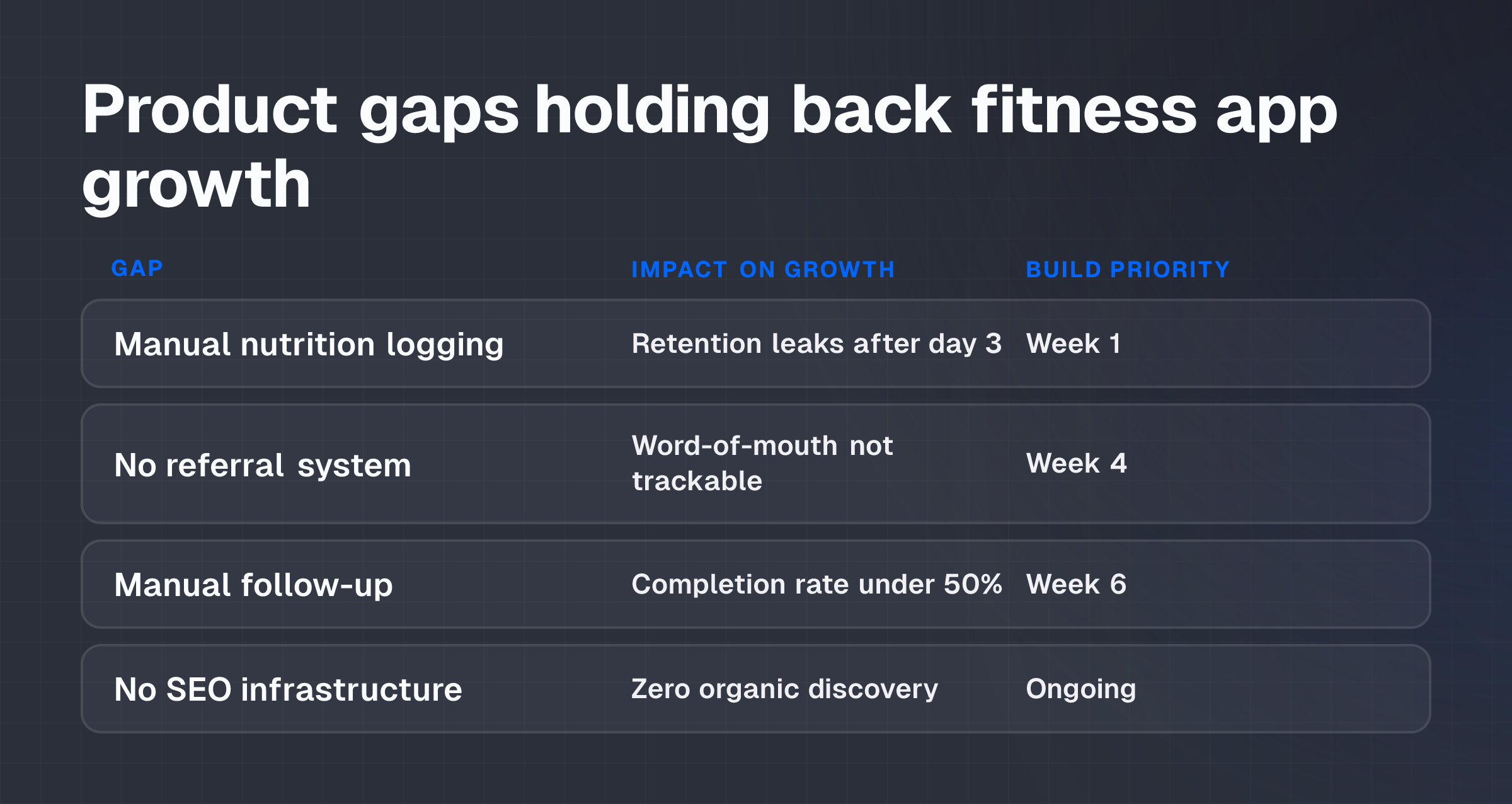
I started by mapping what 8WTC had built and what was missing.
The core issue was that the app had stalled. It was a web app that hadn't evolved. That meant three critical levers for growth weren't working.
Retention was leaking. Members had no built-in way to track nutrition data. They had to leave the app, use a separate tool, then come back. That friction compounds over eight weeks.
Referrals weren't automated. Scott's community was word-of-mouth driven, which is powerful. But there was no system to turn that word-of-mouth into trackable growth. Members couldn't easily share their progress or invite friends from within the app.
Follow-up was manual. Every check-in, every nudge, every accountability message had to be handled by hand. That doesn't scale.
I saw the same pattern in other fitness apps: founders build the coaching and the content, then ship a minimum product and assume growth will come. It doesn't. Growth comes from closing the gaps between what members want to do, stay accountable, track food, share results, get nudged, and what the app makes easy.
The Calorie Scanner: Building in a Week
The highest-friction moment in 8WTC's user journey was nutrition tracking. Members follow macro targets and flexible dieting plans, that's core to the program. But they had to manually log everything. Most people stop after day three.
I saw calorie scanning as the fastest win.
The seven-day Fuel8 build gave me practical insight into where modern development tools could shorten product cycles and where complexity still remained. The complete build process, including what shipped and what I learned, is documented in the separate Fuel8 case study.
The lesson here for fitness app operators: the best growth lever is often not the most complex feature. It's the one that removes the most friction from your core use case. For 8WTC, that was turning nutrition logging from a chore into a three-second action.
Referrals and Community Leverage
8WTC's strength was community. Members saw real transformations. They trusted Scott and the coaching. But that trust wasn't being converted into referrals at scale because there was no referral system built into the app.
I identified this as a structural gap: a proven, loyal customer base with no automated way to spread. That's money left on the table.
A referral system does three things. Makes sharing frictionless, members can invite friends with one tap, not a link they have to dig up and text manually. Tracks outcomes, so you see which members refer, who converts, and how many referred customers stay active. That data changes how you talk about your product. Rewards participation by incentivizing the behaviour you want to see.
For fitness app operators, community loyalty is your second-biggest lever after retention. But loyalty without referral infrastructure is a missed growth channel.
Automated Follow-Up and Accountability
The third gap was follow-up.
In a transformation program, the member who gets nudged on day 27 when motivation dips is more likely to finish the eight weeks. That nudge can't be manual. It has to be built into the app.
I looked at when members were most likely to disengage and what messages worked. Then I designed an automated sequence: progress reminders, accountability messages, motivational content, nutrition checks. The system had to be smart enough to adapt, if a member hadn't logged workouts, the message changed. If they hadn't updated food, it changed.
This is where I see most fitness apps fail. They build the program, they build the app, then they leave retention to hope. Automated follow-up is the difference between a 40% completion rate and a 75% completion rate.
The lesson for operators: every member who doesn't finish your program is a churn event and a missed referral source. Automate the behaviours that predict completion.
SEO and Discoverability
The fourth gap was SEO infrastructure. 8WTC had no SEO strategy, which meant people searching for "eight-week fitness transformation" or "transformation challenge app" weren't finding them.
For fitness apps, SEO works because the intent is clear: people search for transformation programs, coaching styles, and app reviews. They're already looking. You just have to be there.
Building SEO infrastructure means publishing content around your program (nutrition guides, workout advice, transformation stories), structuring your app and website for search engines (page titles, metadata, schema), and earning links from fitness sites, health publications, and partner platforms.
For 8WTC, this opened a new customer acquisition channel. It also validated Scott's approach: people were searching for what he was already delivering. The Complete 2024/2025 SEO Playbook: Tactics to Rank Drive Growth covers how to do this at scale, and Scaling Up: Strategies for Growing Your Business Effectively walks through the broader operating model once search traffic starts converting.
The Operating Lesson
The reason I invested in 8WTC wasn't the spreadsheet. It was the community. But once I was in, I realized the community was being constrained by product gaps. The app wasn't making it easy to stay, track, share, or improve.
That's the operating lesson for fitness app founders: your product isn't your coaching. Your product is the system that turns coaching into habit, habit into results, and results into word-of-mouth. If your app makes it hard to do those things, growth will stall no matter how good your coaching is.
I've mapped this across all the growth levers: retention (calorie scanner), referrals (built-in share system), follow-up (automation), and discovery (SEO). Close those gaps, and you unlock the value that's already in your community. The Product Journey to Get 100K Signups: MVP to Full Product lays out how to sequence product builds when you're racing to close identified gaps.
See how I'm helping build 8WTC at the project page.
Download the 8WTC app, free: iPhone or Android
Use code OWEN for 10% off.
FAQs
What are the biggest retention leaks in fitness apps?
The biggest leak is friction in your core loop. For 8WTC, that was nutrition logging. Members have to track food, but if that takes five minutes per meal, most quit by day three. Build the smallest, fastest version of your core feature. Make it a three-tap action, not a form. That's where retention moves.
How do fitness apps drive growth without paid ads?
Community, referrals, and SEO. If your members are getting results, they'll talk. Build a referral system so talking becomes a trackable, rewarded action. Publish content so people searching for transformation programs find you. Automate follow-up so members stay engaged and become advocates. Those are your three free growth levers.
Why does automated follow-up matter more than the workout itself?
Because motivation is finite. Members join with high intent and declining energy. The members who get nudged at the right moment, when they're about to quit, are the ones who finish. Finish rates become referral rates. Automate the nudges, you automate the growth.