
An eight-week fitness transformation comes down to one decision: join a structured, all-in-one challenge with built-in accountability, or assemble your own toolkit of independent apps and tracking methods. Integrated challenges bundle training plans, nutrition guidance, progress tracking, coaching check-ins, and community support into one platform. Standalone tools, individual apps for calorie tracking, workout logging, or performance measurement, suit participants with existing fitness knowledge and specific preferences. Research consistently shows that structured programs with external accountability mechanisms tend to achieve higher participant adherence rates compared to self-directed approaches, though the magnitude of that difference across eight-week programs remains sparse and often proprietary to program providers.
Quick answer: Integrated vs. standalone for eight-week fitness programs
The determining factor is alignment between program design and participant behavior. Participants with limited fitness knowledge, preference for predefined structure, or reliance on external motivation benefit from integrated challenges. Those with strong fitness knowledge, specific preferences, and willingness to manage multiple disconnected systems can achieve comparable results using standalone tools.
Neither approach guarantees results on its own. Adherence and consistency matter more than format.
Who this decision is for
This decision applies to operators, founders, and product leaders designing fitness programs or platforms serving participants entering an eight-week transformation. It also applies to participants evaluating whether to join an integrated challenge or assemble a custom toolset.
The decision differs significantly based on participant profile:
- Beginners or those with limited fitness knowledge who need structured guidance and decision-making removed from their plate.
- Experienced participants with strong understanding of exercise mechanics and nutritional principles who prefer granular control.
- Participants with inconsistent self-discipline who benefit from external check-ins and community engagement.
- Self-directed participants with high internal motivation who may find structured programs restrictive.
- Program operators deciding whether to build or acquire integrated capabilities versus partnering with standalone tool providers.
The decision criteria
Evaluation of integrated versus standalone approaches rests on four core criteria.
Fitness knowledge and experience
Beginners or those with limited fitness knowledge generally benefit from structured, integrated approaches that remove decision-making friction. Participants with strong understanding of exercise mechanics and nutritional principles often perform well with less guided options.
A clear understanding of proper form, basic periodization, calorie needs, and macronutrient balance indicates readiness for standalone tools. Uncertainty about any of these areas suggests integrated support reduces risk of injury or ineffective programming.
Preference for customization versus structure
Participants who prefer a predefined plan with minimal daily decisions suit integrated challenges. Those wanting granular control over exercise selection, dietary components, or tracking methods prefer standalone tools.
A strong stated desire to modify exercises based on equipment availability, dietary preferences, or personal constraints indicates a customization preference. Conversely, participants who describe themselves as wanting "someone to tell me exactly what to do" are better matched to structure.
Available time for program management
Integrated challenges centralize resources and reduce administrative burden. Standalone tools require research, selection, integration, and ongoing management across multiple systems.
Limited time for weekly program organization, researching tools, importing data, cross-referencing metrics across platforms, all point toward integrated solutions. Participants with significant discretionary time and technical comfort can absorb the overhead of standalone tools.
Impact of external support and community
Participants who find motivation, guidance, or social support meaningful often experience higher adherence in integrated challenges with coaching and community features. Those with strong internal motivation may not require this.
A history of struggling with self-motivation, enjoying group activities, or previous success with coach-directed programs suggests external support is a significant factor. Participants who've succeeded independently and describe themselves as self-motivated may derive less incremental value from community features.
Options and trade-offs
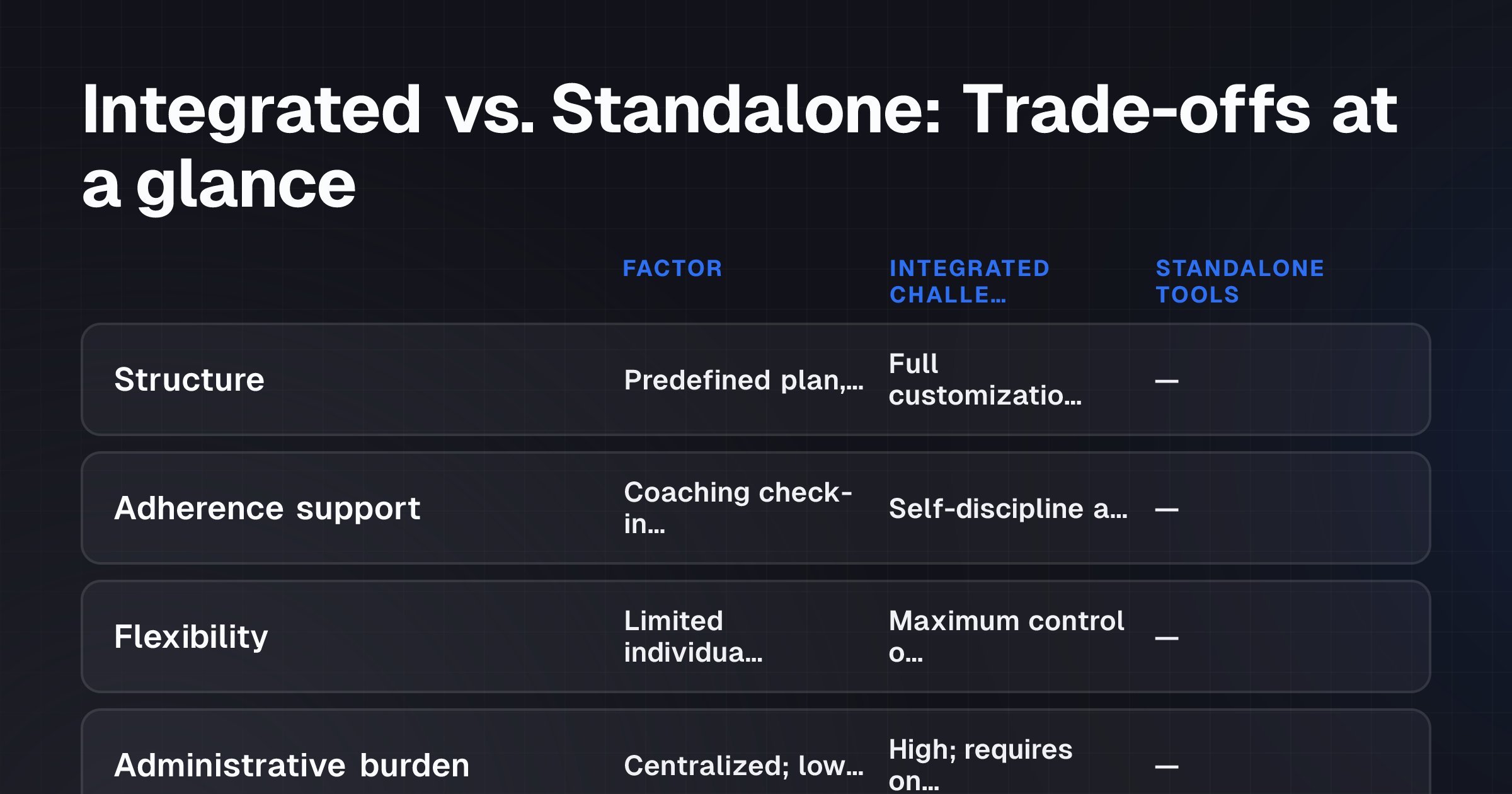
| Factor | Integrated Challenge | Standalone Tools |
|---|---|---|
| Structure | Predefined plan, minimal decision-making | Full customization, requires research and assembly |
| Adherence support | Coaching check-ins, community engagement, accountability mechanisms | Self-discipline and self-monitoring only |
| Flexibility | Limited individual modification | Maximum control over every component |
| Administrative burden | Centralized; low daily overhead | High; requires ongoing research and management |
| Data integration | All metrics in one system | Disconnected data; requires manual cross-referencing |
| Suitability for beginners | High (structure removes decision friction) | Low (requires significant prior knowledge) |
| Suitability for experienced, self-directed participants | Lower (structure may feel restrictive) | High (supports customization preference) |
Integrated challenges: Trade-offs and risks
High structure and built-in accountability come with reduced flexibility for individual preferences.
A "one-size-fits-all" approach may not optimize results for participants with specific constraints: equipment limitations, dietary requirements, injury history, or scheduling conflicts.
The common mistake is joining a challenging program without fully understanding the time commitment required for consistent engagement, leading to abandonment when real-world scheduling conflicts arise.
Standalone tools: Trade-offs and risks
Maximum customization and control require significant effort in research, setup, and ongoing management.
Disconnected data, inconsistent tracking methodology, and lack of integrated feedback can lead to suboptimal progress, missed pattern recognition, or program abandonment.
The common mistake is overestimating self-discipline and fitness knowledge, leading to a fragmented approach that lacks overall coherence. Participants often assemble tools without a clear underlying training philosophy or periodization strategy.
Integrated challenge model
Setup cost: Participant pays upfront for the complete program (pricing varies by provider and market).
Implementation friction: Low. Participant enrolls, receives a plan, and follows guidance. The program operator handles integration, data flow, and feedback mechanisms.
Risk to participant: Misalignment between program design and individual needs. If the program's training methodology or nutrition approach doesn't suit the participant, switching costs are high, loss of upfront fee, restart time.
Ongoing cost: Single program fee covers all components; no additional tool subscriptions required.
Evidence on effectiveness: Research indicates that structured programs with external accountability mechanisms achieve higher participant adherence rates. The concept mirrors principles discussed in The Importance of Routines in Life and Business, where predefined structure reduces decision fatigue and supports consistency.
Standalone tool model
Setup cost: Variable. Some tools are free; others charge per month or per feature. Total cost depends on how many tools are assembled and whether all are paid tiers.
Implementation friction: High. Participant must research tools, integrate them (manually or via API), learn each interface, and manage data flow across systems.
Risk to participant: Fragmentation risk. Without a coherent training philosophy underlying the tool selection, participants may collect metrics without a clear action framework, leading to confusion or poor adherence.
Ongoing cost: Cumulative subscription fees across multiple tools. Total cost may exceed integrated challenge pricing if many premium tools are selected.
Evidence on effectiveness: Individual tracking applications serve as components in a self-assembled plan. Effectiveness depends entirely on participant discipline and underlying program structure; the tool itself doesn't provide accountability or coaching feedback.
Which option fits which situation
Integrated challenges are the better fit when:
- Participant has limited fitness knowledge and benefits from structured guidance removing decision-making friction.
- Participant values external accountability, coaching check-ins, community engagement, as a motivator.
- Participant has limited time for program management and prefers a centralized system.
- Participant benefits from predefined periodization and progression built into the program.
- Operator is designing for mass-market appeal and wants to reduce participant dropout due to complexity.
- The program's training methodology and nutrition approach align with the participant's constraints and preferences.
Standalone tools are the better fit when:
- Participant has strong fitness knowledge and clear understanding of their own training preferences.
- Participant values customization and the ability to modify exercises, nutrition, or tracking based on individual constraints.
- Participant has the time and technical comfort to research, integrate, and manage multiple systems.
- Participant has high internal motivation and doesn't rely on external accountability mechanisms.
- Participant has specific needs, particular dietary restriction, injury history, or equipment limitation, that a standard program doesn't address well.
- Operator is designing for a power-user segment that expects granular control.
What to verify before deciding
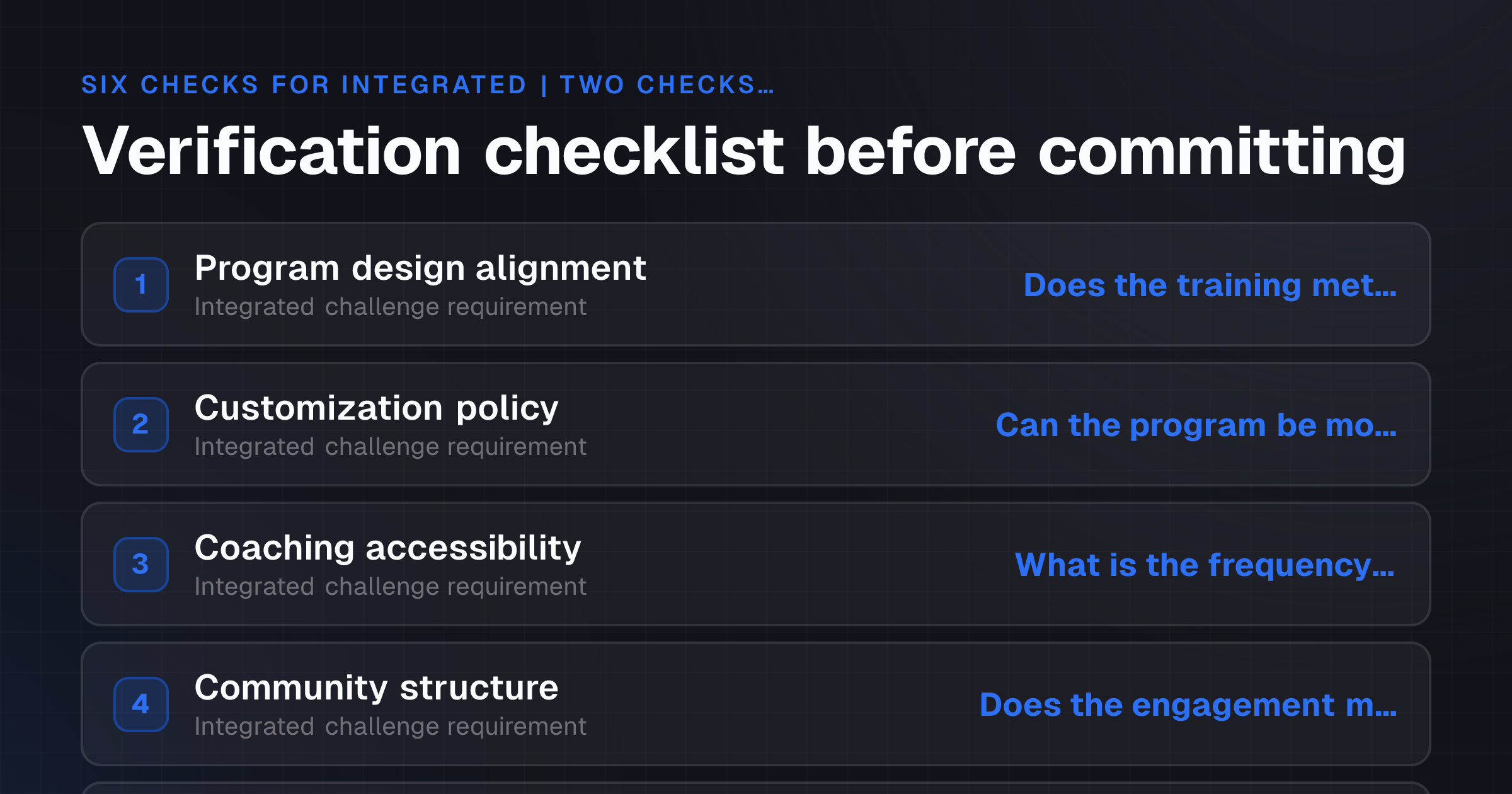
Before committing to either approach, verify the following:
For integrated challenges:
Program design alignment: Does the training methodology (e.g., periodization style, rep ranges, exercise selection) match your fitness goals and current experience level?
Customization policy: Can the program be modified for equipment limitations, injury history, or dietary constraints without violating program terms?
Coaching accessibility: What's the frequency and format of coaching check-ins? Is feedback personalized or templated?
Community structure: Does the community mechanism, private group, forum, video calls, match your preference for social engagement?
Completion guarantee terms: If a money-back guarantee exists, what specific outcomes must be met? Adherence percentage, compliance with program guidelines?
Data retention: Can you export your data at program end, or does it remain locked in the platform?
For standalone tools:
Underlying program philosophy: Before selecting tools, define a clear training methodology (e.g., linear periodization, hypertrophy focus) and nutrition approach (e.g., calorie targets, macro allocation). Don't select tools first and then try to build a program around them.
Integration capability: Can the tools communicate with each other via API or shared export? Or will data entry be entirely manual?
Measurement consistency: Does each tool measure metrics in a compatible way? For example, do all apps track macronutrients using the same food database?
Feedback mechanisms: Will you build in regular, weekly or biweekly, review points to assess progress and adjust the program? Without these checkpoints, standalone tools become data collectors rather than decision-making systems.
Support access: If you get stuck or injured, does any single tool offer coaching or guidance, or will you need to source support separately?
Total cost calculation: Sum the actual monthly or annual cost of all tools you plan to use. Compare to the cost of a comparable integrated challenge.
Next step
For operators and program designers: assess your target participant population. Define the typical profile, fitness knowledge, motivation type, technical comfort, time availability. Decide whether integrated or standalone better aligns with that profile and your operational capacity.
Then design your program or platform accordingly. If you serve both segments, consider offering both models: one integrated offering for mass-market appeal and one toolkit approach for power users. The strategic considerations share principles with From Employee to Entrepreneur: A Mindset Shift for Success, where matching approach to audience capacity drives results.
For participants: identify which of the four decision criteria, fitness knowledge, customization preference, available management time, reliance on external support, matter most to you. If three or more favor integrated approaches, join a structured challenge. If three or more favor standalone tools, invest time in building a coherent program first, then select tools to support it.
Don't reverse this order. A structured approach to time management, discussed in How to Make the Most of Your Free Hours: Small Steps Toward Big Success, applies equally to fitness transformations: clarity of purpose before tool selection reduces wasted effort. For comprehensive guidance on structuring an eight-week program holistically, whether integrated or self-assembled, refer to Your GPS for the whole ecosystem.