Affiliate Marketing vs Traditional Business: The Ultimate Profitability Showdown
Give a café and an affiliate the same $100K in revenue and one keeps $15K while the other keeps $85K. I run the net margins across a dozen traditional industries and every affiliate model — so you can see exactly where t…

Entrepreneurs keep asking me the same question: what's the leanest way to actually generate income? For decades the default answer was a traditional business. Meanwhile, affiliate marketing quietly rewired the maths.
Minimal startup costs. Serious scalability. And on net profit — the number that actually matters — affiliate marketing now rivals, and in many cases beats, the traditional industries.
So let's run it properly. I'll take you through average margins across the classic industries, the main affiliate models, and what $100,000 in revenue actually leaves behind in each one.
First: what profit margin actually means
Quick definition, because everything below hangs on it:
Profit margin = (net profit / revenue) x 100
It's how much you keep after everything's paid. Make $100,000 in revenue and net $30,000 after all expenses — that's a 30% margin.
Two versions matter:
- Gross profit margin — what's left after the cost of goods sold, before operating costs.
- Net profit margin — what's left after everything: operations, marketing, payroll, taxes.
Net is the honest one. That's the number I'm using here — the true profitability indicator.
What traditional industries actually keep
Traditional business covers a huge spectrum, from labour-heavy construction firms to IP-driven SaaS. Here's how average net profit margins stack up, industry by industry:
- Accounting, law, consulting — 15% to 25%
- Software & SaaS — 10% to 30%+
- Finance (e.g. investment firms) — 15% to 25%+
- Real estate (brokerage, flipping) — 15% to 25%+
- Healthcare (non-insurance) — 10% to 15%
- E-commerce — 5% to 10%
- Manufacturing — 5% to 15%
- Retail (physical) — 2% to 6%
- Restaurants & food services — 3% to 8%
- Construction — 5% to 10%
- Transportation & logistics — 4% to 9%
- Hospitality (hotels, events) — 4% to 10%
Notice the ceiling. Traditional models eat capital, teams, infrastructure and logistics — and even a lean operation rarely clears 25–30% net.
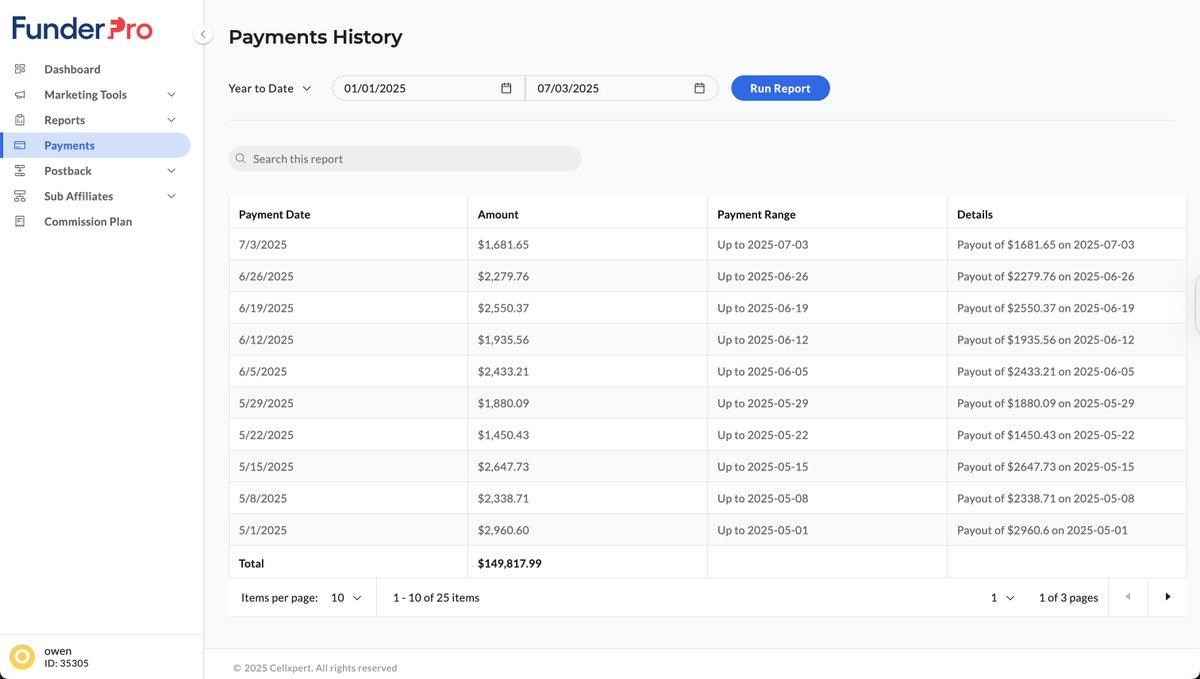
Affiliate marketing: the margin outlier
Affiliate marketing skips the expensive parts. No product to develop. No fulfilment to manage. No customer support queue. You earn commissions for driving leads or sales to someone else's business.
Typical net margins by model:
- Organic affiliates (blogs, SEO, YouTube) — 70% to 85%
- Email list monetisers — 70% to 90%
- Social media influencers (faceless or personal brands) — 50% to 80%
- Funnel-based marketers — 50% to 75%
- PPC/paid traffic affiliates — 15% to 30%
Those numbers hold because the cost base is tiny. Typically it's just:
- Content creation tools (Canva, ChatGPT, Descript)
- A landing page or email tool (ConvertKit, Systeme.io)
- The occasional virtual assistant or some media buying
The $100,000 breakdown, model by model
Now the part that makes it real. Give an affiliate marketer and a traditional business the same $100,000 in revenue. What's left after expenses?
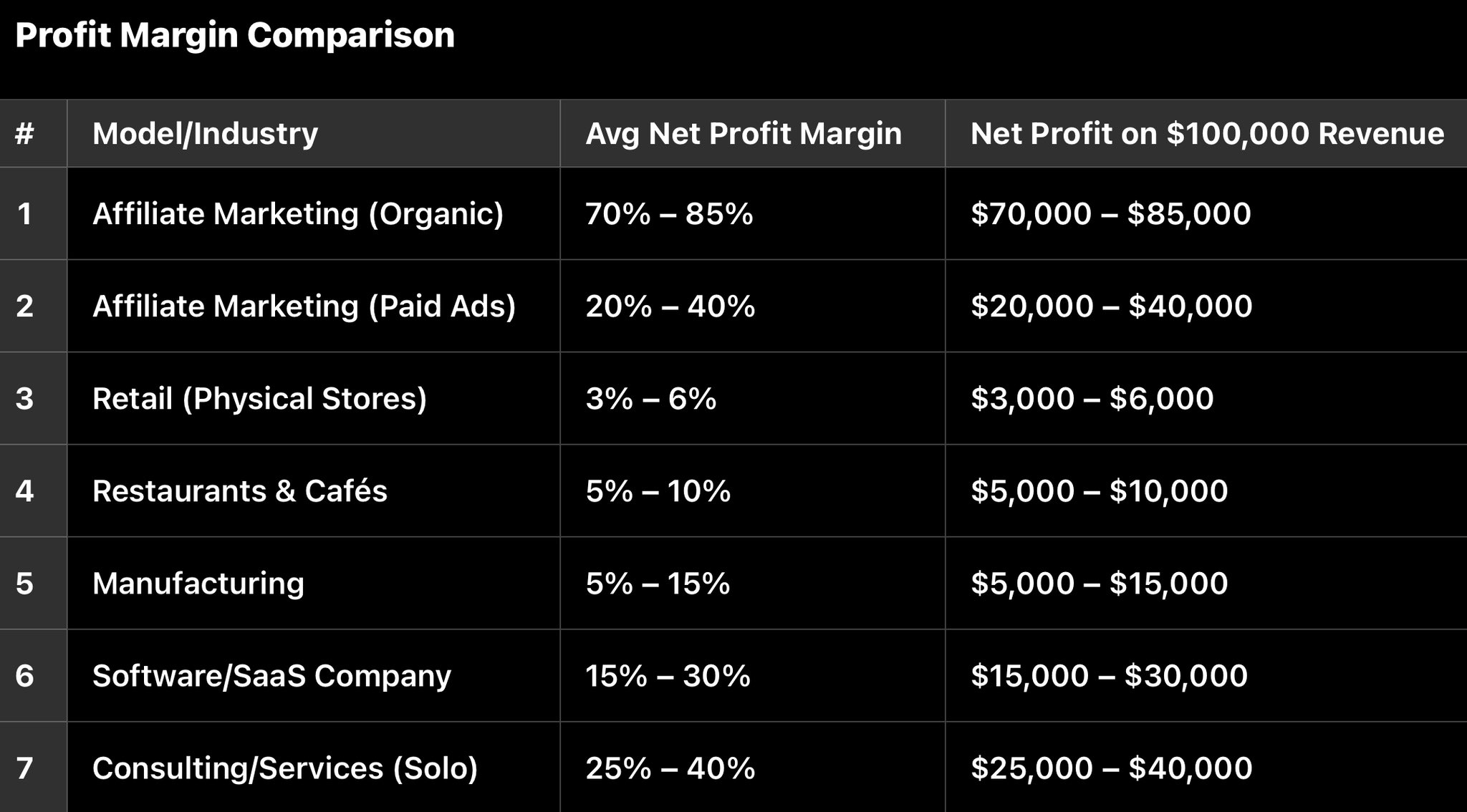
Why affiliates come out ahead
It comes down to simplicity and scalability:
- Low overhead — no office, no staff, no inventory.
- High scalability — one piece of content can keep paying you for years.
- Automation — emails, funnels and social posts run without you in the room.
- Leverage — AI, VAs and templates multiply what one person can do.
A restaurant needs ten staff, licences, rent and inventory to make $100K. An affiliate may need time, a laptop and a strategy.
The risks — because there are risks
I won't pretend this model is perfect. It isn't:
- Platform dependence — a YouTube, Instagram or Google change can hurt your visibility overnight.
- Commission changes — merchants can lower or cancel programmes whenever they like.
- Delayed payouts and inconsistent earnings.
- High competition in trending niches.
The answer is diversification — across platforms, programmes and traffic sources. Manage it that way and the risk stays workable. And when something breaks, pivoting is faster and cheaper than it ever is in a traditional business.
Scaling the income
Say you're earning $5,000 a month in affiliate income at a 75% margin. That's $3,750 net. Scale to $50,000 a month and you're keeping $37,500 — more than most full-service agencies or stores.
To scale smart:
- Build an email list with lead magnets — free guides, checklists, courses.
- Automate follow-ups so your affiliate offers promote themselves.
- Repurpose content across Twitter, IG, YouTube and email.
- Choose high-ticket offers — prop firms, SaaS, coaching tools.
- Track and optimise with UTM links and analytics.
A real comparison: affiliate vs café owner
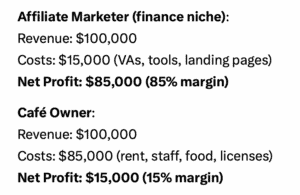
Similar revenue. The affiliate keeps 5x more in profit.
Where I land on this
Affiliate vs traditional isn't close on the numbers: better net margins, easier scaling, far less operational stress. Traditional business still has its place — build one if you want tangible assets or a brick-and-mortar legacy brand. But for lean, fast-moving entrepreneurs? Affiliate marketing is one of the smartest models available.
Whether you're starting with zero capital or already running profitable funnels, scaling income without scaling overhead is the whole game. Digital tools keep getting smarter, audiences keep moving online, and the affiliates building now are the ones positioned to benefit.
Would you rather make $100K and keep $15K… or $85K? Run the numbers yourself.
Use the links below to go deeper
My 30-day passive income process
FunderPro — use code Owen
Follow my Telegram channel for more
TradesAI free signals
Not financial advice.
Building something in this space?
I partner with a select few founders to scale IP-driven businesses — like the ones in the portfolio.
Apply to BuildRelated reading
 Founders Series
You’re Doing Affiliate Marketing Wrong.
Most people who "try" affiliate marketing post a link twice and quit — that's a Tuesday, not a business. Here's what the nine-out-of-ten who…
Read more→ Founders Series
How My First 15 Years in Business Prepared Me for Success
More than $4.7 million in under two years looks like a lucky break. It wasn't — it was 15 years of preparation nobody saw, from bartending i…
Read more→Founders SeriesThe Real Reason Most Entrepreneurs Never Break $10K/Month
Most entrepreneurs hit the same ceiling: income climbs to five figures a month, then flattens. The fix isn't skill — it's leverage. Here's t…
Read more→Ready to build your future?
Work with an operator who has launched, scaled and exited across fintech, payments and trading.