
New brokerage operators choosing their infrastructure path in 2026 face three distinct models: licensing a complete white-label platform, assembling best-of-breed components via APIs, or building proprietary technology in-house. Each carries different regulatory timelines, upfront costs, ongoing unit economics, and long-term control trade-offs. The decision hinges on target jurisdiction, team capacity, capital availability, and whether speed to market or proprietary differentiation drives your launch strategy. This piece outlines what founders should verify before signing any platform contract, the due diligence items that determine whether you've chosen the right path for your regulatory exposure, growth projections, and operational constraints.
What changed: Three infrastructure models now define broker entry strategy
Brokerage operators historically faced a binary choice: license a turnkey platform or undertake a full in-house build.
A viable third model has emerged. API-first infrastructure, integrating specialized components from different providers rather than accepting a single vendor's constraints or bearing the full cost and timeline of a monolithic build, now offers a middle path that many early-stage operators overlook during their initial evaluation.
TradeLocker, a web platform launched in March 2023 with TradingView charting built for brokers and prop firms, exemplifies this maturation. It enables over 80 prop firms to operate on its infrastructure rather than building separate platforms. FunderPro launched in March 2023 on TradeLocker infrastructure, demonstrating rapid market entry via white-label licensing.
The shift matters because it expands operator optionality. A new prop firm or broker is no longer choosing between speed-with-constraint or control-with-delay. You can now evaluate three trade-off profiles: proven-and-fast, modular-and-flexible, or owned-and-bespoke.
Who is affected: New prop operators and early-stage brokers making infrastructure decisions
This decision applies directly to:
- New proprietary trading firms preparing to launch challenge-based or instant-funding products and needing a compliant trading platform within a defined regulatory jurisdiction.
- Emerging forex or CFD brokers targeting specific geographies, such as Mauritius FSC-regulated operators like NextTrade, and requiring proof of technology capability during licensing review.
- Fintech operators expanding into trading verticals and evaluating whether to build, buy or integrate specialist vendors.
- Platform teams at brokers or aggregators deciding whether to maintain a monolithic in-house system or migrate to modular, vendor-managed components.
The choice affects regulatory approval timelines, capital deployment, team hiring, and competitive differentiation.
It's not a one-time decision. Operators may shift models as they scale, migrate between platforms, or encounter regulatory changes that force a technology rethink.
The practical operating impact: Regulatory timelines, costs, and unit economics differ materially across models
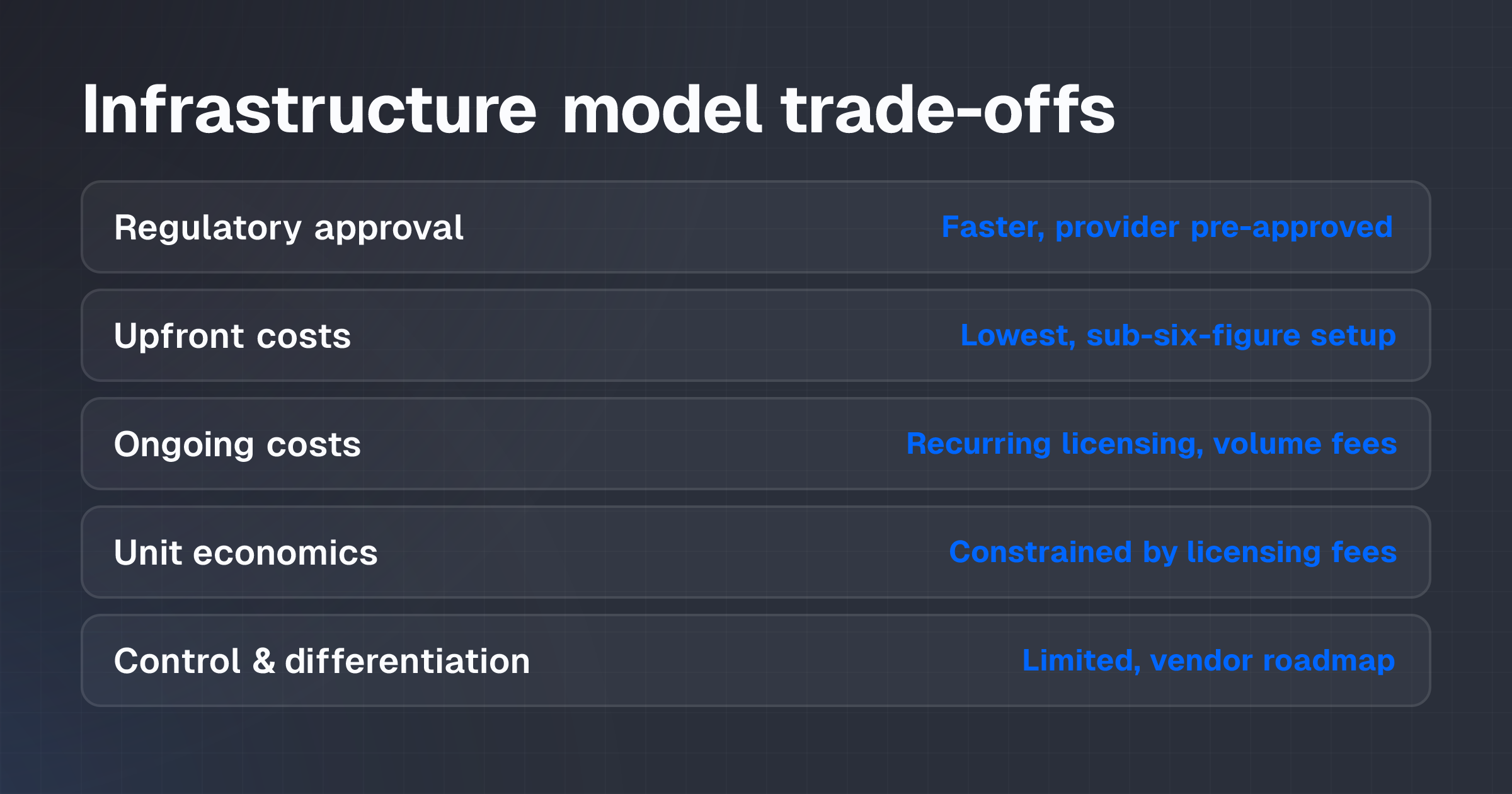
White-label licensing
Regulatory approval: Faster than in-house builds. The platform provider operates with established licenses and has undergone prior regulatory scrutiny in your target jurisdiction, so your application typically focuses on your firm's governance, capital, and business conduct, not technology validation. Timelines vary by jurisdiction; a Mauritius-based FSC application may differ from a European or Middle Eastern pathway, and you should engage local regulatory counsel to estimate the specific timeline for your setup.
Upfront costs: Lower than in-house. Setup fees, onboarding, and minimum commitments typically range below six figures for smaller operators, though this article does not cover specific pricing because it varies widely by provider and client scale.
Ongoing costs: Recurring licensing fees, per-user charges, volume-based fees, data fees, and support tiers. A lower transaction cost does not automatically mean a lower total operating cost; monthly recurring expenses can accumulate, and operators should request detailed cost breakdowns to compare total cost of ownership across multiple vendors before committing.
Unit economics: Per-client profitability depends on the revenue model, spreads, commissions, funding fees, minus licensing fees and support costs. White-label providers often standardize features, which may constrain your ability to differentiate on product. Margin pressure can result if multiple brokers on the same platform compete for similar client segments.
Control and differentiation: Limited. You inherit the provider's roadmap, feature set, and compliance refresh cycle. Proprietary intellectual property in the platform is unavailable. Vendor lock-in risk is material: migrating client data and operations to a different platform incurs cost and operational disruption, which many operators underestimate when they sign the initial contract.
API-first (modular) infrastructure
Regulatory approval: Moderate complexity. You integrate components from multiple licensed providers, trading engine, KYC, payment gateway, CRM, each of which may carry existing regulatory approvals. Your application must document integration points, data flow, and security protocols. This is more work than white-label but potentially less than a full proprietary build. Approval timelines depend on the jurisdiction and the integration's complexity.
Upfront costs: Mid-range. You pay setup fees to each component provider, plus engineering time to integrate APIs and test workflows. Capital required is lower than in-house builds but higher than white-label licensing.
Ongoing costs: Multiple vendor relationships. Each provider charges separately; the total can exceed a single white-label fee if you integrate many components. However, you can optimize each element: choosing the cheapest charting API, the most cost-effective payment gateway, or the fastest KYC provider based on your client mix and geographic focus.
Unit economics: More favorable if executed efficiently. You can mix and match vendors based on cost-per-user or transaction volume, adapting as your client mix changes. Managing multiple SLAs, support channels, and uptime dependencies is operationally demanding, though, and some teams underestimate the coordination overhead.
Control and differentiation: Moderate to high. You control the workflow, user experience, and data architecture. You can swap vendors if one underperforms or raises prices. Proprietary advantage is possible through unique integration patterns or feature combinations, but integration complexity can delay launches and introduce unforeseen bugs that a turnkey solution would have already resolved.
In-house build
Regulatory approval: Slowest. Regulators typically require extensive validation of proprietary systems: architecture reviews, penetration testing, audit trails, disaster recovery plans, and trading engine certification. Timelines often extend 6-12 months or longer depending on jurisdiction and regulator stringency.
Upfront costs: Highest. Engineering hiring, infrastructure, security certifications, and legal/compliance setup can reach seven figures before launch. You must fund development, QA, security audits, and regulatory pre-approval work upfront.
Ongoing costs: Primarily staff and infrastructure. No external licensing fees, but you bear full responsibility for platform maintenance, security patches, compliance updates, and scalability as client volumes grow.
Unit economics: Favorable at scale. Once development is amortized, per-client costs decrease. If you operate at high client volumes or long time horizons, the lower ongoing fees offset high initial investment. Early stages are unprofitable from a per-user perspective, which matters if you're raising capital or managing runway.
Control and differentiation: Complete. You own all intellectual property, set your own roadmap, and can build features competitors cannot immediately replicate. Long-term strategic advantage is available, but only if you sustain the technical and organizational investment over multiple years without distraction or funding gaps.
What teams should review: A founder's platform contract checklist
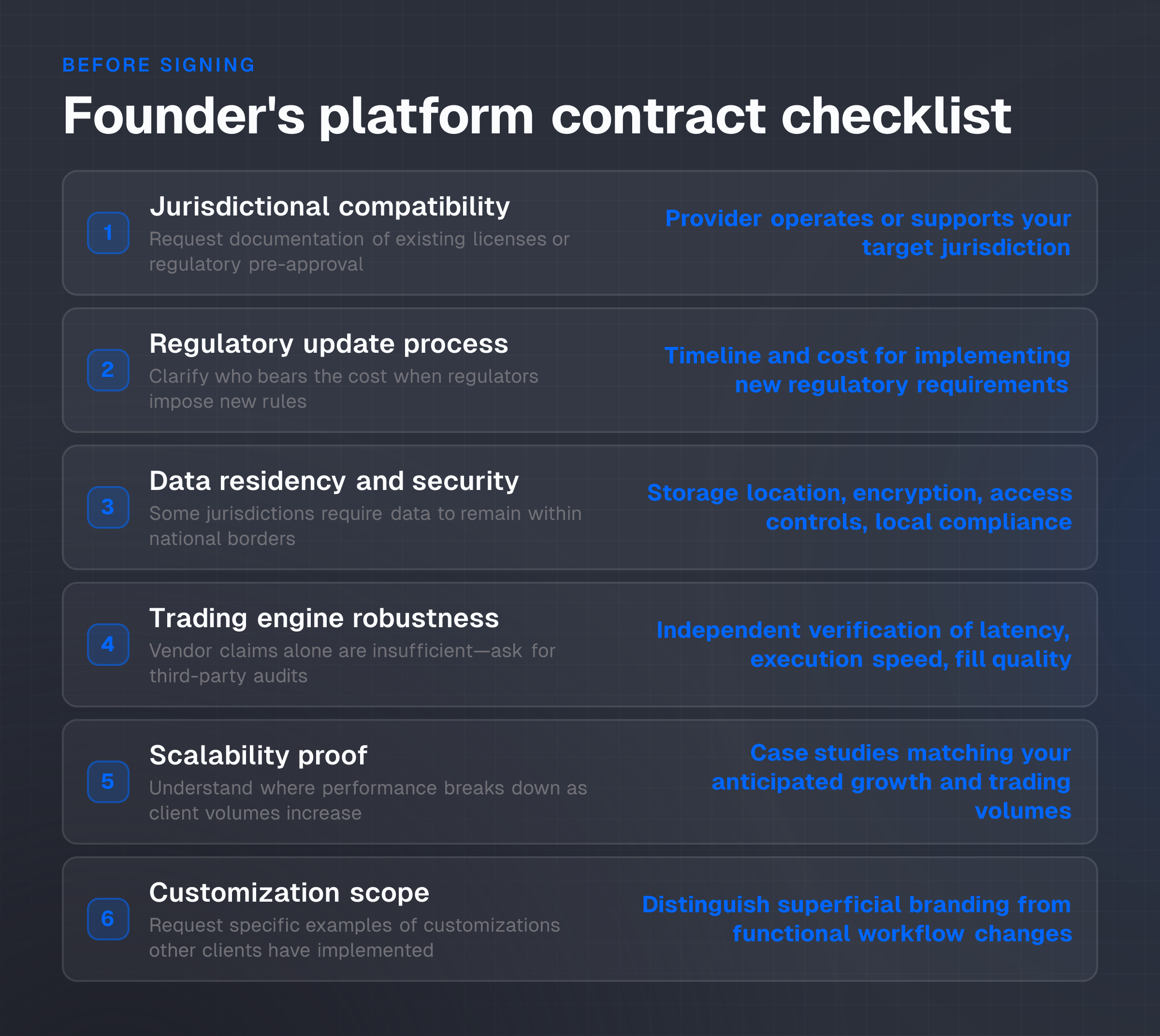
Before signing any platform contract, whether white-label or API-first, engage technical, legal, and compliance specialists to verify the following.
Regulatory compliance and support
Jurisdictional compatibility: Does the provider operate in your target jurisdiction or explicitly support licensing applications there? Request documentation of existing licenses or regulatory pre-approval. Some providers list jurisdictions they support but lack direct operating experience in those markets, which can delay your approval or introduce compliance gaps.
Regulatory update process: How does the provider handle regulatory changes? What is their timeline for platform updates to reflect new requirements? If a regulator imposes a new reporting obligation or trade surveillance rule, you need to know whether the provider will implement it within weeks or months, and whether you bear any cost for that work.
Data residency and security: Where is client data stored? Does it comply with local data protection laws, GDPR, CCPA, or jurisdiction-specific rules? What encryption and access controls are in place? Some jurisdictions require data to remain within national borders, and violating those rules can result in fines or license suspension.
Technology and performance
Trading engine robustness: Request independent verification of latency, order execution speeds, and fill quality. Vendor claims alone are insufficient; ask for third-party audit reports or arrange a proof-of-concept test under realistic load conditions.
Scalability proof: Ask for case studies or proof-of-concept runs matching your anticipated client growth and trading volumes. A platform that works well for 500 users may degrade at 5,000, and you need to understand where those breaking points occur.
Customization scope: Distinguish superficial branding, logos, colors, from functional customization: workflow changes, reporting, user experience. Clarify what is genuinely possible within the licensing agreement, not just what the sales team describes as "flexible." Request specific examples of customizations other clients have implemented.
Uptime and redundancy: Request specific SLA percentages (e.g., 99.9%) and review disaster recovery and business continuity plans in writing. If the platform goes down during peak trading hours, what is the provider's response time, and what compensation or credits do you receive?
API documentation (if modular): Are APIs well-documented and stable? Is dedicated developer support available? Some vendors release APIs with minimal documentation, which increases integration time and error rates.
Integration ecosystem: What third-party integrations, CRM, payment, KYC/AML, are pre-built or easily connected? This accelerates time-to-launch and reduces the engineering burden on your team.
Costs and commercial terms
Upfront costs: Itemize all setup fees, onboarding costs, minimum commitments, and implementation support. Some providers bundle these into a single figure; others charge separately, and the total can diverge significantly from the initial quote.
Ongoing fees: Request detailed breakdowns of monthly licensing, per-user charges, volume-based fees, data fees, support tiers, and any other hidden charges. Ask for cost projections under different growth scenarios, 100 clients, 1,000 clients, 10,000 clients, so you can model profitability accurately.
Exit and migration: What are the terms for leaving? Can you export client data? Are there penalties or prohibitive data migration costs? Clarify these before signing, because some contracts impose steep exit fees or withhold client data until all fees are settled, which can trap you in a relationship that no longer serves your business.
Price transparency: Request a detailed cost model showing total cost of ownership over 12, 24, and 36 months under different client growth scenarios. This helps you compare platforms on a like-for-like basis rather than relying on headline figures that obscure the true cost structure.
Support and partnership
Technical support channels: What are response times for critical issues? Is 24/7 support available, and in which languages? If your clients trade around the clock, you need support that matches those hours.
Dedicated account management: Will you have a named account manager? What is their involvement in onboarding, roadmap influence, and issue escalation? Some providers assign account managers only to larger clients, leaving smaller operators to rely on generic support tickets.
Roadmap and feature releases: How often is the platform updated? How is new functionality communicated? Can you influence feature priorities, or is the roadmap entirely determined by the provider's largest clients?
References: Request contact information for existing clients operating at similar scale or in similar regulatory contexts. Speak with them directly. Ask about hidden costs, support responsiveness, and whether they would choose the same provider again.
What remains uncertain: Data gaps in infrastructure cost and regulatory timelines
This analysis does not cover:
- Specific average costs (upfront and ongoing) for each model in 2026. Pricing varies widely by provider, jurisdiction, and client scale. Operators must obtain and compare detailed quotes from multiple vendors before committing.
- Precise regulatory approval timelines for different jurisdictions and each infrastructure model. Timelines depend on regulator workload, the complexity of your business plan, and the jurisdiction's technology validation practices. Engage local regulatory counsel to estimate the timeline for your specific setup.
- Quantified case studies showing ROI, time-to-profitability, or cost savings for each approach. Published comparisons are limited; most operators run internal financial models to evaluate paths based on their own client acquisition costs, revenue projections, and capital constraints.
Operators should budget time and capital for due diligence: obtain multiple cost quotes, engage local regulatory counsel to estimate approval timelines, and request references from operators who have chosen each path in your target jurisdiction.
Timeline and primary sources
This article draws on the brand's published materials and verified public sources. Key facts include:
- TradeLocker launch: March 2023, described as a web platform with TradingView charting built for brokers and prop firms, serving over 80 prop firms.
- FunderPro launch: March 2023, operating on TradeLocker infrastructure, demonstrating rapid market entry via white-label licensing.
- Regulatory context: Operating a regulated FX broker, such as NextTrade in Mauritius (FSC-regulated), requires adherence to specific guidelines and capital requirements that vary by jurisdiction.
The comparison framework, white-label, API-first, and in-house build, reflects current market practice among operators launching in 2026.
Last verified
3 November 2026
Next step
If you're evaluating infrastructure options, begin by clarifying your regulatory jurisdiction and required licenses. Then define your technical team's capacity: do you have in-house developers experienced in high-performance financial systems, or will you depend on external vendors? Use the founder's contract checklist above to structure your due diligence with each potential provider. Request detailed cost projections, regulatory support documentation, and references before committing. Compare total cost of ownership across all three models over your anticipated time horizon, 3 to 5 years, accounting for likely client growth and regulatory change. The right choice depends on your geography, risk tolerance, team capacity, and whether speed to market or long-term proprietary control aligns with your strategic intent.
For deeper context on launching broker infrastructure, see Build vs. Buy: Prop Firm Trading Infrastructure Guide and Why TradeLocker Is the Top B2B Trading Platform for Brokers.