
A trader with stable capital and consistent discipline has built something valuable, but scaling a new business venture typically requires more capital than reinvested trading profits alone can provide, and more time than market hours allow. The constraint is real: dividing focus between active trading and building a business risks both. The solution traders have used to navigate this is the side business model, a parallel revenue stream designed specifically to fund founder growth without cannibalizing trading discipline or capital. This case examines how one operator structured this decision, what trade-offs emerged, and what the model requires to work.
The short version: bootstrapping a parallel revenue stream while maintaining trading discipline
A trader seeking to fund a larger venture faces a practical problem: seed capital and available time are both finite. Rather than deplete trading reserves or compress trading hours, the approach involves identifying a low-capital, flexible side business that generates revenue specifically earmarked for the new venture. The side business acts as a capital engine, freeing the trader from the choice between trading and building.
The key constraint is time separation and financial segregation, keeping trading and the side business in distinct time blocks and separate accounts to prevent one from contaminating the other.
What problem we were solving
Traders who want to build and scale a new business face a structural conflict.
Trading requires consistent execution, discipline, and protected time during market hours. A new venture requires capital investment, product development, customer acquisition, and attention. The capital problem is immediate: seed funding from a traditional source (investors, loans) either requires equity or carries risk to personal finances. The time problem is equally acute, attempting to run both simultaneously, without boundaries, erodes performance in both.
The specific problem this model addresses isn't whether a trader should pursue a new venture, but how to fund and develop it without sacrificing the income source that funds it. How do you bootstrap a founder business using income generated outside of trading, while preserving the trading discipline and capital that underpin the entire operation?
The constraint or trade-off
The central trade-off is attention and energy.
Time allocated to a side business is time not spent on market analysis, trade execution, or rest. The more demanding the side business, the greater the cognitive load and the higher the risk of decision fatigue, a state where judgment deteriorates across multiple domains, affecting both trading and business decisions.
A second trade-off is capital risk. If the side business requires upfront investment, that capital is exposed to venture risk rather than held in reserve for trading. Even small capital draws can compound if they reduce trading account size below an operational threshold or trigger margin constraints.
A third trade-off is emotional spillover.
A losing trade can affect motivation and decision-making in the business. A failed customer acquisition effort can trigger impulsive financial decisions in the trading account. Without clear psychological boundaries between the two activities, negative outcomes in one can cascade into the other.
Common mistakes in this model include underestimating the time required to launch and run the side business, failing to establish clear time boundaries between trading and entrepreneurship, misallocating trading capital into the unproven venture, and allowing emotional outcomes in one domain to override discipline in the other.
What we decided and why
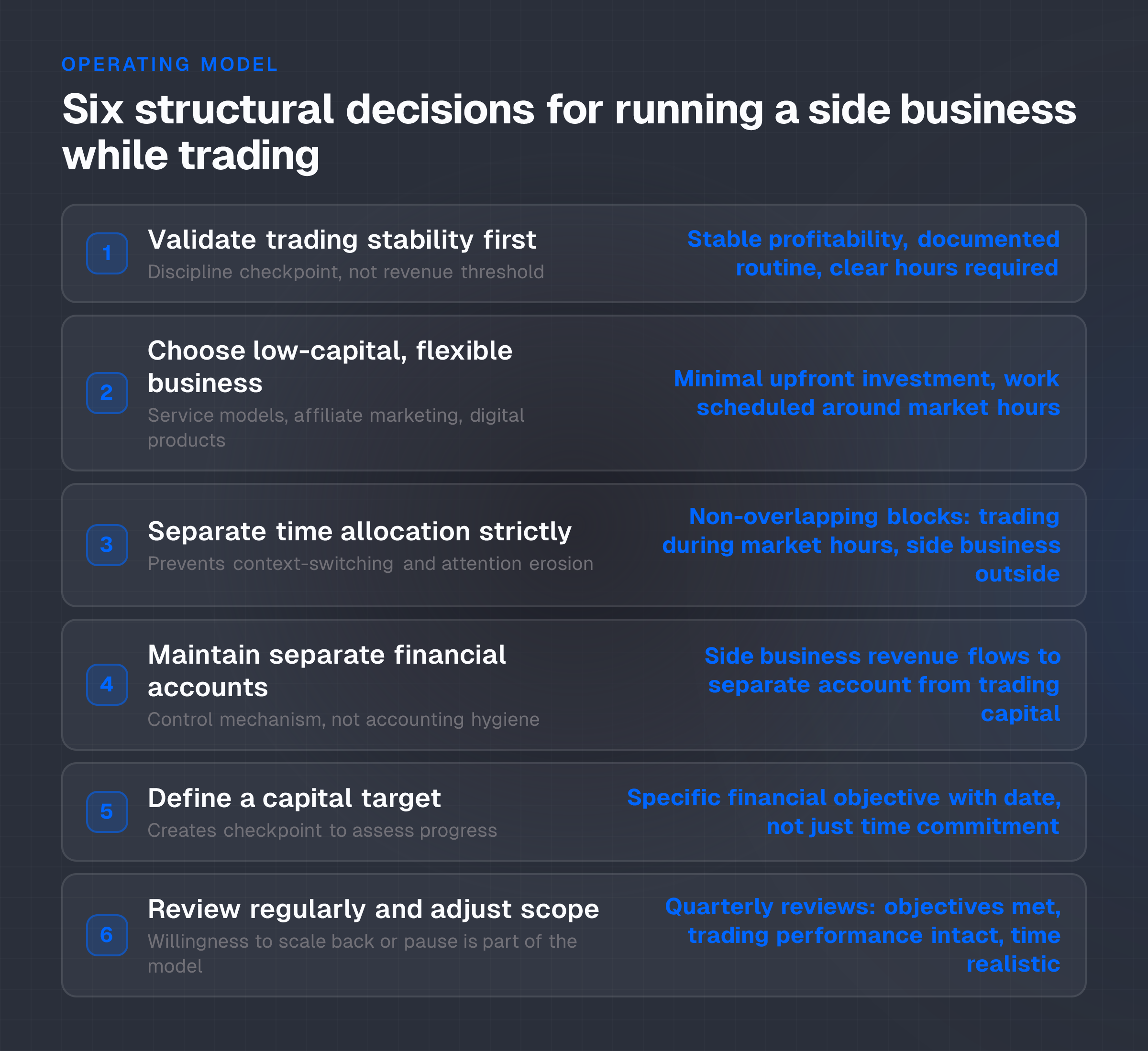
The operating model rests on six structural decisions.
1. Validate trading stability first
Before launching a side business, the trader must establish a baseline: stable profitability in trading, a documented routine, and a clear understanding of hours required to maintain performance. This isn't a revenue threshold but a discipline checkpoint. If trading is inconsistent or relies on reactive decision-making, adding a side business will degrade both.
2. Choose a low-capital, flexible business model
The side business must require minimal upfront investment and allow work to be scheduled around market hours, not during them.
Service-based models (consulting, freelancing), affiliate marketing, and digital products meet this criterion. Inventory-based or customer-support-heavy models don't.
Affiliate marketing, specifically, offers a structural advantage for this use case. It requires no product creation, no inventory, no direct customer support, and operates on a commission basis, capital is generated only after value is delivered to a customer. The model is also measurable: revenue can be tracked precisely, and performance can be audited independent of trading results.
A case in point: affiliate marketing generated $4.7M in commissions over 21 months for one operator using a connector model, linking customers to established brands without requiring a product or upfront audience. This model scales with effort and skill rather than capital, making it structurally suitable for a trader with limited time and capital to deploy.
3. Separate time allocation strictly
Establish non-overlapping time blocks for trading and side business activities.
Trading should occur during market hours with full attention. Side business work should happen outside market hours, early mornings, evenings, or weekends, in dedicated blocks. This prevents the common error of checking market positions while managing a customer issue or abandoning a customer conversation to react to a trade alert.
4. Maintain separate financial accounts
Side business revenue should flow into a separate bank account from trading capital.
This isn't merely accounting hygiene; it's a control mechanism. It prevents the impulse to deploy side business profits into trading capital (which defeats the purpose of capital diversification) and makes it immediately visible whether the side business is actually generating profit or merely moving money between accounts.
Side business profits should initially be reinvested into the side business or held in reserve for the primary founder project, not cycled back into trading.
5. Define a capital target, not just a time commitment
The side business should have a specific financial objective: "Generate $X by date Y to fund the founder venture" or "Produce enough profit to cover operational costs of the new business for Z months."
This target creates a checkpoint. If the side business isn't on pace to meet it, the decision can be made to either double down, pivot to a different model, or reallocate time differently. A target also prevents the side business from becoming a perpetual, low-priority activity that generates noise but not progress.
6. Review regularly and adjust scope
As the side business scales, its time demands may increase.
Quarterly reviews should assess whether the side business is meeting its objectives, whether it's eroding trading performance, and whether the time allocation remains realistic. The willingness to scale back, pivot, or pause the side business is part of the operating model. The goal isn't to run both forever; it's to run both long enough for the side business to fund the transition to the new venture.
What happened
The affiliate marketing model, when executed with discipline, demonstrates the viability of the approach.
The operator earning $4.7M in affiliate commissions in 21 months did so by applying a connector model: identifying established brands, understanding what customers needed from them, and facilitating that connection in exchange for a commission. The model required no product development, no audience to begin with, and no customer support infrastructure. It was measurable, scalable with effort, and capital-light.
This outcome isn't typical; it reflects high execution skill and a saturated market for fintech affiliate products. It does, however, demonstrate that the model works when the operator has discipline around time allocation, clear targeting, and an understanding of the market they're connecting.
The key finding is structural: when the side business model was implemented with the six decisions above, stable trading baseline, low-capital operation, time separation, financial segregation, a defined target, and regular review, it produced capital specifically earmarked for the founder venture without degrading trading performance.
The side business didn't interfere with trading because the time blocks didn't overlap and the capital was managed separately.
Outcomes vary significantly based on the side business model chosen and the operator's skill in execution. What remained consistent was that operators who enforced strict time boundaries and financial separation saw both trading and the side business perform better than those who blurred the lines between the two.
What we would do differently
Several adjustments would strengthen the model.
Invest earlier in clear role definition. Waiting until the side business becomes time-consuming to establish boundaries is reactive. The time blocks and financial accounts should be set up before revenue starts flowing, not after. This prevents the drift that happens when a small side business grows without explicit operational structure.
Measure opportunity cost explicitly. Track not just side business revenue but the hours invested to generate it. Compare hourly return to trading returns. If the side business generates lower hourly returns than trading during high-opportunity-cost periods (like during major market events), reallocate time to trading in those windows. Many operators optimize for total revenue without accounting for the cost of the time consumed.
Build in a sunset condition.
The side business has a purpose: fund the founder venture. Without a clear endpoint, a revenue target that signals "the side business has done its job, now allocate full time to the new venture", the side business can become permanent, consuming time and attention that should migrate to scaling the main business. A decision rule (e.g., "when the side business reaches $X monthly profit, shut it down and move to the new venture full-time") creates clarity.
Separate emotional decision-making from operational decisions. A trading loss shouldn't trigger a decision to increase side business effort or invest more capital. A side business setback shouldn't cause account-draining trading behavior. Creating a review cadence, quarterly rather than daily, prevents these emotional spillovers from becoming operational changes.
The transferable lesson
The lesson extends beyond traders and side businesses: any operator balancing two demanding activities faces the same structural problem.
Dividing attention between them without clear boundaries degrades both. The solution isn't willpower or longer hours; it's operational architecture.
Specifically: compartmentalization is a force multiplier. Separate time blocks prevent context-switching costs. Separate accounts prevent capital misallocation and emotional spending. A defined financial target prevents drift. Regular review prevents slow degradation of the operating model.
This applies beyond trading and side businesses. It applies to founders running a primary business while advising, founders managing operations while developing products, investors executing trades while managing a fund.
The constraint is always finite time and attention. The solution is always structural separation, not just personal discipline.
The practical insight is that the best performers in dual-activity roles aren't those with the most willpower; they're those with the clearest operating rules. The operator earning $4.7M in affiliate commissions didn't do so by outworking everyone; they did so by building a repeatable, measurable system and protecting the time and capital required to execute it.
For traders specifically, the lesson is: if you want to bootstrap a founder venture, don't compromise trading capital or trading time. Instead, build a third activity, a side business, with its own separate time block and financial account, designed to fund the transition. The constraint that makes this necessary (time and capital are finite) is also what makes it work (it forces discipline on all three activities).
Next step
Before starting a side business alongside trading, assess your trading baseline.
Are your returns consistent? Is your routine established? Do you have protected market hours? If the answer to any of these is no, don't add a side business, stabilize trading first.
If your trading is stable, define your side business objective. What capital do you need to fund your founder venture? What timeline? Work backward from that target to calculate monthly revenue requirements and the effort required to hit them.
Then choose a side business model aligned with your constraints: low capital, flexible schedule, measurable output.
Affiliate marketing, consulting, and digital products meet these criteria; inventory-based or customer-support-heavy models generally don't.
Set up the operational structure before revenue starts flowing. Open a separate account. Block out non-overlapping time. Write down your financial target and review date. This isn't overhead; it's the foundation that allows the model to work.
The transferable principle is that founders who fund their ventures through side income don't do so through heroic effort. They do so through clear operating rules that separate the activities, protect both, and create accountability for each. Start there, and the rest follows.