
Payment processors and stablecoin issuers operating in the European Union face a hard regulatory deadline: by 2026, any entity issuing e-money tokens (EMTs) must hold authorization as either a credit institution or an electronic money institution (EMI). MiCA Article 49 sets this requirement, and the clock began in June 2024. This isn't optional compliance, it determines whether a fintech can legally issue stablecoins pegged to a single fiat currency, or must exit the EU market.
The compliance pathway involves six concrete steps: scope classification, regulatory pathway selection, formal authorization application, operational infrastructure upgrades, staffing and training, and ongoing post-2026 reporting. Each step carries direct costs, application fees, system changes, personnel, and each delays the rest if started late. Last verified: December 2024.
What changed: MiCA Article 49 authorization requirements for e-money token issuers
MiCA (Markets in Crypto-Assets Regulation) entered into force in June 2023. Its stablecoin rules, including Article 49, applied from June 30, 2024. Article 49 mandates that any issuer of e-money tokens, crypto-assets referencing a single fiat currency and intended for payment, must be authorized as a credit institution (bank) or electronic money institution (EMI) under EU law.
Previously, stablecoin issuance operated in a regulatory gray zone in most EU jurisdictions. Article 49 removed that ambiguity.
An entity can't legally issue EMTs in or for the EU market without one of these two authorizations. The regulation applies to payment processors that issue EMTs on behalf of clients, entities that issue proprietary stablecoins, and intermediaries handling EMT issuance workflows.
The phased timeline matters:
- June 30, 2024: Stablecoin rules (Titles III and IV) took effect.
- December 30, 2024: General crypto-asset rules came into force.
- 2026 onward: Full compliance is expected; exact dates for certain reporting provisions may be refined through delegated acts from the European Banking Authority (EBA) and European Securities and Markets Authority (ESMA).
For payment processors, this means authorization applications should have begun in 2024 for completion by 2026.
What it actually requires: EMI licensing, capital reserves, and operational infrastructure
Article 49 doesn't create a new license type. Instead, it channels EMT issuers into existing EU financial institution frameworks.
The two pathways
Electronic Money Institution (EMI) License: Most payment processors pursue this path. An EMI is authorized under the Electronic Money Directive (2009/110/EC) to issue electronic money and provide related payment services. Requirements include:
- Minimum capital: Typically €350,000 in initial capital, though this varies by member state.
- Governance: Board structure, internal audit, risk management committees, and compliance functions.
- Risk management framework: Anti-money laundering (AML), counter-terrorist financing (CTF), operational resilience, and cyber security policies.
- Technical infrastructure: Systems for transaction recording, reconciliation, audit trails, consumer dispute resolution, and regulatory reporting.
- Consumer protection: Segregation of customer funds, complaint handling, and transparency on terms and conditions.
Credit Institution (Bank) License: Full banking authorization carries substantially higher capital requirements (often €1 million+), more intensive governance, and broader prudential rules. It's rarely chosen solely for EMT issuance but suits entities already operating as banks.
Operational requirements under Article 49
Beyond licensing, Article 49 imposes specific obligations:
- Prudential requirements: Maintain capital buffers, manage liquidity risk, and hold reserves sufficient to ensure redemption of EMTs at par value in the referenced fiat currency at all times.
- Redemption guarantee: Issuers must guarantee redemption on demand without delay.
- Consumer information: Clear disclosure of risks, including that the token isn't bank money and may not be protected by deposit insurance.
- Operational monitoring: Real-time tracking of EMT circulation, reserves, and redemption requests.
- Regulatory reporting: Quarterly or annual reporting to competent authorities on EMT issuance, reserves, and redemption activity.
- Custody and segregation: Customer funds and issuer reserves must be properly segregated and held with qualified custodians.
GDPR data protection also applies: any personal data collected for KYC, AML, or transaction purposes must be processed lawfully, transparently, and securely.
Who it affects: Payment processors, stablecoin issuers, and cross-border fintech platforms
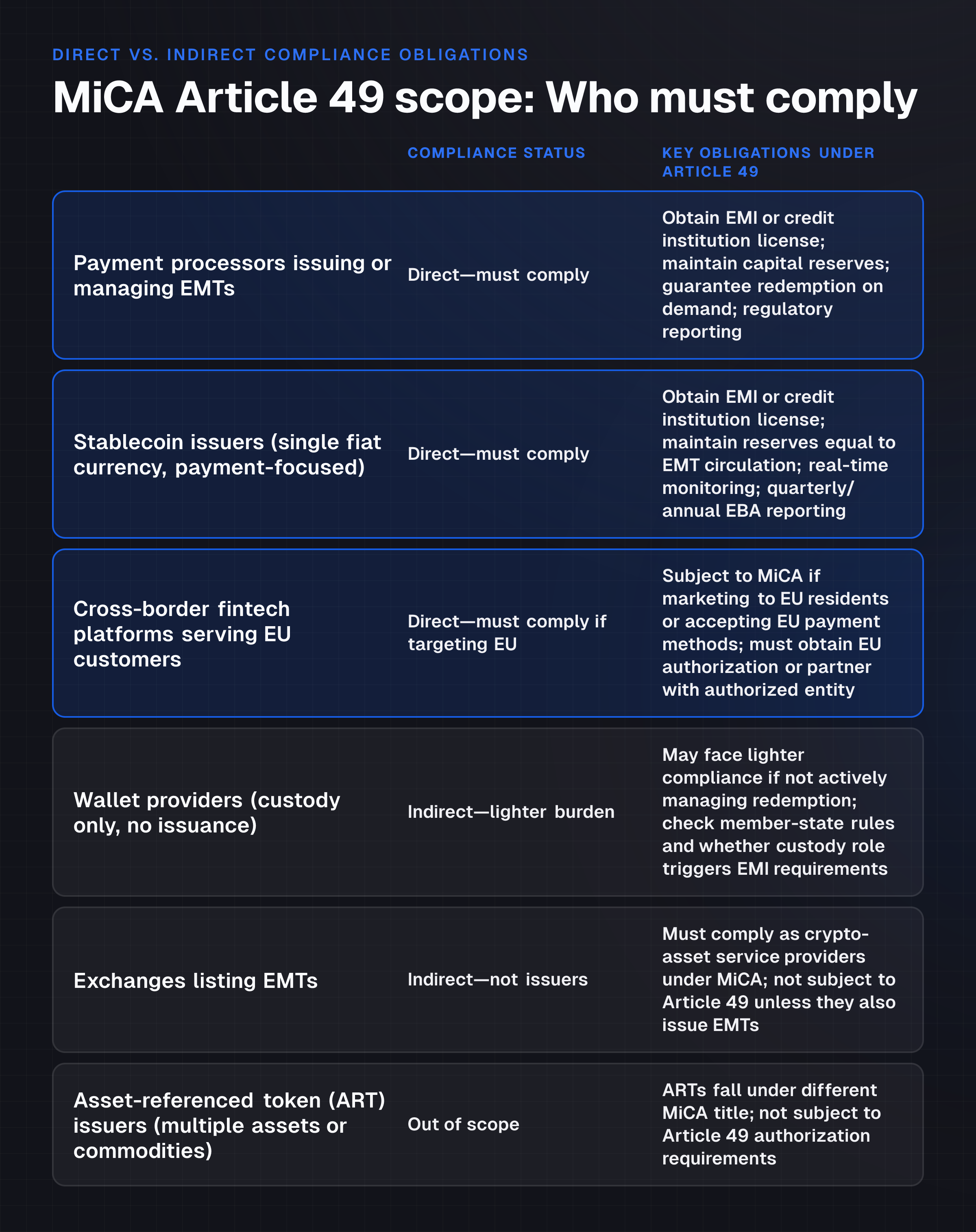
Direct scope: Who must comply
Payment processors issuing or managing EMTs: Any entity that issues an EMT, whether as the direct issuer or on behalf of a client, falls under Article 49. This includes:
- Fintech platforms offering stablecoin payment services.
- B2B payment rails enabling cross-border stablecoin transactions.
- Intermediaries minting or redeeming EMTs for merchant or corporate clients.
Stablecoin issuers: Any firm issuing an EMT (a stablecoin pegged to EUR, USD, GBP, or another single fiat currency) for payment purposes within the EU.
Cross-border fintech platforms: Platforms serving EU customers and offering stablecoin issuance or management, even if incorporated outside the EU, must comply if they target EU users.
Indirect scope: Entities less directly affected
- Wallet providers holding but not issuing EMTs may face lighter compliance burdens depending on whether they actively manage redemption or merely custody.
- Exchanges listing EMTs aren't issuers; however, they may face MiCA obligations as crypto-asset service providers.
- Non-payment stablecoins: Asset-referenced tokens (ARTs) that reference multiple assets or commodities fall under different MiCA rules and aren't subject to Article 49.
Geographic reach
MiCA applies to any activity targeting EU residents or conducted on EU territory. Entities outside the EU offering services to EU customers may be in scope if they:
- Market their EMTs to EU consumers.
- Accept EU bank accounts or payment methods.
- Hold EMT reserves in EU custodians.
What it costs: Authorization fees, system upgrades, staffing, and ongoing compliance
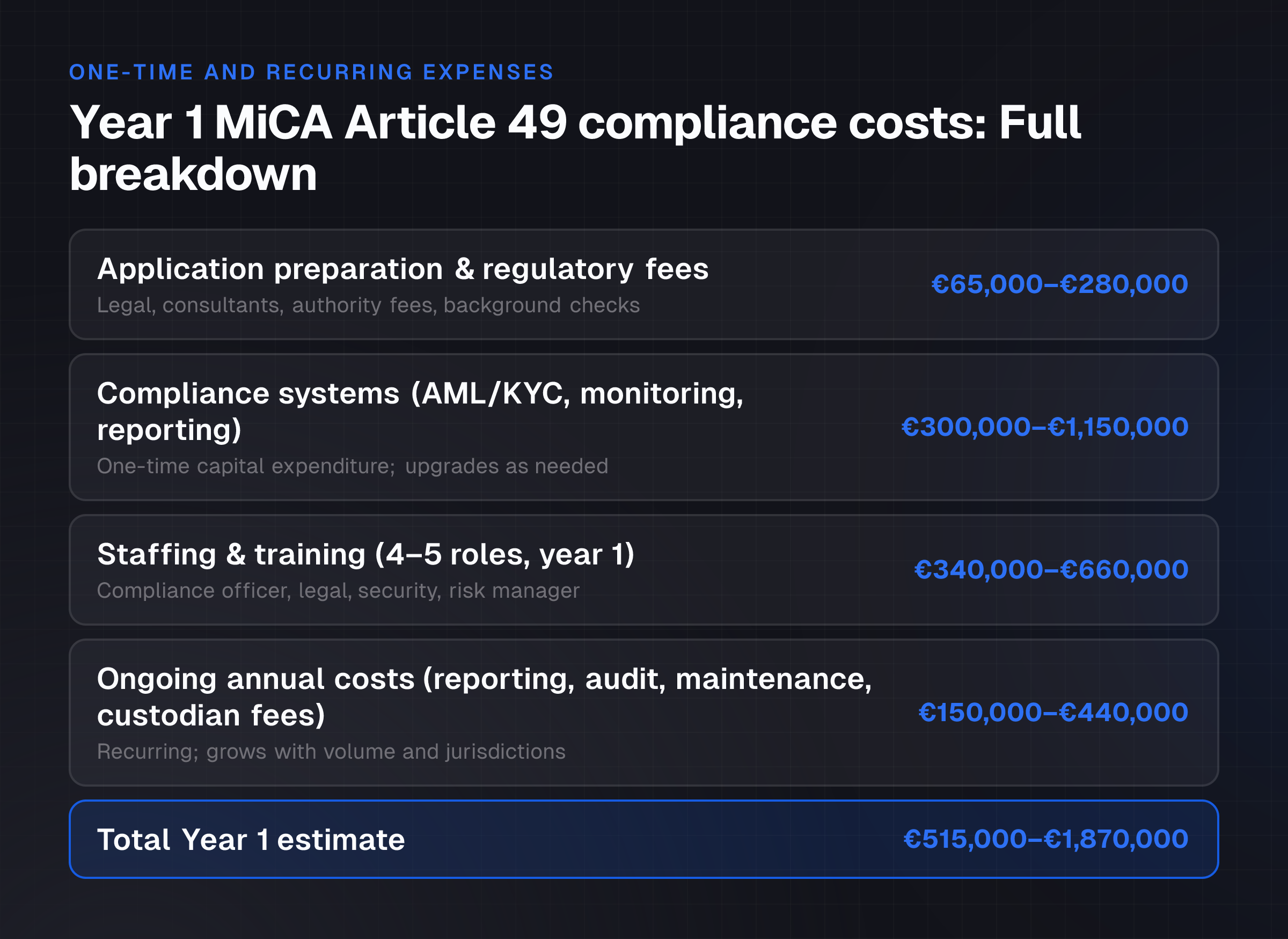
Compliance costs break into several categories. While exact figures vary by jurisdiction and business model, this framework illustrates the scale:
Authorization and licensing costs
| Cost Category | Typical Range | Notes |
|---|---|---|
| Application preparation | €50,000, €200,000 | Legal, compliance, consultants; varies by complexity |
| Regulatory authority fee | €5,000, €50,000 | Varies by member state; some charge flat fees, others charge per application |
| Background checks & verification | €10,000, €30,000 | Beneficial owners, directors, key staff |
| Total authorization phase | €65,000, €280,000 | Non-recurring; 12-18 months to complete |
Operational infrastructure and systems
| Cost Category | Typical Range | Notes |
|---|---|---|
| Compliance systems (AML/KYC) | €100,000, €500,000 | New systems or upgrades to existing platforms |
| Transaction monitoring & reporting tools | €50,000, €200,000 | Regulatory reporting, audit trails, GDPR compliance |
| Cybersecurity & data protection | €100,000, €300,000 | Penetration testing, encryption, incident response |
| Reserve & redemption infrastructure | €50,000, €150,000 | Real-time reconciliation, custodian integration |
| Total systems & infrastructure | €300,000, €1,150,000 | One-time capital expenditure; varies by scale |
Staffing and training
| Role | Annual Cost (per FTE) | Number Required |
|---|---|---|
| Compliance officer / AML specialist | €80,000, €150,000 | 1-2 |
| Legal counsel (crypto/fintech expertise) | €100,000, €200,000 | 1 (often external retainer) |
| Technical security lead | €90,000, €180,000 | 1 |
| Risk manager | €70,000, €130,000 | 1 |
| Total annual staffing (year 1) | €340,000, €660,000 | 4-5 roles; may be hybrid with external advisors |
Ongoing annual compliance costs
| Cost Category | Annual Cost | Notes |
|---|---|---|
| Regulatory reporting & filings | €20,000, €60,000 | ESMA RTS, EBA guidelines, member state specifics |
| System maintenance & updates | €50,000, €150,000 | Security patches, regulatory changes, scaling |
| External audit & legal review | €40,000, €100,000 | Annual compliance audit, regulatory change analysis |
| Training & certification | €10,000, €30,000 | Staff professional development, new rules |
| Custodian & banking fees | €30,000, €100,000 | Reserve holding, transaction settlements |
| Total annual ongoing | €150,000, €440,000 | Recurring; grows with volume and jurisdictions |
Total cost to launch and operate (Year 1 estimate)
€515,000, €1,870,000 in the first year, including authorization, systems, and staffing. In years 2+, recurring costs are approximately €150,000, €440,000 annually, depending on scale and regulatory complexity.
Key factors affecting costs:
- Scale of operation: Smaller issuers (€1-10M annual EMT volume) cluster at the lower end; larger platforms (€100M+) at the higher end.
- Existing infrastructure: Firms with robust AML, KYC, and audit systems incur lower system upgrade costs.
- Jurisdictional variation: Some member states (e.g., Germany, France) have higher application fees and more detailed technical requirements; others are less prescriptive.
- Build vs. buy: Custom development is costlier than adopting third-party compliance suites.
- Regulatory clarity: Where member states issue detailed guidance or use-case templates, implementation is faster and cheaper.
What to do: A 6-step compliance roadmap from classification through post-2026 reporting
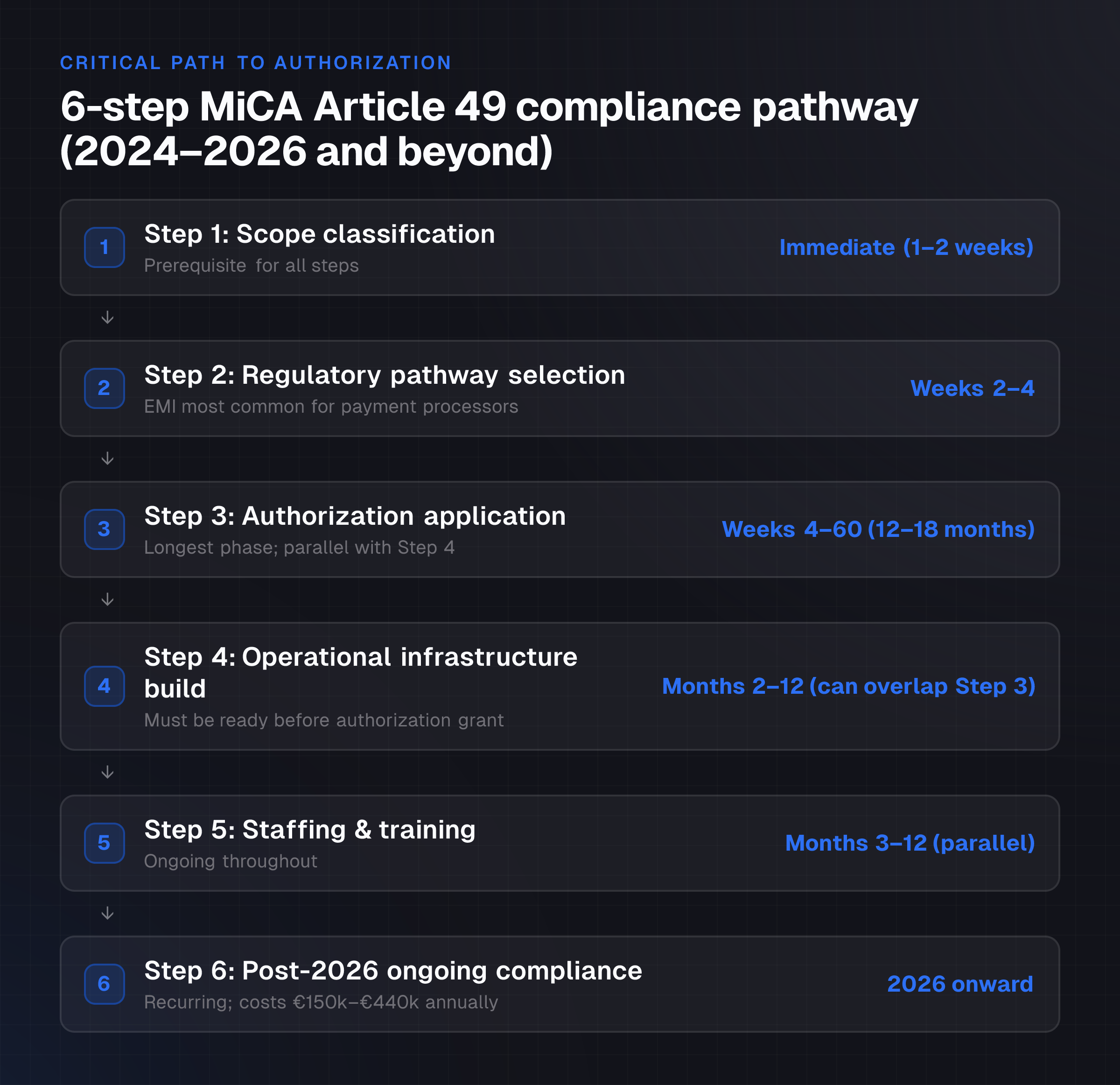
Payment processors must move quickly. Authorization timelines run 12-18 months, meaning firms should have begun applications in 2024 to finish by 2026. Here's the actionable pathway:
Step 1: Determine scope and classification (Immediate, if not already done)
Action:
- Assess whether the stablecoin in question meets the MiCA definition of an e-money token (EMT): Does it reference a single fiat currency? Is it designed to facilitate payments?
- Document this assessment in writing, with reference to the MiCA framework and the token's use case.
- If the answer is yes, Article 49 applies.
Outcome: Clear written determination that triggers Article 49 compliance obligations.
Timeline: 1-2 weeks.
Step 2: Select regulatory authorization pathway (Immediate)
Action:
- Engage legal counsel with MiCA and EU financial services expertise.
- Compare Electronic Money Institution (EMI) licensing vs. Credit Institution (bank) authorization based on the firm's scale, capital position, and service breadth.
- For most payment processors, EMI licensing is the appropriate choice.
Outcome: Decision to pursue EMI or bank authorization, documented with legal rationale.
Timeline: 2-4 weeks.
Step 3: Prepare and submit authorization application (Begin immediately; complete by end of 2025)
Action:
- Hire or assign a compliance lead and legal counsel (internal or external).
- Prepare comprehensive application dossier, including:
- Detailed business plan (service offerings, target market, revenue projections).
- Governance structure (board, committees, audit function).
- Risk management framework (AML/CTF, operational risk, cyber security, market risk).
- Technical specifications (systems architecture, data protection, transaction logging).
- Financial projections and proof of minimum capital (typically €350,000 for EMI).
- Beneficial ownership disclosures and background checks for directors and key staff.
- Submit to the relevant national competent authority (BaFin in Germany, AMF in France, FCA in the UK post-Brexit, etc.).
- Engage with the regulator's pre-application process (if available) to clarify expectations.
Outcome: Formal authorization application filed and under review by competent authority.
Timeline: 8-16 weeks to prepare; submission ideally by Q3 or Q4 2025 to allow processing time before 2026.
Step 4: Implement operational and technological infrastructure (Parallel with Step 3; complete by mid-2026)
Action:
- Deploy or upgrade AML/KYC systems: real-time customer screening, ongoing monitoring, sanctions list matching.
- Implement transaction monitoring: flagging of suspicious patterns, automated reporting to financial intelligence units (FIU).
- Build regulatory reporting infrastructure: data feeds to generate ESMA RTS reports, EBA guidelines compliance dashboards.
- Establish cybersecurity measures: penetration testing, incident response procedures, data encryption, access controls.
- Set up segregated reserve accounts: with qualified custodians, ensuring customer funds and issuer capital are held separately.
- Integrate with EMT issuance and redemption workflows: real-time minting/burning, par-value redemption guarantee, settlement confirmation.
- Ensure GDPR compliance: lawful basis for data processing, privacy impact assessments, data retention policies.
Outcome: Production-ready systems for transaction monitoring, reporting, settlement, and consumer protection.
Timeline: 16-24 weeks; begins in parallel with authorization application and must complete before or shortly after authorization is granted.
Step 5: Hire, train, and embed compliance and risk personnel (Ongoing until 2026, then sustained)
Action:
- Recruit or contract: compliance officer (or head of compliance), legal counsel, risk manager, technical security lead, and transaction monitoring specialist.
- Conduct onboarding training on MiCA, EBA/ESMA guidelines, AML/CTF obligations, and internal policies.
- Establish policies and procedures: capital management, reserve reconciliation, consumer dispute resolution, regulatory change response.
- Document governance: board-level oversight, audit committee reporting, escalation procedures for compliance issues.
Outcome: Fully staffed and trained compliance function with clear reporting lines and escalation procedures.
Timeline: Recruit 8-12 weeks before authorization; continuous training through 2026 and beyond.
Step 6: Maintain ongoing compliance and reporting (Post-2026)
Action:
- Submit prudential reporting to competent authorities (frequency and format to be specified by EBA/ESMA guidance).
- Monitor regulatory developments: delegated acts, technical standards, member state implementation guidance.
- Conduct annual compliance audits and engage external auditors as required.
- Update risk assessments, controls, and documentation annually.
- Manage consumer complaints and maintain complaint register.
- Verify reserve adequacy and redemption capability continuously.
- Conduct staff training refresher and keep personnel current with regulatory changes.
Outcome: Demonstrable, documented adherence to all MiCA Article 49 obligations; clean audit findings; no regulatory breaches.
Timeline: Ongoing, with annual cycles of reporting and review.
Key implementation insight: Delay in Step 3 (authorization application) creates cascading delays. If an application isn't submitted by mid-2025, regulatory processing timelines alone make 2026 compliance at risk. Firms should prioritize initiating this process now if they haven't done so already.
FAQs
What exactly is an e-money token under MiCA, and how does it differ from other stablecoins?
An e-money token (EMT) is a stablecoin that references a single fiat currency (such as EUR, USD, or GBP) and is intended to function as a means of payment. Article 49 applies specifically to EMTs. Stablecoins referencing multiple assets or commodities are classified as Asset-Referenced Tokens (ARTs) and face different MiCA rules. The key distinction: EMTs are pegged to one fiat currency and enable payments; ARTs don't fit this definition and are treated separately. Understanding this classification is critical because misclassification can result in applying the wrong regulatory pathway.
Does MiCA Article 49 apply to payment processors outside the EU?
Yes, if those processors issue EMTs or offer EMT services to EU residents or conduct activity on EU territory. MiCA's geographic scope extends to any activity targeting EU consumers or using EU infrastructure. Non-EU processors serving EU customers must either comply with Article 49 or cease offering EMT services in the EU. Jurisdictional analysis should be part of early scope assessment.
What is the difference between EMI licensing and obtaining a full banking license, and which should a typical payment processor pursue?
An Electronic Money Institution (EMI) license permits issuance of electronic money (including EMTs) and related payment services. A Credit Institution (bank) license permits a broader scope of activities, including lending, deposit-taking, and proprietary treasury operations. For payment processors focused solely on EMT issuance and payment services, EMI licensing is typically sufficient and carries lower capital requirements (€350,000 vs. often €1M+ for banks) and less intensive governance. EMI is the standard choice unless the processor plans broader banking activities. Consult with regulatory counsel to confirm the right pathway for your specific business model.
When must authorization be completed, is 2026 a hard deadline or a grace period?
MiCA stablecoin rules took effect June 30, 2024. The expectation is full compliance by 2026, but exact deadlines for specific reporting provisions may be clarified through delegated acts. Regulatory practice typically allows a transition period for entities already operating in good faith to complete authorization, but there's no formal grace period for new entrants or entities not yet compliant. Treating 2026 as a hard deadline is prudent; delays in authorization applications begun in 2025 create material compliance risk by year-end 2026.
What happens if a payment processor doesn't obtain authorization by 2026?
Continued unauthorized issuance of EMTs is a violation of MiCA Article 49. Enforcement may include cease-and-desist orders, fines (up to 6% of annual turnover or €5M under MiCA), reputational damage, freezing of operations in the EU, and loss of customer trust. Member states' competent authorities are tasked with enforcement. Non-compliance isn't a gray zone; it's treated as a breach of securities and payments law.
Are there any transitional provisions or pathways that streamline compliance for small payment processors?
MiCA doesn't include a formal small-business exemption for Article 49. However, EMI licensing requirements are generally proportionate to the size and nature of the operation. Smaller processors may be able to start with lighter infrastructure and scale as volume grows, but they must still obtain authorization before issuing EMTs. Some member states offer pre-authorization guidance or sandboxes; inquiry with the relevant competent authority can clarify available pathways.
Last verified: August 28, 2026
Related reading:
- Understand MiCA Stablecoin Redemption Requirements to grasp post-authorization obligations.
- Explore how Stablecoin Rails for Prop Trading Firms shape settlement and compliance in operational trading environments.
- Review How High-Risk Fintechs Actually Get (and Keep) Bank Accounts for insights into navigating banking relationships during compliance build-out.
- See the broader picture in What Billions in Annualised Stablecoin Volume Taught Us on how scale affects operational readiness.