
An established prop firm considering an AI trading journal must first verify that the system can accurately capture trade data across entry, exit, size, and P&L, while clearly distinguishing individual journaling from firm-wide oversight. The decision hinges on three parallel tracks: data reliability, privacy protocols that protect individual traders while enabling aggregate performance analysis, and a realistic adoption plan that encourages active traders to log a significant portion of their trades within a defined timeframe. HybridTrader, live since September 2026, offers psychology scoring, macro desk integration, and broker sync, but requires testing against the firm's specific trading instruments and workflows before deployment.
This framework applies to prop firm operators and product leaders evaluating whether and how to roll out an AI trading journal across a trader population. It assumes the firm has existing trading platforms and brokers already in place, and that the goal is to improve individual trader performance and decision-making while gathering anonymized insights for firm-level risk management and benchmarking.
Quick answer: deploying an AI trading journal at scale
The decision isn't simply buy or build. It's verify that data accuracy meets acceptance tests, establish clear privacy boundaries between individual and firm-level access, and measure trader adoption before expanding beyond a pilot cohort.
Three conditions must hold for a prop firm to proceed: the AI journal automatically captures trade data from existing brokers with better than 99% accuracy, the system allows traders to keep sensitive journal entries private while the firm can access anonymized aggregates, and at least 75% of traders actively use the journal and engage with its feedback within the first month. If any of these fails, the implementation will create friction rather than insight.
Who this decision is for
Prop firm operators, compliance officers, and product leaders managing trader performance and risk.
This applies to firms with 20 or more active traders where manual performance review is no longer scalable, but where privacy and adoption risk can derail a tool if not addressed early. It's less relevant for very small prop teams (fewer than 10 traders) where one-on-one coaching is still feasible, or for firms where traders already use external journaling tools and adoption of a proprietary system faces cultural resistance. The decision also assumes the firm isn't required by regulators to implement specific journaling systems; where such mandates exist, the framework shifts to implementation detail rather than whether-to-decide.
The decision criteria
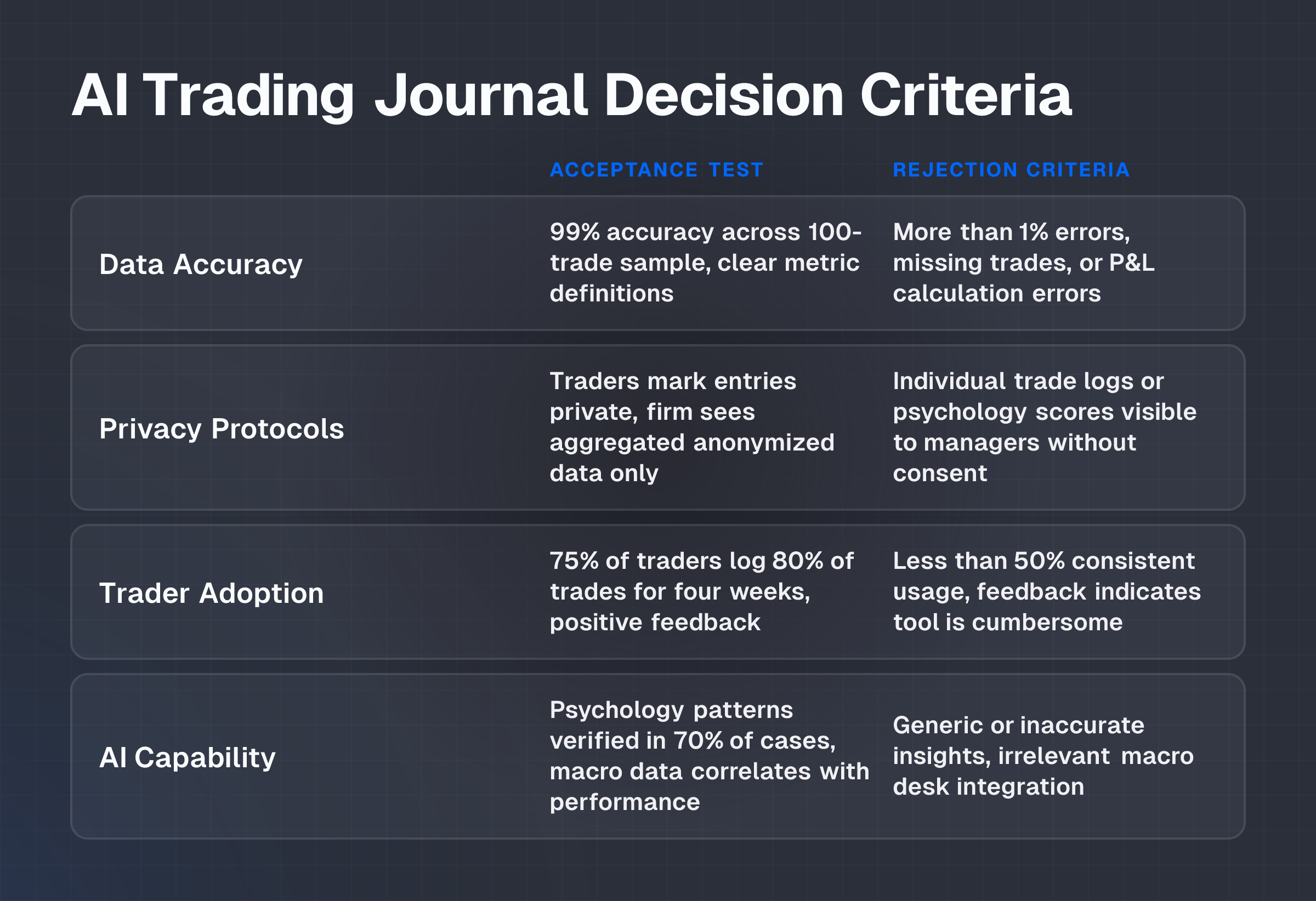
Evaluating an AI trading journal requires assessing four parallel dimensions: data accuracy and integration, privacy and reporting boundaries, trader adoption likelihood, and AI capability alignment.
Data accuracy and integration
The AI journal must pull trade data from the firm's primary trading platforms automatically. No manual entry. No post-trade reconciliation.
Test this by running a sample of 100 trades through the system and verifying entry price, exit price, position size and P&L against broker records. Any discrepancies above 1% of the sample indicate the journal isn't ready for production use. Also verify that the system can distinguish between demo and live trading if the firm operates both; misclassifying demo trades into performance metrics will distort performance benchmarking.
The acceptance test: 99% accuracy across entry/exit prices, size and P&L for a representative 100-trade sample, with clear, consistent metric definitions published to all traders.
The rejection criteria: More than 1% of tested trades missing, misdated or showing P&L calculation errors. Inability to segment demo and live data where applicable.
Reporting boundaries and privacy protocols
Define what data remains private to the individual trader and what is aggregated for firm oversight.
A trader's individual journal entries, reasoning behind a trade, emotional state, private reflections, should not be visible to firm management without explicit consent. However, aggregated metrics such as average psychological score across all traders, common behavioral biases, or win-rate distributions by strategy can provide firm-level insights without exposing individual traders.
Test this by having the AI journal's dashboard show:
- Individual trader view: only their own trades, psychology scores, and private notes.
- Firm view: aggregated performance metrics (e.g., average win rate, common overtrading patterns) with no trader names or specific trade details attached.
The acceptance test: Traders can mark journal entries as private. Firm dashboard displays aggregated data without revealing individual identities or specific trade details.
The rejection criteria: System exposes individual trade logs or psychology scores to firm managers without trader consent. Aggregation methods don't effectively anonymize individual performance.
Trader adoption and engagement
An AI journal is only useful if traders actually use it consistently.
Define adoption success as 75% of active traders logging at least 80% of their trades and engaging with the journal's feedback features (e.g., reviewing psychology scores, analyzing trade reports) for four consecutive weeks after the initial training period. If adoption falls below 50%, the journal becomes a compliance burden rather than a performance tool.
Factors affecting adoption include ease of integration with existing workflows, perceived value (does it genuinely help traders improve?), training quality, and whether usage is voluntary or mandatory. Mandatory adoption typically faces more initial resistance but sustains better if the tool proves valuable.
The acceptance test: 75% of active traders log 80% of their trades and engage with feedback features for four consecutive weeks. Trader feedback indicates positive perception of the journal's value.
The rejection criteria: Less than 50% of traders consistently use the journal after rollout. Significant trader feedback indicates the journal is cumbersome or unhelpful.
AI capability alignment
The AI journal must provide insights specific to the firm's trading strategies and risk profile.
Generic psychology scoring that labels all traders as "overtrading" or "risk-averse" without actionable specificity isn't useful. Similarly, macro desk data must correlate with the instruments the firm actually trades; a six-feed macro desk is irrelevant if four of the feeds cover asset classes the firm doesn't trade.
For tools like HybridTrader, verify:
- Psychology scoring: Can the AI identify recurring behavioral patterns (e.g., overtrading after losses, hesitating on winners) that are independently verifiable through trader interviews or historical trade review?
- Macro desk integration: Do the data feeds (HybridTrader offers six) cover the economic indicators, news sources or market events that materially affect the firm's trading?
- Broker sync: Does the broker integration work reliably with the firm's current brokers and trading platforms, or will it require workarounds and manual data uploads?
The acceptance test: AI psychology scoring identifies recurring patterns verifiable in 70% of cases through independent trader interviews. Macro desk data correlates with significant market movements that impacted observed trader performance.
The rejection criteria: AI insights are generic or inaccurate. Macro desk integration doesn't provide relevant context for the firm's trading instruments.
Option 1: Build in-house AI trading journal
Develop a custom journaling system using the firm's own engineering resources, tailored to the firm's specific instruments, strategies and risk model.
Pros:
- Complete control over data privacy, UI and feature roadmap.
- Integration with proprietary risk models and reporting standards.
- No ongoing subscription or licensing costs to a third party.
Cons:
- High upfront engineering cost (estimated weeks to months of development).
- Ongoing maintenance and support burden on internal team.
- Risk of feature lag compared to market leaders; psychology scoring and macro data integration require specialized expertise.
- Data security and compliance responsibility entirely on the firm.
Trade-off: Control and customization versus speed to market and cost.
Option 2: Adopt a third-party AI journal (e.g., HybridTrader)
License an existing AI trading journal system. HybridTrader, live since September 2026, offers psychology scoring, a six-feed macro desk, and broker sync.
Pros:
- Faster deployment (weeks rather than months).
- Vendor handles ongoing development, security updates and feature improvements.
- Psychology scoring and macro desk are pre-built; no need to develop AI models in-house.
- Broker sync automates data capture, reducing manual entry.
Cons:
- Monthly or annual licensing cost.
- Limited customization; features and reporting are designed for a general prop trader audience, not necessarily the firm's specific strategies or instruments.
- Vendor-dependent; if the vendor discontinues the product or changes pricing, the firm must migrate.
- Data privacy is managed by the vendor; the firm must trust their security and compliance practices.
- Adoption risk: traders may resist adopting yet another tool if not convinced of its value.
Trade-off: Speed and vendor support versus customization and cost control.
Option 3: Hybrid approach, use a third-party tool with internal enhancements
License HybridTrader (or similar) for core journaling and psychology scoring, then build internal modules for firm-specific reporting, risk integration or custom feedback loops.
Pros:
- Faster initial deployment than pure build-in-house.
- Core AI capabilities (psychology, macro desk) are handled by the vendor.
- Internal team can focus on integrating the journal with the firm's proprietary risk systems and reporting dashboards.
- Reduces vendor lock-in by maintaining some internal control over data and insights.
Cons:
- Ongoing cost to both the vendor and internal team.
- Integration complexity; maintaining compatibility when the vendor updates their API or feature set.
- Still dependent on the vendor for core platform stability.
Trade-off: Faster deployment with customization, but ongoing dual maintenance cost.
Option 4: Pilot with a subset of traders before full rollout
Regardless of build or buy decision, deploy the AI journal to 10-20% of the trader population first. Use a four-week pilot to test data accuracy, adoption rates, and identify friction points before rolling out firm-wide.
Pros:
- Limits downside if the journal underperforms or adoption is poor.
- Provides real-world data on accuracy and adoption before committing budget to firm-wide licensing or development.
- Allows traders to provide feedback and influence feature prioritization.
- Reduces change management risk; pilot cohort can become internal advocates if the tool proves valuable.
Cons:
- Delays firm-wide deployment by at least one month.
- Pilot traders may feel like test subjects; requires clear communication about the pilot's purpose and timeline.
- Small sample may not surface all edge cases or integration issues that emerge at scale.
Trade-off: Slower rollout for higher confidence in readiness.
Cost structure
Third-party licensing (HybridTrader or similar):
- Estimated annual licensing cost depends on the number of trader seats and feature tier; this article doesn't cover current pricing.
- Trader training and onboarding: 10-20 hours of internal time to create documentation, run training sessions and support early questions.
- Data migration (if transitioning from an existing journaling system): variable, typically 20-40 hours depending on data volume and format.
Build in-house:
- Initial development: 200-400 engineering hours (assuming standard web stack and no exotic AI requirements).
- Ongoing maintenance and support: 40-80 hours per year for bug fixes, security updates and feature requests.
- Infrastructure and hosting costs: variable, typically $500-$2,000/month depending on data volume and redundancy needs.
Hybrid approach:
- Third-party licensing cost as above, plus 100-200 engineering hours for integration and custom reporting modules.
Implementation risks
Data accuracy and broker sync failures: If the AI journal can't reliably pull trade data from the firm's brokers, adoption will stall and the journal becomes unreliable for performance analysis.
Mitigation: test broker integration with 100 trades before rollout; establish an acceptance test with your broker partner.
Privacy and trader resistance: If traders perceive that the firm will use the journal to surveil their decision-making or penalize risk-taking, adoption will be poor.
Mitigation: establish and publish clear privacy protocols; anonymize firm-level reporting; frame the journal as a development tool, not a monitoring tool; get trader input during pilot phase.
Adoption plateau: Traders may log trades initially but stop engaging with the journal's feedback after a few weeks if they don't see value.
Mitigation: tie journal insights to real performance improvements (e.g., traders using psychology scores report higher consistency); provide incentives for consistent use; conduct periodic check-ins during the first month.
AI insight misalignment: If psychology scoring or macro desk data doesn't match the firm's trading reality, traders will lose confidence in the tool.
Mitigation: validate AI insights against actual trader interviews and historical performance; involve top traders in pilot feedback; adjust AI models or reporting if insights are generic or unhelpful.
Vendor dependency (third-party adoption): If HybridTrader changes pricing, discontinues features, or has an outage, the firm's trader performance analysis is disrupted.
Mitigation: ensure data export capabilities so the firm can migrate if needed; negotiate multi-year contracts with price protection if material to the budget; maintain a secondary journaling method for critical data.
Timeline for deployment
Pilot phase (4 weeks):
- Week 1: Set up system, integrate with broker data, onboard 10-20 pilot traders.
- Weeks 2-4: Traders log trades, engage with journal feedback, provide feedback on UX and value.
- End of week 4: Review adoption metrics, data accuracy, and trainer feedback; decide on go/no-go for full rollout.
Full rollout (if pilot succeeds):
- Week 5-6: Onboard remaining traders, run group training.
- Weeks 7-12: Monitor adoption, provide support, surface issues.
- By week 12: Measure firm-wide adoption against the 75% / 80% acceptance test.
Which option fits which situation
Choose Option 1 (build in-house) if:
- The firm has experienced AI/ML engineers available and wants to integrate journaling with proprietary risk models.
- The firm trades highly specialized or niche instruments where off-the-shelf psychology scoring and macro data don't apply.
- Long-term cost control is critical; the firm expects to run the journal for 5+ years and the NPV of licensing would exceed build cost.
- Privacy and data sovereignty are non-negotiable; the firm can't send trader data to a third-party vendor.
Choose Option 2 (third-party like HybridTrader) if:
- Speed to deployment is important; the firm needs journaling and psychology insights within weeks, not months.
- The firm's traders use common instruments (forex, crypto, equities) and the vendor's macro desk and psychology scoring are aligned with those.
- The firm prefers to outsource maintenance and security; letting the vendor handle updates and compliance is valuable.
- Budget is constrained; licensing cost is lower than engineering headcount for the pilot and first year.
Choose Option 3 (hybrid) if:
- The firm wants to leverage a third-party vendor's AI capabilities but also integrate the journal with proprietary risk dashboards or trading infrastructure.
- The firm has internal engineering capacity (50-100 hours) available to build integration layers without delaying time to market.
- The firm expects high customization needs over time and wants to own part of the stack to reduce vendor lock-in.
Choose Option 4 (pilot first) if:
- Trader adoption or data accuracy is uncertain; the firm hasn't validated whether traders will use an AI journal or if broker sync will work reliably.
- Budget is available for a small pilot but a firm-wide rollout would require board approval; use pilot results to justify the investment.
- The firm wants trader input before committing to build or buy; a pilot surfaces real friction and helps shape requirements.
What to verify before deciding
Before committing to an AI trading journal, conduct the following tests and conversations:
Technical verification
Broker data integration: Contact your broker's API team and HybridTrader (or your chosen vendor) to confirm that real-time trade data export is supported. Run a small test: export 100 recent trades and verify accuracy against broker records. Document any data lag, missing fields or format mismatches.
Data accuracy acceptance test: If using a third-party vendor, request a proof-of-concept environment where your firm's trades are imported. Run the acceptance test (99% accuracy on entry/exit/size/P&L) on your own data. Don't rely on the vendor's internal test results; use your actual trades.
Privacy and reporting architecture: Request documentation or a demo of the vendor's data model. Verify that individual trader entries can be marked private and that firm-level dashboards truly anonymize individual data. Ask: "If I'm a trader, can I see my own journal entry but the compliance officer can't?" and "If I'm a compliance officer, can I see an aggregated report of psychological biases without knowing which trader drove each bias?"
API and data export: Confirm that the vendor allows data export in standard formats (CSV, JSON) so the firm isn't locked in. Ask: "If we need to migrate away in two years, can we export all our journaling data and performance metrics?"
Operational and trainer verification
Trader interview: Before the pilot, interview 3-5 experienced traders about whether an AI journal would be useful. Ask: "What insights would make you use this consistently?" and "What workflow friction would discourage you?" Use their feedback to shape your adoption plan and marketing pitch.
Psychology scoring validation: If the vendor claims psychology scoring identifies overtrading, risk aversion or other behaviors, ask for examples or documentation of the methodology. Then independently review 5 trades from each of 3 traders and label their behavior yourself. After that, run the same trades through the AI journal and compare. Do the AI's labels match your independent assessment 70% of the time?
Macro desk relevance: If using HybridTrader's six-feed macro desk, ask the vendor which feeds are included and whether they cover the currencies, commodities or indices your traders actually trade. Request a demo and confirm that macro events (e.g., interest rate announcements) correlate with actual market volatility in your traders' instrument universe.
Commercial and contractual verification
Pricing and commitment: Clarify the cost model (per-trader seat, per-month or per-trade, tiered by volume). Confirm whether there are setup fees, data migration charges, or termination fees. Negotiate multi-year pricing if the firm is committing to the platform.
SLA and support: Confirm uptime guarantees (e.g., 99.5%), support response times for critical issues, and what happens if broker sync fails. Document escalation paths.
Privacy and compliance documentation: Request the vendor's security practices (encryption, data storage location, backup), compliance certifications (SOC 2, ISO 27001) and privacy policy specific to trader data. If the firm operates in a regulated jurisdiction, confirm that the vendor's data handling meets local data protection rules.
Next step
After verification, follow this sequence:
Convene a small steering group (head of trading, head of ops, a lead trader, compliance). Review the decision criteria and verification findings. Decide whether to build, buy or pilot.
If piloting, recruit 10-20 traders and set a four-week clock. Make adoption voluntary in the pilot to surface real friction. Define success as 75% of pilots logging 80% of trades and engaging with feedback.
Run the acceptance tests outlined above during the pilot. Document data accuracy, broker integration performance, psychology scoring validity and trader sentiment.
Collect feedback from traders and operational staff at the end of week 4. Specifically ask: Did the journal help you identify trading patterns? Was the UI intuitive? Would you use this if it were mandatory? Summarize findings in a one-page pilot report.
Make a go/no-go decision based on whether the three core conditions held:
- Data accuracy exceeds 99%.
- Privacy protocols allow individual traders to keep entries private and the firm to see only anonymized aggregates.
- Adoption rates exceed 75% in the pilot cohort.
If go, plan a phased firm-wide rollout starting with high-adoption traders (advocates from the pilot) and expanding to the full population over 4-8 weeks. Monitor adoption and support throughout.
If no-go, document why (e.g., "Broker sync failed on crypto trades"; "Psychology scoring was too generic"; "Only 40% of pilots used the tool"). This feedback will inform whether to revisit the decision in 6-12 months or pursue a different approach.
The right timing for a full rollout is only after you have evidence that the journal works in your firm's specific environment and that traders will actually use it.